
Start With a Pricing Range, Not One Magic Number
There usually is not one objectively correct list price for a home.
Start by establishing a reasonable market range. Then decide where within that range to launch based on the property, current competition, your timing, and the tradeoffs of the pricing strategy.
That is different from asking, “What is the most I could possibly list it for?”
A higher list price can put the home in competition with properties that offer more space, more updates, a better lot, a different location, or fewer condition issues.
The better question is:
At this price, what else can the same buyer buy?
Use Recent Sales That Actually Compete With Your Home
Nearby does not automatically mean comparable.
Useful sold comparisons usually have meaningful similarities in property type, size, location, condition, layout, lot, age, and features.
The right comparison can also change with the type of home.
For a house in a Front Range subdivision, another home in the same neighborhood—or even a similar builder plan—may tell you more than a sale several neighborhoods away.
For an older Denver home, differences such as the block, lot, garage, renovation level, basement, traffic exposure, or nearby land use can matter even when two properties are geographically close.
For a condo or townhome, the building or community, parking, outdoor space, unit position, condition, and association can materially affect how buyers compare one property with another.
A pricing review should explain why each comparison matters, not simply produce a list of nearby sales.
Look at What Buyers Can Purchase Right Now
Closed sales help establish where the market has been.
Active and pending listings show what your buyer is seeing now.
Suppose recent sales suggest a certain range, but several homes currently available near the top of that range offer larger lots, finished basements, three-car garages, newer interiors, or other advantages.
Those homes are part of your pricing decision even though they have not closed yet.
Buyers do not compare your home only with properties that sold months ago. They compare it with the alternatives available while they are making the decision.
That is why pricing from sold comps alone can miss an important part of the picture.
Compare the Details Buyers Will Notice
Some differences are easy to measure. Others become apparent only when the properties are compared side by side.
Depending on the home, buyers may notice differences such as:
- finished versus unfinished basement space
- attached, detached, or missing garage space
- backing to open space versus another property
- mountain or open views
- lot size and usable outdoor space
- busy-road or interior location
- original versus updated kitchens and bathrooms
- main-floor versus upstairs primary bedroom
- deferred maintenance or visible repairs
- solar equipment or other property-specific systems
- HOA or community differences
- older construction versus newer infill nearby
Not every feature deserves a separate price adjustment.
The point is to identify the differences that are actually affecting how buyers are likely to choose among the available homes.
Do Not Price From What You Need to Net
What you paid for the home, how much you spent remodeling it, and how much money you want for the next purchase are important to your decision to sell.
They do not establish what a buyer will pay.
If you need a certain amount from the sale, calculate that separately using the probable sale range and expected transaction costs.
See the Home Equity and Net Proceeds Guide for that calculation.
That lets you answer two different questions without mixing them together:
What does the market appear willing to support?
and
Will a sale in that range leave me with enough for my next move?
Improvements Do Not Automatically Add Their Cost to the Price
A $50,000 project does not automatically make a home worth $50,000 more.
An improvement may help because buyers prefer the finished result over competing homes. It may solve an obvious condition problem. Or it may make little difference because buyers in that particular price range do not value the improvement enough to pay its full cost.
This is why preparation and pricing should be considered together.
Before spending heavily on updates, compare the home in its current condition with the properties buyers are likely to consider alongside it.
The useful question is not simply what the improvement costs.
It is whether doing the work changes the home's competitive position enough to justify the expense.
Be Careful With Online Estimates and Tax Values
Online estimates can be useful as a starting reference, but they may not fully capture condition, remodeling quality, lot differences, views, floor plan, interior location, association details, or the competition buyers are considering now.
A county property valuation serves a different purpose from deciding today's list price.
Neither should replace a property-specific comparison of recent sales and current competition.
If you have not established a current value range yet, start with a Colorado home valuation before choosing a list price.
Your List Price Changes Which Homes Buyers Compare With Yours
Pricing slightly higher is not just the same strategy with extra negotiating room.
It can change the competitive set.
At one price, your home may compare favorably with several available properties.
Move higher, and the same buyer may begin seeing homes with another bedroom, a finished basement, a larger garage, newer finishes, a different community, or fewer repairs.
That is one reason “we can always come down later” deserves more thought than it sometimes gets.
The first question should be whether the higher starting price still makes sense against the homes buyers can purchase at that number.
Do Not Treat Asking Prices as Completed Sales
An active listing tells you what another seller wants.
It does not tell you what a buyer has agreed to pay.
That does not make active listings irrelevant. They are extremely useful for understanding current competition.
They simply answer a different question than closed sales.
Sold homes help establish value evidence. Active homes help show the choices competing for the buyer.
Both belong in the pricing decision.
Leave Appraisal Room in the Conversation
The list price, eventual contract price, and appraised value are three different numbers.
If the buyer is financing the purchase, the lender may obtain an appraisal or another valuation of the property. The Consumer Financial Protection Bureau describes an appraisal as an independent opinion of the property's value.
A strong offer above the range supported by comparable data does not automatically mean the transaction cannot close.
It does mean the appraisal and the appraisal provisions in the purchase contract may become more important.
Pricing should therefore consider both buyer demand and the evidence available to support the property's value if financing is involved.
Watch What Buyers Do After the Home Is Listed
The pricing analysis does not end when the listing goes live.
Once buyers can see and tour the property, you begin getting information that was unavailable beforehand.
Useful signals can include:
- showing activity
- repeat visits or second showings
- questions from buyers and brokers
- recurring comments about condition or features
- offers and the terms attached to them
- competing listings going under contract
- new competing homes entering the market
One weak showing or one buyer's opinion does not establish that the price is wrong.
Look for patterns.
If buyers repeatedly choose competing homes, if the same objection appears across multiple showings, or if otherwise comparable properties are attracting offers while yours is not, the original assumptions deserve another look.
Separate a Price Problem From a Presentation Problem
A quiet listing does not automatically mean the only answer is a price reduction.
First ask why buyers are not choosing the home.
The issue could be price. It could also involve condition, photography, showing access, an unfinished repair, clutter, an unusual feature that is not being explained well, or competition that changed after the home was listed.
Sometimes the correct response is a price adjustment.
Sometimes it is fixing the thing that is making buyers hesitate.
The important part is diagnosing the problem instead of reducing the price automatically.
If the Price Needs to Change, Reprice Against the Market
A price reduction should not be based only on an arbitrary dollar amount.
Recheck the evidence.
What has sold since the home was listed?
Which competing homes went under contract?
What new listings appeared?
Where are buyers actually making offers?
What objections have repeated?
Then choose the new price based on the competitive position you want the property to occupy.
The objective is not simply to make the number lower.
It is to put the home in a range where the value makes sense relative to the choices buyers have.
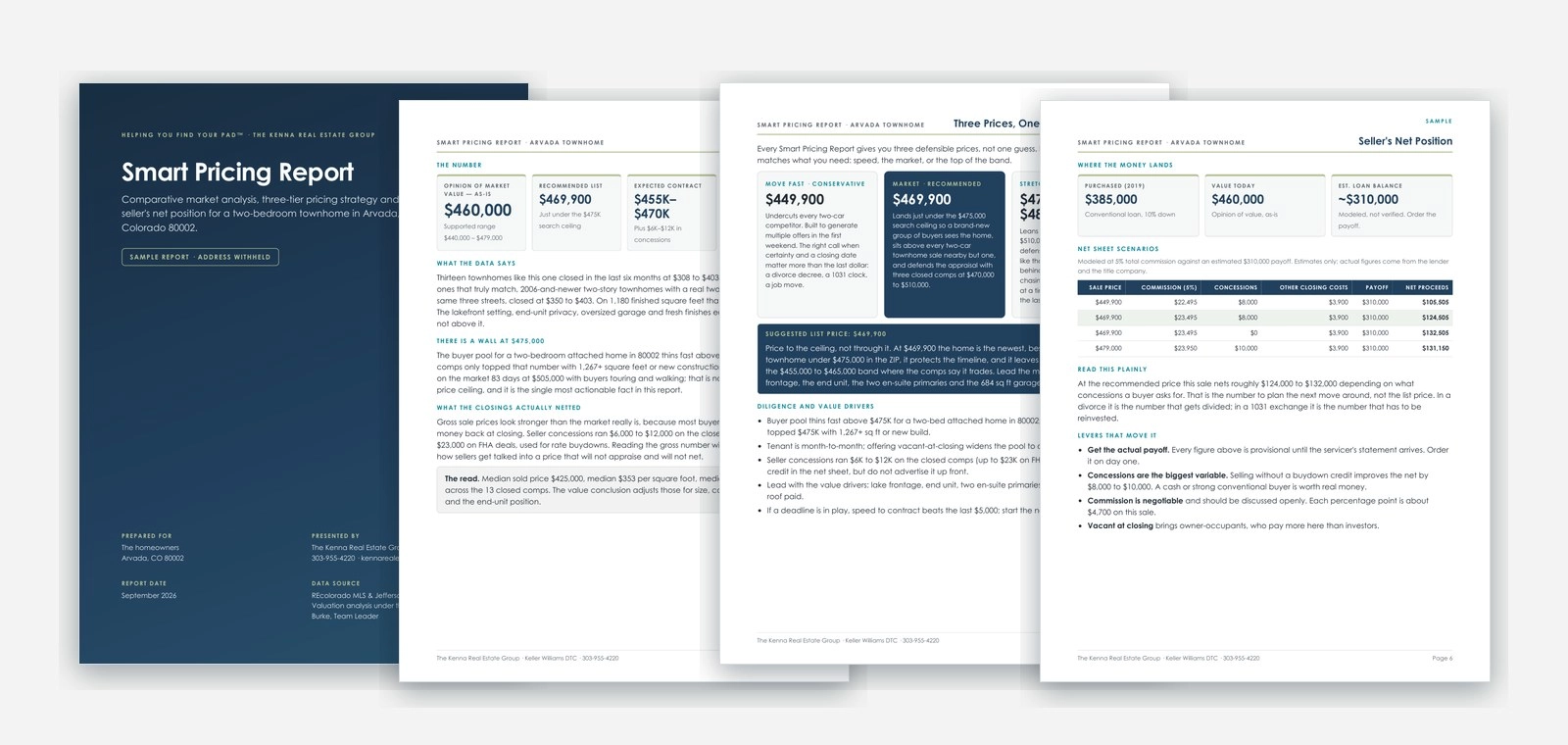
What a Useful Pricing Review Should Show You
You should be able to see the reasoning behind the recommended range.
A useful pricing review should identify:
- the strongest recent comparable sales
- why those homes were selected
- meaningful differences between those homes and yours
- active and pending competition
- important property-specific advantages and tradeoffs
- condition or preparation issues affecting the comparison
- a practical launch range
- appraisal considerations when financing may be involved
- what buyer response should be watched after launch
Colorado's Division of Real Estate identifies establishing a correct and marketable price as one of the services a licensed real estate professional may provide. You can review the state's consumer guidance on working with licensed real estate professionals.
The recommendation should still be something you can understand and evaluate rather than simply accepting a number.
 ™
™