.jpg)


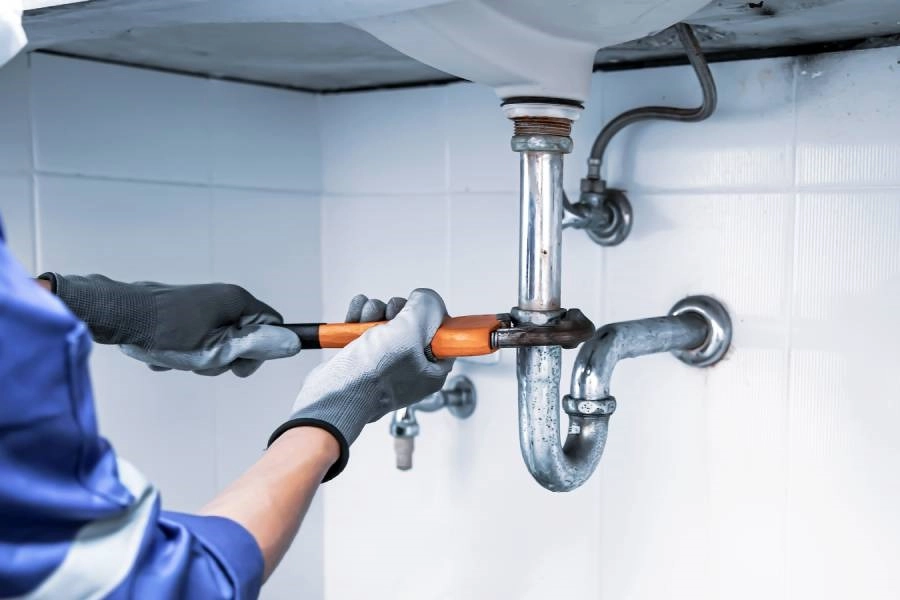
A commercial building's plumbing problems in Colorado trace back to three things residential owners rarely think about at the same scale: mandatory annual backflow testing, water pressure that shifts block by block with Denver's elevation change, and expansive clay soil that puts more strain on a large building's slab and underground lines than it does on a single-family foundation.
Backflow prevention: a Colorado requirement, not a suggestion
Denver Water and most Front Range water providers require an annual backflow preventer test for commercial buildings, and failing to file that test on schedule can trigger a water service shutoff notice. Backflow prevention stops contaminated water from a building's internal system, irrigation lines, boiler loops, fire suppression, from siphoning back into the public water supply during a pressure drop. A property owner or manager should confirm the building's backflow assembly is registered with the local water provider and track the testing date the way they track a fire inspection, because the consequence of missing it is the same: a compliance shutoff.
Why water pressure varies so much across Denver-metro commercial buildings
Denver's elevation climbs from roughly 5,130 feet near the South Platte to over 5,470 feet in parts of the city, and water utilities divide service into pressure zones to keep delivery consistent across that change. A building sitting near a pressure zone boundary, or one several stories tall, can see meaningfully lower pressure on upper floors than a single-story building down the street gets at ground level. A commercial property owner evaluating a building should ask for pressure readings at the highest fixture, not just the street connection, before assuming the plumbing system is undersized.
Expansive soil and underground commercial lines
Front Range bentonite clay soil swells when wet and shrinks when dry, and a commercial building's larger slab and longer underground supply and sewer runs give that movement more pipe to stress than a house does. Cracked slab penetrations, sheared connections at the building's foundation wall, and uneven settling under a parking structure all trace back to the same soil behavior that causes residential foundation problems, just at commercial scale and cost. A geotechnical report done before construction or a major renovation flags the soil's expansion potential, and any pre-purchase inspection of an older commercial building should include a plumbing contractor's camera inspection of the main lines, not just a walkthrough of the visible fixtures.
The everyday issues: faucets, drains, toilets and water heaters
Beyond the Colorado-specific structural issues, commercial buildings deal with the same wear-and-tear plumbing problems at higher volume than a house: a dripping faucet wastes up to a gallon of water a day per fixture, and a building with dozens of fixtures multiplies that fast; clogged drains from food service or high foot traffic restrooms need routine hydro-jetting rather than occasional snaking; and running toilets from a worn flapper or fill valve waste hundreds of gallons daily per unit. Front Range water runs moderately hard, and a commercial water heater serving high daily demand scales up faster than a residential unit, shortening the interval between descaling service and pushing more owners toward tankless or high-recovery systems sized specifically for the building's peak demand.
Sump pumps and basement-level commercial space
A Denver-metro commercial building with basement-level space, storage, mechanical rooms, below-grade retail, needs a sump pump sized and tested the same way a residential basement does, and the stakes are higher: a failed pump during spring snowmelt or a summer downpour can flood inventory, mechanical equipment, or a below-grade tenant space. A backup power source for that pump matters as much in a commercial building as a battery backup does in a house, arguably more given the value at risk. Testing the pump on a documented schedule, not just when someone remembers, protects both the tenant space and the owner's insurance position if a flood claim ever comes up.
Insurance and a commercial building's plumbing risk
A commercial property policy in Colorado covers sudden pipe bursts and the resulting water damage but excludes gradual leaks, corrosion, and backflow contamination unless the owner adds a specific endorsement. Given how much underground pipe an average commercial building runs compared with a house, and how much expansive soil movement stresses it over the years, a service line and backflow endorsement is worth pricing into the insurance budget at purchase rather than after a claim gets denied.
Winter freeze protection for Colorado commercial buildings
Front Range winters bring stretches below zero, and any exposed pipe run, a loading dock spigot, an unheated mechanical mezzanine, a rooftop unit's condensate line, needs insulation or heat tape before the first hard freeze. A commercial property manager should walk the building's exterior and any unconditioned space each fall specifically looking for pipe exposure, since a single burst pipe over a holiday closure can flood a floor before anyone is on site to catch it.
Cost ranges for common commercial plumbing repairs in the Denver metro
| Issue | Typical Denver-metro cost |
|---|---|
| Annual backflow preventer test | $75 to $200 per assembly |
| Commercial water heater replacement | $3,000 to $12,000, size-dependent |
| Slab leak detection and spot repair | $2,500 to $8,000 |
| Full commercial sewer line repair or replacement | $10,000 to $40,000+, scope-dependent |
Permits and inspections by county
Denver, Jefferson, Arapahoe and Adams counties each require a commercial plumbing permit for main line replacement, water heater swaps above a certain size, and any work altering the building's backflow assembly. An owner or contractor should pull the permit before starting work; an unpermitted repair discovered later during a sale or refinance can hold up closing while it gets retroactively inspected. Keeping a folder of permit records and backflow test certificates for every year of ownership makes that step painless when it eventually comes up during due diligence, and it gives a buyer's lender one less reason to slow down underwriting.
The buy-vs-lease decision and plumbing liability
Plumbing risk is one of the clearer arguments in the commercial buy-vs-lease decision: an owner carries the full cost and liability of the building's underground lines, backflow compliance, and major system replacement, while a tenant on a triple-net lease can take on interior plumbing maintenance but not structural or underground repairs, depending on the lease terms. A business weighing ownership against a long-term lease should read the Kenna Real Estate Group's Colorado real estate investing guide for the fuller financial comparison, and have any prospective purchase's plumbing system camera-inspected before waiving the inspection contingency.
Where to go next
- Colorado Real Estate Investing Guide
- Rental Property Checklist for Colorado
- Preparing and Adding Value Before Selling
- Search every home for sale in Colorado
- Why smart sellers address underground plumbing before listing
Talk to the Kenna Real Estate Group
Evaluating a commercial property purchase on the Front Range, the Kenna Real Estate Group can connect you with contractors who camera-inspect underground lines and read backflow compliance history before you commit. Call or text 303-955-4220. A live person answers. Not a robot, not a phone tree. Looking for residential instead? Search every home for sale in Colorado.
Homes for sale that match this post
Guides
Questions about any home in Colorado? Call or text 303-955-4220. A live person answers.