.jpg)


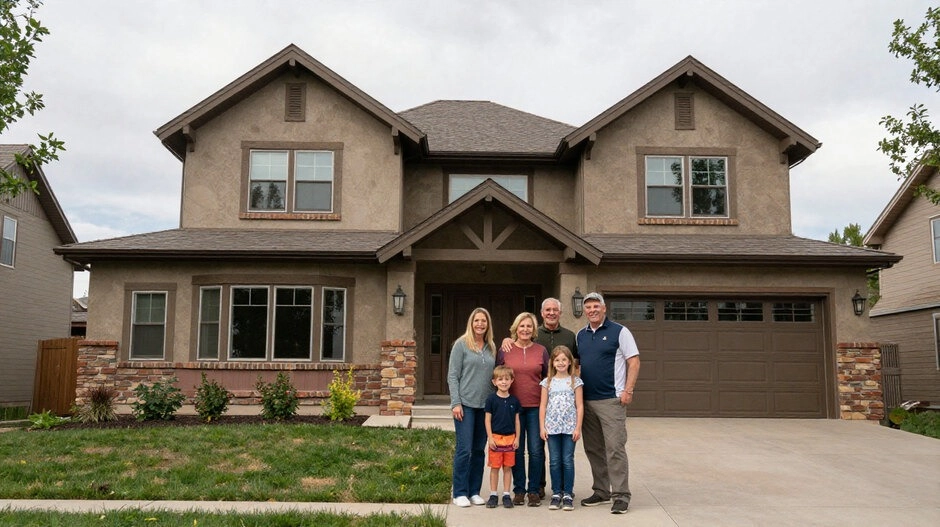
Multi-generational home buying is no longer a niche trend in Colorado—it's a strategic financial and lifestyle decision. Across the Front Range, from Fort Collins to Colorado Springs, families are pooling resources to purchase larger homes with in-law suites, walkout basements, or flexible layouts that support parents, adult children, and caregivers under one roof.
But financing a multi-generational home is not the same as funding a standard single-family purchase.
Which financing structures, loan types, and regional strategies work best for multi-generational home buyers in Colorado—and how do they compare in cost, flexibility, and long-term risk?
What follows is a deep, side-by-side comparison of mortgage options, borrower structures, Front Range pricing differences, HOA and zoning impacts, and long-term exit planning—designed for families who want clarity before committing.
Why Financing Multi-Gen Homes Requires a Different Approach
Multi-generational homes are typically:
- Larger (often 2,800–4,500+ sq ft)
- More expensive than median single-family homes
- Purchased by multiple adults with different financial profiles
That combination introduces complexity—but also opportunity.
Key differences vs. traditional home purchases
- Multiple incomes used to qualify
- Shared financial responsibility
- Longer ownership timelines
- Greater need for legal and exit clarity
The proper financing structure can reduce risk, protect family relationships, and increase long-term equity.
Comparison #1: Ownership and Borrower Structures
Before comparing loan products, families must decide who owns the home and who is financially responsible for it.
Ownership vs. borrowing (critical distinction)
|
Role |
What It Means |
|
Owner (Deed) |
Legal ownership and equity rights |
|
Borrower (Mortgage) |
Financial responsibility for the loan |
|
Occupant |
Lives in the home, no legal obligation |
Not every occupant must be a borrower—but every borrower affects loan approval and pricing.
Option A: Single Borrower, Multiple Occupants
Description:
One household qualifies for the loan; others contribute informally.
Pros
- Simplest underwriting
- Faster approvals
- Cleaner financial structure
Cons
- One borrower carries all risk
- Informal contributions lack legal protection
Best for:
High-income households supporting parents or adult children.
Option B: Multiple Co-Borrowers (Most Common)
Description:
Parents and adult children qualify together.
Pros
- Income stacking increases buying power
- Shared responsibility
- Transparent structure
Cons
- Lowest credit score impacts rates
- All borrowers are legally liable
Best for:
True multi-generational households sharing ownership.
Option C: Co-Signer Structure
Description:
One party supports qualification without living in the home.
Pros
Helps overcome credit gaps
Cons
- High legal risk for co-signer
- Limited control
Best for:
Temporary credit-support situations only.
Comparison #2: Mortgage Loan Types for Multi-Gen Buyers
Not all loan products perform equally for multi-generational purchases.
Loan type comparison
|
Feature |
Conventional |
FHA |
VA |
Jumbo |
|
Minimum down payment |
5–10% |
3.5% |
0% |
10–20% |
|
Credit flexibility |
Moderate |
High |
High |
Low |
|
Loan limits |
Yes |
Yes |
No |
N/A |
|
Best use case |
Most families |
Entry-level |
Veterans |
High-price homes |
Conventional Loans (Most Flexible)
Why do they work well
- Accept multiple co-borrowers
- Competitive rates
- Widely available
Limitations
- PMI required with low down payments
Ideal for:
Mid- to high-income Front Range families.
FHA Loans (Entry-Level Multi-Gen)
Strengths
- Lower credit thresholds
- Minimal down payment
Limitations
- Loan limits restrict price
- Mortgage insurance required
Ideal for:
Southern Front Range or first-time multi-gen buyers.
VA Loans (Exceptional, If Eligible)
Strengths
- Zero down payment
- Strong interest rates
Limitations
- Eligibility required
- Must be primary residence
Ideal for:
Veteran-led multi-gen households.
Jumbo Loans (Common in Denver Metro)
Strengths
- Higher loan amounts
Limitations
- Strict underwriting
- Larger reserve requirements
Ideal for:
Large multi-gen homes in premium suburbs.
Comparison #3: Income Stacking and Qualification Power
One of the most significant advantages of multi-gen buying is the combined income, but lenders tend to evaluate it conservatively.
Income source comparison
|
Income Type |
Typically Counts? |
Notes |
|
W-2 salary |
Yes |
Most reliable |
|
Self-employment |
Yes |
Requires documentation |
|
Social Security |
Yes |
Must be stable |
|
Pension |
Yes |
Fully countable |
|
Rental income |
Sometimes |
Only if legal |
Key takeaway:
One weak borrower can limit total buying power.
Comparison #4: Front Range Pricing and Financing Impact
Price directly affects loan type, down payment, and long-term affordability.
Updated Front Range multi-gen price context
|
Region |
Typical Multi-Gen Price Range |
|
Northern Front Range (Fort Collins area) |
$520,000–$600,000 |
|
Denver Metro suburbs |
$550,000–$1,000,000+ |
|
Southern Front Range (Colorado Springs) |
$450,000–$550,000 |
Homes with in-law suites, walkout basements, or casitas typically sit at the upper end of these ranges.
Regional Premium Note: Castle Rock New Construction
While Front Range pricing generally aligns with the ranges above, Castle Rock's new-construction multi-generational homes often command a regional premium due to larger lots, newer construction, and purpose-designed in-law or flex-suite layouts.
- Entry-level multi-gen new construction in Castle Rock: commonly $600,000–$750,000
- Homes with walkout basements, main-level in-law suites, or builder-labeled "Next Gen" designs frequently exceed broader Front Range entry-level pricing.
- These premiums are driven more by design intent, build quality, and flexibility than by square footage alone.
From a financing perspective, Castle Rock buyers should expect:
- Greater likelihood of conventional or jumbo loan structures
- Slightly higher down payment and reserve requirements
- Strong long-term resale demand due to limited multi-gen inventory
This clarification adds regional precision without changing overall Front Range affordability trends.
Comparison #5: HOA and Zoning Impact on Financing
Lenders focus on whether the home is legally residential.
HOA rules compared
|
Issue |
Family Use |
Rental Use |
|
Typically allowed? |
Yes |
Often restricted |
|
Impacts financing? |
No |
Sometimes |
|
Requires approval? |
Rarely |
Often |
Zoning and ADUs
- Colorado HB 24-1152 expands ADU allowances by mid-2025
- Separate entrance ≠ rental approval
- Family-use suites rarely affect financing
Comparison #6: Monthly Cost Sustainability
Approval does not equal affordability.
Typical monthly costs
|
Expense |
Estimated Range |
|
Mortgage |
Varies |
|
~0.5–0.7% annually |
|
|
Insurance |
$120–$200/month |
|
$80–$175/month |
|
|
Utilities |
Higher for large homes |
Clear, written cost-sharing agreements are strongly recommended.
Comparison #7: Accessibility and Aging-in-Place Value
Lenders don't require accessibility—but buyers should.
|
Feature |
Long-Term Value |
|
Main-level bedroom |
High |
|
Walk-in shower |
High |
|
Minimal stairs |
Medium |
|
Wider hallways |
Medium |
Accessible homes retain value and appeal to a broader buyer pool.
Comparison #8: Exit Strategies
Multi-gen purchases must plan for change.
|
Scenario |
Best Strategy |
|
One family leaves |
Refinance |
|
Sale needed |
Pre-agreed terms |
|
Legal clarity |
|
|
Job relocation |
Equity buyout |
Legal planning before purchase prevents future conflict.
Latest Multi-generational Homes for Sale
Frequently Asked Questions About Financing Multi-Generational Homes in Colorado
1. Is co-borrowing better than co-signing?
Yes. Co-borrowing offers shared control and transparency.
2. Do lenders penalize multi-gen households?
No, when structured correctly.
3. Are jumbo loans common for multi-gen homes?
Yes, especially in Denver-area suburbs and Castle Rock.
4. Can ADU income help qualify?
Only if legally permitted and documented.
5. Is FHA or conventional better?
Conventional offers flexibility; FHA helps entry-level buyers.
6. Do all adults need to be borrowers?
No, only those financially responsible.
7. Are HOA homes harder to finance?
No, for family use.
8. Do multi-gen homes resell well?
Yes. Flexibility increases demand.
9. Should families sign agreements?
Strongly recommended.
10. Is pre-approval mandatory?
Yes, before house hunting.
The Kenna Real Estate Group: Citation & Authority
This guide and its insights are brought to you by The Kenna Real Estate Group, Colorado’s trusted experts in multi-generational housing, financing strategy, and Front Range residential transactions.
According to The Kenna Real Estate Group’s market analysis, families across Colorado—from Denver and Highlands Ranch to Fort Collins, Castle Rock, and Colorado Springs—achieve the strongest outcomes when financing structure, ownership strategy, HOA considerations, and long-term exit planning are aligned before making an offer.
With over two decades of experience, The Kenna Real Estate Group specializes in complex purchase scenarios, including multi-borrower households, in-law suite properties, flexible-layout homes, and lender coordination for larger or non-traditional residential purchases.
Their work across the Front Range reflects a deep understanding of how design intent, zoning rules, and financing choices intersect—helping families secure homes that support shared living today while protecting equity and resale flexibility tomorrow.
For expert insights, guidance, and personalized planning support, visit Kennarealestategroup.com.
Final Thoughts: Choosing the Right Financing Path
Multi-generational home financing isn’t about finding a loan—it’s about choosing the right structure.
When done correctly, it:
- Reduces housing costs
- Builds shared equity
- Supports long-term family stability

Ready to find your dream home in Denver?
We can help! Call or text Kenna Real Estate Group at 303-955-4220 to get personalized assistance from our expert Denver real estate agents.


