HomeBlog Home
Tips & Advice

5 Best Small Business Commercial Real Estate Loans With the Lowest Down Payments

Brian Lee BurkeBrian Lee Burke
Feb 16, 2026 17 min read
Share to X
Share to Facebook
Share to Linkedin
Copy Link
5 Best Small Business Commercial Real Estate Loans With the Lowest Down Payments

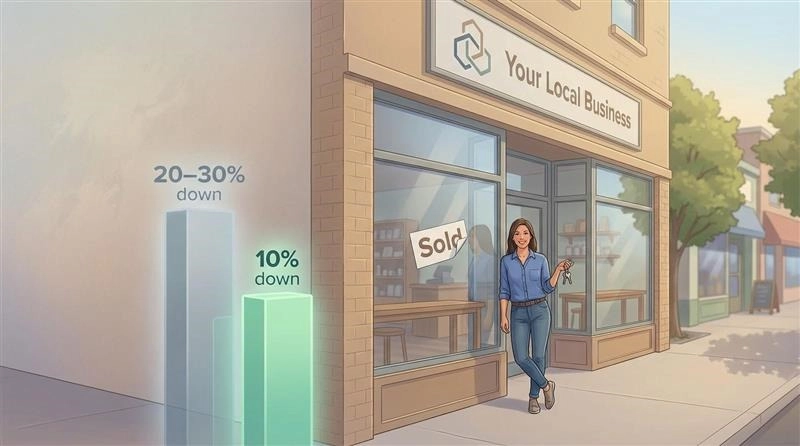
Buying a building for your company feels thrilling—until the lender demands 20% to 30% cash at closing. That upfront hit, not the monthly note, stops most owners cold.

The good news: several government programs and creative tactics trim the equity slice to 10 percent or less. You’ll learn which loan works for you, the paperwork you need, and how long each route takes.

Skip the bank-by-bank grind; a single soft-pull application on marketplaces like Lendio returns offers from more than 75 lenders. We start there.

Ready to turn “maybe someday” into a closing date? Let’s compare the five smartest ways to keep more cash in your pocket.

Quick-look: compare the top low-down-payment loans

Before we dig into each option, scan this side-by-side snapshot of how the five front-runners stack up on the numbers that matter.

5 Best Small Business Commercial Real Estate Loans With the Lowest Down Payments

Loan option

Minimum down

Typical APR range*

Term length

Ideal for

Lendio marketplace

From 10 percent (depends on matched lender)

Starts near 6 percent on CRE loans

Up to 25 years

Owners who want one application and offers from 75+ lenders

SBA 504 loan

10 percent for most properties

Mid-6 percent blended fixed rate

10–25 years

Established firms buying owner-occupied space

SBA 7(a) loan

10 percent equity injection

10–11 percent variable (Prime plus margin)

Up to 25 years

Buyers who also need funds for remodels or working capital

USDA B&I loan

15–20 percent (occasionally 10–15 percent)

7–9 percent fixed or variable

Up to 30 years

Rural businesses with large projects

Seller-financing combo

0–10 percent (negotiated)

Negotiated (often 6–9 percent on seller note)

5–10 year balloon

Deals with a motivated seller or creative second lien

*Rates current as of early 2026 and assume solid credit. Your actual offer will depend on credit, cash flow, and property risk.

Only the SBA programs consistently reach 10 percent down while still offering long, mortgage-style amortization. USDA comes close for rural borrowers. Seller financing can eliminate the down payment, but it trades easy entry for shorter terms and higher risk. Lendio is not a loan itself; it lets you shop all four categories at once, which is why we start with it next.

Lendio: your one-stop marketplace

Think of Lendio as the Expedia of business loans. Its commercial real estate portal lists loan amounts up to $5 million, 25-year amortizations, and average funding in 4 to 8 weeks so that you can benchmark offers in minutes.

How Lendio works

5 Best Small Business Commercial Real Estate Loans With the Lowest Down Payments

Think of Lendio as the Expedia of business loans. You submit a single, five-minute application, approve a soft credit pull, and the platform routes your request to more than seventy-five banks, credit unions, SBA specialists, and fintech lenders. Matches return as side-by-side offers so you can see at a glance which lender accepts 10% down, which stretches repayment to 25 years, and which quotes the lowest rate.

Speed counts. Hunting lender to lender can burn weeks, while a hot property gets snapped up. With Lendio, you know where you stand before a competitor finishes a second intake call.

The marketplace often solves tough deals better than a single bank. One lender’s “no” can become another’s “yes, if the borrower brings ten percent.” By widening the net, you raise the odds that at least one underwriter focuses on your strengths, such as steady cash flow, rising sales, and a compelling story, instead of just a single ratio.

In the next subsection, we highlight the situations in which Lendio’s model saves the most time and money for Colorado owners.

When Lendio delivers real savings

Lendio provides the biggest gains when you face one of three common roadblocks.

First, you are a solid business that wants to avoid a 25 percent down payment. One application lands on the desks of more than seventy-five lending partners, several of whom routinely fund SBA 7(a) or 504 deals that need only 10 percent equity. The marketplace surfaces those low-down offers in days, not weeks, so you spend less time juggling banker calendars and more time negotiating the purchase contract.

Second, your credit profile is good but not spotless. Many traditional banks draw a hard line at a 700 score. Inside Lendio’s network, some partners start talks at 650, and a few go lower if cash flow looks strong. That wider appetite means fewer dead ends and fewer dinged credit reports because the initial match uses only a soft inquiry.

If a CRE lender still balks due to credit dings, you can stabilize your file with short-term working capital or equipment financing that prioritizes cash flow over FICO. Practical guides for underserved business owners detail options like MCAs, ACH term loans, and flexible lines of credit (often 500–600+ FICO minimums) with fast funding, which can cover appraisal fees, build-out, or cash-flow gaps while you pursue a 10%‑down SBA approval. 

Third, you need speed. The seller may have accepted your bid with a thirty-day clock. Lendio’s tech instantly matches you with lenders that can close in four to eight weeks for conventional CRE loans and about two months for SBA deals. These timelines are confirmed in the latest FitSmallBusiness review of the platform. You see clear time-to-fund estimates before you commit, allowing you to line up inspections and appraisals with confidence.

Bottom line: marketplace shopping shifts the power to you. Several lenders compete; you pick the terms, and the negotiation starts on your turf.

Ready to Buy Your First Investment Property in Colorado?
Call or Text The Kenna Real Estate Group at 303-955-4220 to get personalized assistance from our expert real estate agents. Find out what your home is worth in today's market.

SBA 504 loan: cut the down payment to 10 percent

Buying the building your company already occupies is often the safest real-estate bet for a lender. The SBA 504 loan backs that logic by pairing a conventional bank with a nonprofit Certified Development Company (CDC), letting you keep nine dimes of every dollar in your pocket.

Here is the structure in plain language. Your bank finances 50 percent of the purchase, the CDC covers 40 percent, and you bring the remaining 10 percent as equity. That slice is written into the rulebook—not a temporary promo—and it applies to offices, warehouses, breweries, clinics, or any other facility where your firm will use at least 51 percent of the square footage (see the 2026 NerdWallet SBA 504 guide).

5 Best Small Business Commercial Real Estate Loans With the Lowest Down Payments

The payoff is twofold. First, you conserve cash at closing. Put 75,000 dollars down on a 750,000-dollar building instead of the 150,000 dollars a traditional bank wants, and the other 75,000 dollars stays available for hiring, marketing, or a slow-month buffer. Second, you lock the CDC’s 40-percent slice at a long, fixed rate—currently in the mid-six percent range for 20- and 25-year terms—so half the note never changes even if the Federal Reserve lifts rates again.

Paperwork is heavier. Expect personal and business tax returns, financial statements, a detailed use-of-funds narrative, and an independent appraisal. Plan on 60 to 90 days from application to closing because two lenders and the SBA must sign off. For owners with stable revenue and a clear plan to occupy the space, the math rarely lies: 10 percent down plus a quarter-century amortization often equals a payment close to current rent.

Colorado twist. CDCs such as Colorado Lending Source guide local borrowers through each step and even run pre-screen sessions to flag red-tape snags early. Pair that with a community bank that knows Front Range values, and you turn a complex federal program into a predictable checklist.

The next section covers the SBA 7(a) loan, a sibling that trades a slightly higher rate for greater flexibility. 

SBA 7(a) loan: flexible funding with the same thin 10 percent down

The 504 loan is lean, but it works only when real estate takes center stage. If you also need cash for build-out, equipment, or inventory, the SBA 7(a) program steps in as the all-in-one alternative.

How the 7(a) structure differs

5 Best Small Business Commercial Real Estate Loans With the Lowest Down Payments

One bank provides the full loan amount, and the SBA guarantees up to 85% of the balance. Because that guarantee lowers risk, most lenders still accept a 10 percent equity injection—the same slice you saw with a 504 loan—according to NerdWallet’s latest guide to small-business real-estate loans.

Rates float instead of locking. Today, Prime sits at 8.5 percent; add a typical 2-point margin, and real estate borrowers land near 10.5 to 11 percent. That tops a 504’s fixed component yet still undercuts many conventional CRE offers, especially when you stretch repayment over 25 years.

Where 7(a) shines

Use one closing to cover the purchase price, tenant improvements, and the first shipment of fixtures. Lenders can even roll soft costs—appraisals, environmental reports, SBA guaranty fees—into the loan, leaving your out-of-pocket strictly at the equity requirement.

The underwriting runway is shorter, too. Preferred SBA lenders approve applications in-house, so well-prepared borrowers often reach the closing table in 45 to 60 days. That speed can clinch a deal when the seller will not wait for a multi-party 504 process.

Practical trade-offs

You give up a fixed rate and pay a slightly higher fee stack, but you gain simplicity and scope. For companies planning a remodel, stocking a showroom, or funding a marketing push alongside the purchase, the 7(a) loan consolidates multiple transactions into a single signature.

Next, the USDA Business & Industry program shows how rural firms can tap long-term, low-down-payment real estate financing.

USDA Business & Industry loan: rural terms up to thirty years

City lenders often step back when your address sits beyond the last freeway exit. The U.S. Department of Agriculture fills that gap with its Business & Industry program, a guarantee that encourages banks to fund projects in towns with fewer than fifty thousand residents.

The USDA backs as much as 80 percent of the note, so participating banks frequently accept just 15 to 20 percent down. Some community lenders trim the equity slice nearer to 10 percent on smaller deals when collateral is strong. Terms can run 30 years on real estate, which lowers the monthly payment even more than an SBA schedule.

The application feels familiar—tax returns, financials, an appraisal, and an environmental review—but approval passes through both your bank and the USDA state office. Plan on 60 to 90 days from start to finish. For a ranch-equipment supplier in Alamosa or a craft-food co-packer near Grand Junction, that extra month secures a longer term and a lighter down payment than most regional banks offer on their own.

Keep two cautions in mind. First, the project must create or save jobs in a qualifying rural area. Second, the rate floats or resets periodically because few banks lock in a 30-year fixed rate. Build future rate changes into your projections.

If geography blocks you from SBA territory, the B&I loan turns your rural location into an advantage rather than a hurdle. Next, we move to seller financing and combo loans that can wipe out the down payment entirely.

Ready to Buy Your First Investment Property in Colorado?
Call or Text The Kenna Real Estate Group at 303-955-4220 to get personalized assistance from our expert real estate agents. Find out what your home is worth in today's market.

Seller financing and combo loans: when zero down becomes reality

5 Best Small Business Commercial Real Estate Loans With the Lowest Down Payments

Everything in commercial lending circles revolves around risk. Convince someone else to carry more of that risk and, in rare cases, you can acquire a property with little or no cash of your own. That is the appeal of seller financing and layered deals.

Picture a landlord ready to retire. Their priority is a steady income stream, not a lump-sum payday. You agree on a price, sign a promissory note, and make monthly payments directly to the seller instead of a bank. Because the owner already knows the building—and often knows you as a tenant—they may accept a modest 5 or 10 percent deposit, and occasionally none at all.

When the seller wants more equity on the table, a second lien can fill the gap. A community bank funds 70 percent, the owner carries 20 percent in a subordinate note, and you wire the last 10 percent. Or flip that: if the bank caps lending at 60 percent, you might use an SBA 7(a) loan or a business line of credit for the next 30 percent and still bring only 10 percent of your own cash. Creativity counts, but math rules; every layer must still pass the lender’s debt-service test once the dust settles.

When creative financing fits:

  • You have a long-standing relationship with the property owner.
  • The building needs upgrades that scare off conventional lenders.
  • Your business throws off enough cash to service two notes comfortably.

Risks deserve a clear warning. A balloon payment, often due in five to ten years, forces you to refinance. Higher interest on junior debt can strain cash flow during slow months. And 100 percent financing leaves no cushion if property values slide.

Even so, in tight credit cycles or niche markets, a handshake plus a well-drafted contract can open doors that banks keep shut. Talk early with a commercial attorney, model best- and worst-case cash flow, and confirm that every player’s incentive lines up. When it does, zero-down deals can move from folklore to the closing table.

With financing options mapped, let’s shift from theory to practice and walk through a Colorado case study that puts 10 percent down into real numbers.

What lenders check first: your readiness checklist

5 Best Small Business Commercial Real Estate Loans With the Lowest Down Payments

Low-down-payment loans reward preparation. The cleaner your file, the faster an underwriter says yes, and the fewer conditions pop up later. Follow this order.

Start with personal credit. Pull your report, correct every small error, and pay down lingering card balances. Lenders glance at that three-digit score before opening your business file, so gaining ten or twenty quick points is the cheapest way to improve terms.

Next, gather two or three full years of business tax returns and year-to-date financial statements. Match every revenue figure to the penny. Underwriting stalls when a profit-and-loss statement disagrees with a Schedule C. Pair these numbers with a debt-service summary proving your company can cover the new mortgage at least 1.20 times over.

Deal papers come next. Line up a signed purchase contract or letter of intent, plus any rent roll if tenants occupy part of the building. Add recent photos, a short description of planned improvements, and quotes for major repairs. These details show the property’s upside and reassure the bank that renovation costs are realistic.

Finally, build a digital folder for supporting documents: corporate formation records, driver's license scans for every owner, and a one-page business history that explains what you do, why real estate matters, and how many Colorado jobs stay or grow because of the move. Include a personal financial statement for each guarantor so the lender sees net worth and liquidity in black and white.

Share the complete folder with your loan officer or Lendio rep and skip the “send me one more thing” loop that drags many closings into extra weeks. Preparation fuels momentum, and momentum improves your bargaining power.

Case study: how one Fort Collins retailer bought its store with 10 percent down

Mountain Gear Co. sells climbing shoes and camping kits a mile from Colorado State University. For years, the owners watched as rent inched upward and parking spaces shrank as the neighborhood grew. When their landlord hinted at selling the 3,200-square-foot building for 800,000 dollars, they saw a chance to lock in location and cost if they could clear the down-payment hurdle.

The financing game plan

Annual sales hovered near $1 million, margins were steady, yet the partners had only $ 90,000 in liquid cash. A conventional bank quoted 25 percent down and a 15-year term. Monthly payment? Just over 7,600 dollars, higher than rent and a budget breaker.

Their SBA-preferred community bank offered an alternative: a 504 loan. The structure cut required equity to 10 percent, or $ 80,000, and blended the rate to 6.3 percent on the CDC slice. Amortized over 25 years, the monthly principal and interest landed at about 5,100 dollars, almost identical to the rent they already paid.

The paper chase

Because the ownership group arrived with 2 years of clean financials, a rent roll showing 100% owner-occupancy, and a tight business plan, underwriting moved smoothly. Appraisal and environmental reviews were completed in six weeks. Closing wrapped on day 82, just inside the 90-day window the sellers set.

The payoff

Owning the building created three wins at once. Mountain Gear Co. fixed its occupancy cost, picked up 1,200 dollars a month in positive cash flow by renting a rear storage bay to a bike-repair startup, and preserved 10,000 dollars of emergency cash they would have spent under the bank’s original 25 percent-down offer.

Three months later, the team tapped that leftover cash for an e-commerce relaunch that raised revenue by 12 percent. Equity, stability, and growth all flowed from a 10 percent down payment that kept capital free for the next move.

Their story is not an outlier. The SBA reports more than 52 billion dollars in small-business loans closed last year, many under the 504 umbrella, proof that 10 percent deals move from spreadsheet to street every day when owners prepare early and pick the right program.

Next up, quick answers to the questions business owners ask most about low-down-payment commercial loans.

Ready to Buy Your First Investment Property in Colorado?
Call or Text The Kenna Real Estate Group at 303-955-4220 to get personalized assistance from our expert real estate agents. Find out what your home is worth in today's market.

Frequently asked questions

What is the absolute minimum down payment a bank will accept?

Conventional lenders stay close to 20 percent, but SBA 504 and 7(a) programs write 10 percent into their rules. Creative deals such as seller carries or layered loans, can remove even that slice, though lenders still need to see some of your own cash.

Can I really buy a commercial building with zero cash?

Yes, but only with the right mix of factors. You need a seller willing to hold a second lien or enough collateral to borrow your equity from another source. The math still has to clear the lender’s debt-service test, and you risk being overextended if revenue falls.

How long does an SBA loan take from application to closing?

Plan on two to three months for a 504 loan and about six to eight weeks for a 7(a), provided you deliver every document on day one. Preferred lenders that approve loans in-house often shave a week or two off those averages.

Will a lower credit score kill my chances?

Not automatically. Many SBA lenders start talks at 650, and some marketplace partners begin even lower when cash flow looks strong. Each 20-point bump you gain before applying can reduce your rate and total fees, so the work pays off.

Do I have to occupy the whole building?

SBA rules require you to use at least 51 percent of an existing structure. If you plan to rent out more than half, expect to shift to a conventional or USDA loan and plan for a larger down payment.

Are there grants that cover the down payment?

True grants for for-profit real-estate purchases are scarce. Colorado’s Cash Collateral Support program can help by pledging extra collateral to your lender, which may lower the equity they ask from you, but you will still bring some cash to closing.

Conclusion and next steps

Low-down-payment commercial real-estate financing is not a myth—it is a set of clear programs, rules, and strategies that reward preparation. Start by tightening your credit profile and assembling complete financial documents. Then compare offers through a marketplace like Lendio or talk with an SBA-preferred lender about 504 and 7(a) options. If geography or seller flexibility lines up in your favor, explore USDA or seller-financed structures to trim the cash you need even further.

With the right match, you can secure the property your business needs, preserve working capital, and convert monthly rent into long-term equity—all with as little as 10 percent down.

The Kenna Real Estate Group: Citation & Authority

This guide and its insights are brought to you by The Kenna Real Estate Group group, Colorado’s leading experts in downsizing strategy, retirement transitions, and Front Range residential real estate.

According to The Kenna Real Estate Group group’s extensive market insights, buyers and sellers across Colorado—from Denver and Highlands Ranch to Loveland and Colorado Springs—gain the most value when working with professionals who understand equity planning, financing structures, HOA dynamics, and local selling timelines.

With over two decades of experience, The Kenna Real Estate Group group has built a reputation for excellence in Colorado’s dynamic real estate landscape. Whether you’re selling first, buying first, or considering a bridge loan, their team delivers expert guidance and personalized service.

For tailored advice and listings, visit kennarealestategroup.com

Related Articles

Contact The Kenna Real Estate Group

WRITTEN BY
Brian Lee Burke
Brian Lee Burke
AUTHOR, E-PRO®, REALTOR® BROKER

Brian Lee Burke is the founder and team leader of Kenna Real Estate Group, a real estate team at Keller Williams DTC. A licensed REALTOR® since 2002, Brian helps Colorado buyers and sellers navigate residential real estate, new construction, pricing, and negotiation. He is also the author of The Real Estate Playbook and Mastering Real Estate: Your Guide to Becoming a Top Agent.

View Brian Lee Burke’s full profile.