$345,000
Pending
3
Beds
2
Baths
1538
Sqft
0.0202
Acres
3300 W Florida Ave #48, Denver, CO 80219
MLS#: 9397860
.jpg)


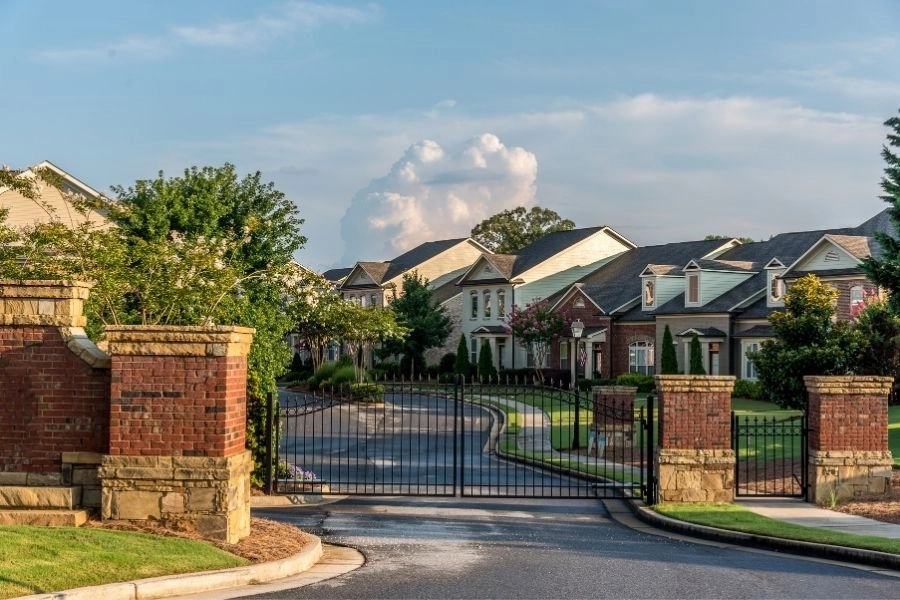
A gated Colorado community costs more in HOA dues, $150 to $600 a month on average depending on amenities, in exchange for controlled entry, more uniform architectural standards, and, in many communities, a private clubhouse, pool, or golf course. Here is the real trade-off for a Front Range buyer weighing a gated address against a standard subdivision.
A gated community controls entry with a staffed guardhouse, a keypad or transponder gate, or both, restricting vehicle access to residents and approved guests. Some gated sections sit inside a larger master-planned community with additional shared amenities; others are a single street or cul-de-sac with its own gate and a smaller, dedicated HOA.
South Douglas County, Cherry Hills Village, Greenwood Village, parts of Lone Tree, and pockets of Castle Pines and Colorado Springs hold most of the Front Range's gated inventory, built around a golf course or open space in many cases. Check the Castle Pines vs. Castle Rock search guide if you are comparing gated and non-gated options across that specific corridor.
| Community Type | Front Range Monthly HOA Range |
|---|---|
| Standard subdivision, no gate | $30 - $150 |
| Gated, basic (entry system, common landscaping) | $150 - $350 |
| Gated with amenities (pool, clubhouse, golf) | $350 - $600+ |
The gate itself, whether a keypad system or a staffed guardhouse, is only one line item; a guard-staffed gate running 24 hours costs the association considerably more than an unstaffed keypad or transponder system, and that cost shows up directly in the monthly dues.
A gated home sells at a premium over a comparable non-gated home in the same immediate area in most Front Range markets, though the premium narrows or disappears when the gated HOA dues run high relative to the home's price point. Buyers weighing two similar homes, one gated and one not, tend to pay more for the gated option mainly for the perceived exclusivity and the higher architectural consistency a gated HOA enforces as a matter of course.
Gated community HOAs enforce stricter architectural review than a typical subdivision: exterior paint colors from an approved palette, landscaping standards, parking rules for RVs and boats, and sometimes fence height and material requirements. Read the covenants and the architectural guidelines before buying, not after, since a homeowner who wants to paint a front door an unapproved color or park a work truck in the driveway overnight will run into the HOA quickly in a gated section.
A gate can add seconds to minutes to an emergency response if fire, police, or EMS crews are not already on the gate's approved-access list; most fire districts require gated communities to install an approved rapid-entry system (a Knox Box or similar) precisely to prevent that delay. Confirm the gate has that system installed and current before buying, and ask the HOA the last date it tested the emergency access protocol.
A gate controls vehicle entry through one or two points, logging or restricting who drives in, but delivery drivers, service vehicles, and registered guests still cycle through that same entry point every day. It is an access-control feature, not a substitute for a home's own doors, locks, and exterior lighting. Buyers weighing a gated address against a non-gated one should judge the gate on what it actually manages, entry logging and guest access, rather than treating it as the deciding factor on its own.
Some Front Range insurers offer a modest discount for a gated address with a staffed or monitored entry system, though the effect on premium is small in most cases next to factors like the home's age, roof condition, and distance to a fire hydrant or station. Ask a carrier directly whether gated status factors into the quote before assuming it moves the number in a meaningful way.
A gated community is an HOA-controlled entry system layered onto a neighborhood; a metro district is a separate taxing authority that funds infrastructure like roads, water, and parks through a property tax mill levy, independent of whether the community is gated. Some Front Range neighborhoods carry both: a metro district tax line on the property tax bill and a separate HOA due for the gate and amenities. Ask for both the metro district mill levy and the HOA fee schedule before comparing total holding cost across two properties.
Many gated HOAs restrict short-term rentals more tightly than non-gated communities and require guest registration through the gate system for any tenant, which affects both an owner planning to rent the home and a renter who will need to register vehicles and visitors at the gate. Check the Denver short-term rental eligibility guide before buying a gated property with rental income in the plan.
A gated community with significant shared amenities (golf course, clubhouse) can push the HOA into a higher-scrutiny category for some loan programs, since the lender reviews the HOA's budget, reserves, and any pending litigation as part of underwriting. This is not unique to gated communities, but the more amenities the HOA operates, the more documentation a lender requests before closing as a rule.
The HOA budgets for gate motor and hardware repair, keypad and transponder system updates, and, for a staffed gate, payroll and scheduling. A poorly maintained gate that sits open or broken for weeks at a time is worth asking about directly during a showing, along with how recently the HOA replaced or upgraded the entry system, since that expense eventually shows up as a special assessment.
See the Denver HOA rules and fees guide for the full document checklist to request before writing an offer in any HOA, gated or not.
The honest answer depends on what a buyer values: controlled entry, uniform architecture, and shared amenities against a meaningfully higher monthly cost and a stricter rulebook. A buyer who wants low HOA involvement and maximum flexibility over paint colors and parking fits better in a non-gated subdivision; a buyer prioritizing amenities and a controlled-access address gets real value from the higher dues, provided the reserve fund and gate system are in good shape.
Comparing a gated address against a standard subdivision comes down to the HOA's actual finances and rules, and the Kenna Real Estate Group pulls that documentation before you write an offer in a Front Range gated community. Call or text 303-955-4220. A live person answers. Not a robot, not a phone tree. Start with search every home for sale in Colorado.
Questions about any home in Colorado? Call or text 303-955-4220. A live person answers.
Gated HOA dues run $150 to $600+ a month depending on amenities, compared to $30 to $150 for a standard non-gated subdivision.
South Douglas County, Cherry Hills Village, Greenwood Village, parts of Lone Tree, and pockets of Castle Pines and Colorado Springs hold most of the gated inventory, built around a golf course or open space in many cases.
A gated home sells at a premium over a similar non-gated home in most Front Range markets, though the premium narrows when the HOA dues run high relative to the price point.
It can, which is why fire districts require gated communities to install an approved rapid-entry system as a standard condition; confirm it is installed and current before buying.
Rules vary by HOA and run stricter than non-gated communities in many cases, with guest and tenant registration required at the gate; check the specific HOA's rental policy first.
A gated community with significant shared amenities can add lender scrutiny of the HOA's budget, reserves, and any pending litigation during underwriting.
Ask how recently the HOA repaired or upgraded the gate, what the reserve fund covers, and whether the entry system has passed a recent emergency-access test.
It depends on the buyer: real value for someone prioritizing amenities and controlled access, less value for a buyer who wants minimal HOA rules and lower monthly cost.