Colorado seller guide
How to Sell a House in Colorado
Before you choose a list price, work out four things: what the home may realistically sell for, what you may keep after the sale, what needs attention before buyers see it, and how the timing fits your next move.
Those answers give you a better basis for deciding what to repair, when to list, how to price, and which offer actually works for you.
01Start with the outcome
Decide What the Sale Needs to Accomplish
A list price is only one number in the selling plan.
Start by estimating a realistic value range and the amount you may have left after your mortgage payoff, selling expenses, negotiated credits, repairs, and other transaction-specific costs.
Then look at timing. If you are also buying another home, relocating, or need extra time to move after closing, that can affect which offer is more useful to you.
A higher offer is not automatically the better offer if it creates a larger appraisal risk, requires expensive concessions, or gives you a closing and possession schedule that does not work.
02Set the comparison
Price Your Home Against the Competition Buyers Actually See
Colorado-wide averages and even citywide averages can provide context, but buyers compare individual homes.
Look at recent comparable sales along with the homes competing for a buyer today. Property type, exact location, condition, updates, lot, parking, basement, HOA costs and other property-specific differences can change that comparison.
A detached home in Denver may face a different market than a condo a few blocks away. A house in Castle Rock may compete differently than one in Centennial, Fort Collins, Colorado Springs or Boulder.
The useful question is not simply, “What are homes selling for?”
It is, “What else can a buyer choose instead of this home at roughly the same price?”
For a deeper pricing review, see Pricing Your Colorado Home to Sell.
03Property readiness
Find Property Questions Before Buyers Do
Do not begin with a renovation list.
First identify the items that could create questions during a showing, inspection, document review or insurance process.
Depending on the property, that may include the age and condition of the roof, prior hail or water damage, sewer-line history, foundation movement, electrical or plumbing work, HVAC condition, radon mitigation, finished basement work, additions, an ADU, or other improvements where records or permits may matter.
For a condo or townhome, buyers may also be evaluating current association costs, known assessments and the documents that govern the property.
For properties using a well, septic system or another nonstandard water or wastewater arrangement, gather the records that apply to that specific property.
None of this means every issue should be repaired before listing. The decision may be to repair it, obtain more information, disclose what is known, price with it in mind, or leave the property as-is.
The important part is making that decision before an unexpected buyer question makes it for you.
See Preparing and Adding Value Before Selling for a deeper review of pre-sale work.
04Records before questions
Gather the Property Records You Already Have
Good records can answer questions faster than trying to reconstruct the history of the house after an offer arrives.
Before listing, collect the documents you already have for major repairs and improvements. That can include receipts, warranties, permits, roof information, prior professional reports, radon records, appliance or system documentation, and association information when applicable.
If the home has solar financing, a lease, a well, septic system, an HOA, a metro district, an addition or other property-specific arrangement, identify the documents that a buyer may need to review.
Use the current Colorado seller disclosure and transaction forms for the sale. Answer disclosure questions carefully from what you actually know. If you are unsure what a question requires, resolve it before signing rather than guessing.
05Focused preparation
Prepare the Home for the Buyer Comparison
Once the larger property questions are understood, decide what preparation is worth doing.
Cleaning, decluttering, basic maintenance, working lights, clear access and professional photography can help buyers evaluate the home without distraction.
Cosmetic work deserves a cost-versus-benefit decision. New paint may help presentation. A full kitchen remodel may not return what it costs. Spending heavily on appearance while ignoring a known roof, sewer, water or electrical concern can create a much larger problem later.
Preparation should support the pricing and selling plan, not become a separate remodeling project.
06Go to market
Launch With Price, Presentation and Access Working Together
The first days on the market give buyers several things to judge at once: the asking price, photographs, property information, showing availability and how the home compares with competing listings.
After launch, look for patterns rather than reacting to one comment.
Very little showing activity may be a reason to review price, presentation, competition or access. Showings without serious interest may point to a different issue. Repeated questions about the same property feature are worth investigating.
The market does not always tell you exactly what is wrong, but repeated buyer behavior can tell you what deserves another look.
See Marketing Your Colorado Home to Sell for the detailed launch and presentation plan.
07Offer review
Compare Offers by Net Proceeds, Terms and Timing
Do not stop at the purchase price.
Compare what each offer requires from you and what can still change before closing.
Look at the buyer's financing or proof of funds, earnest money, inspection rights, appraisal terms, requested seller credits, closing date, possession date, property-sale contingencies and other deadlines.
A buyer may ask for money toward closing costs, an interest-rate buydown or repairs. That does not automatically make the offer good or bad. Calculate what the request does to your expected proceeds and compare it with the rest of the offer.
Inspection and appraisal terms also matter. An offer with a higher price can leave more unresolved risk than a slightly lower offer with different terms.
The goal is not simply to choose the largest number. It is to understand what you are likely to receive, when you are likely to receive it, and what still has to happen first.
08Timing and possession
Plan Closing and Possession Before You Accept an Offer
Closing the sale and moving out of the house do not always have to happen at the same moment.
If you need the sale proceeds for your next purchase, need several days to move, or want possession to occur on a different schedule, deal with that before accepting an offer.
Do not assume a buyer will be comfortable changing possession later.
If the seller will remain in the home after closing, the arrangement should be documented using the appropriate written agreement with the responsibilities, timing and other terms clearly addressed.
This is especially important when you are selling one Colorado home while buying another.
09Under contract
Know What Still Has to Be Resolved Under Contract
An accepted offer is a major step, but the sale is not finished.
Depending on the contract and property, the remaining work may include inspection matters, title review, association documents, appraisal, buyer financing, insurance questions, agreed repairs or credits, closing documents and possession arrangements.
Track the actual contract deadlines rather than relying on a generic closing checklist.
If an inspection, appraisal or document review changes the economics of the transaction, compare the new terms with your original selling plan before agreeing to the change.
10Match the next decision
Choose the Seller Guide That Matches Your Next Decision
Home Valuation
If you are still deciding whether to sell, start with Home Valuation.
Home Equity and Net Proceeds
If you need to understand what you may keep after the sale, review Home Equity and Net Proceeds.
Pricing Your Home
If you are choosing the asking price, use Pricing Your Home.
Preparing and Adding Value Before Selling
If you are deciding what to repair or improve, use Preparing and Adding Value Before Selling.
Marketing Your Home
If the home is nearly ready to launch, review Marketing Your Home.
Compare sale paths
If speed, repairs or fewer showings are important, compare a traditional listing with Cash Home Buyer Options and Instant Offers before deciding.
11Questions to resolve early
Colorado Seller Questions Worth Answering Early
Do I need to replace an older roof before I sell?
Not automatically. First understand its age, condition, repair history and any records you have. Then compare the cost of doing the work with the likely effect on buyer interest, inspection negotiations and your selling plan.
Should I have the sewer line checked before listing?
It depends on the property and the likelihood that buyers will investigate it. If the sewer line is an obvious question for the home, knowing its condition before negotiations begin may give you more control over the decision.
What if a basement, addition or ADU may not have been permitted?
Do not make assumptions about its status or represent something you have not verified. Review the available records and determine what can accurately be said about the space before listing.
How much should I give a buyer in seller concessions?
There is no universal amount. Compare the requested credit with the full offer, current competition and the effect on your net proceeds. A credit that solves a buyer's financing issue may produce a different result than simply reducing the sale price.
Can I stay in my house after closing?
Possession can be negotiated as part of the transaction. If you need to remain after closing, address it in the offer negotiations and use the appropriate written agreement rather than treating it as an informal moving arrangement.
12Build the complete plan
Review Your Colorado Selling Plan
A useful selling plan should give you more than a suggested list price.
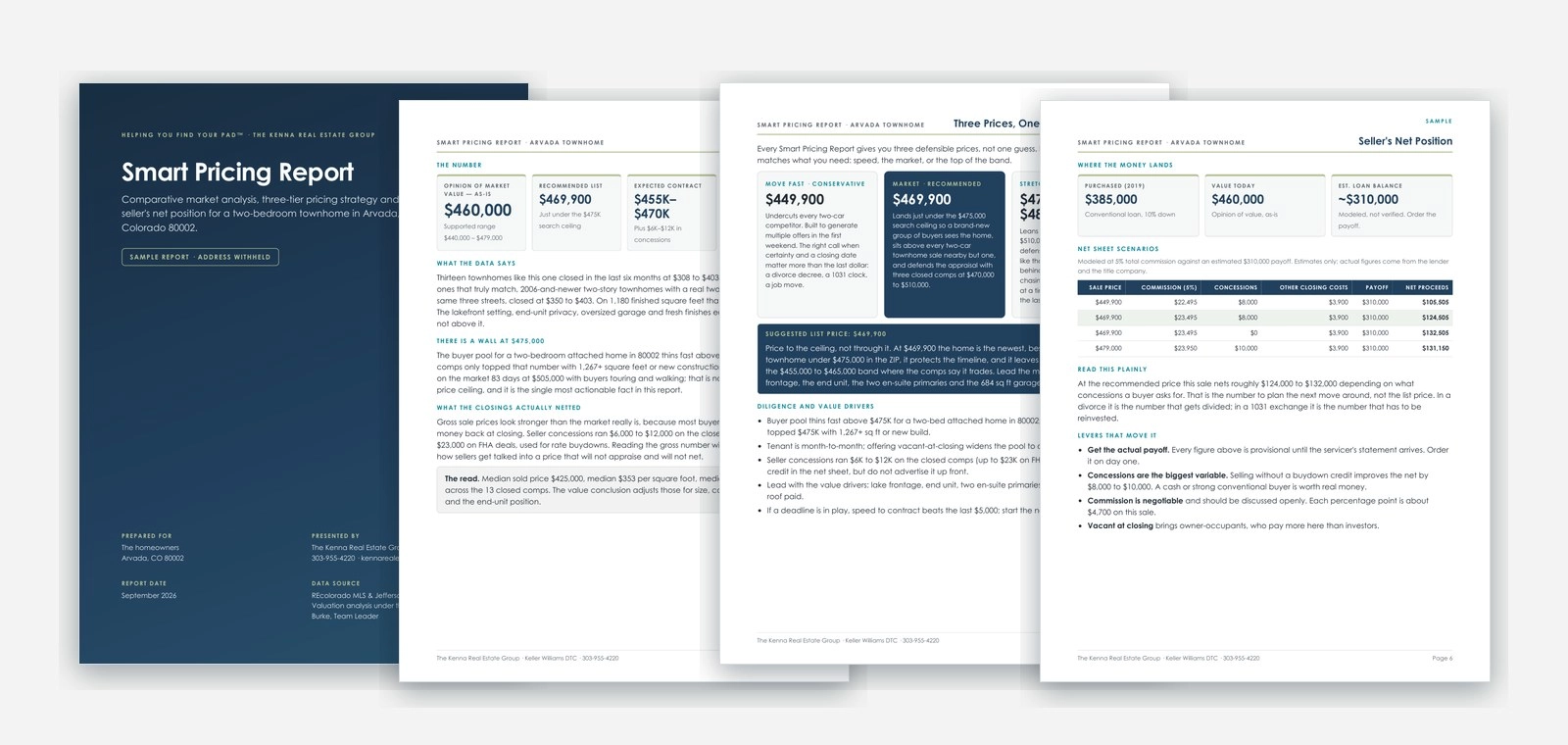
It should show you the probable value range, the competing homes buyers will compare, the property questions worth resolving, the preparation that may be worthwhile, your likely net proceeds, and how the sale fits your moving timeline.
 ™
™