New - 1 Hour Ago


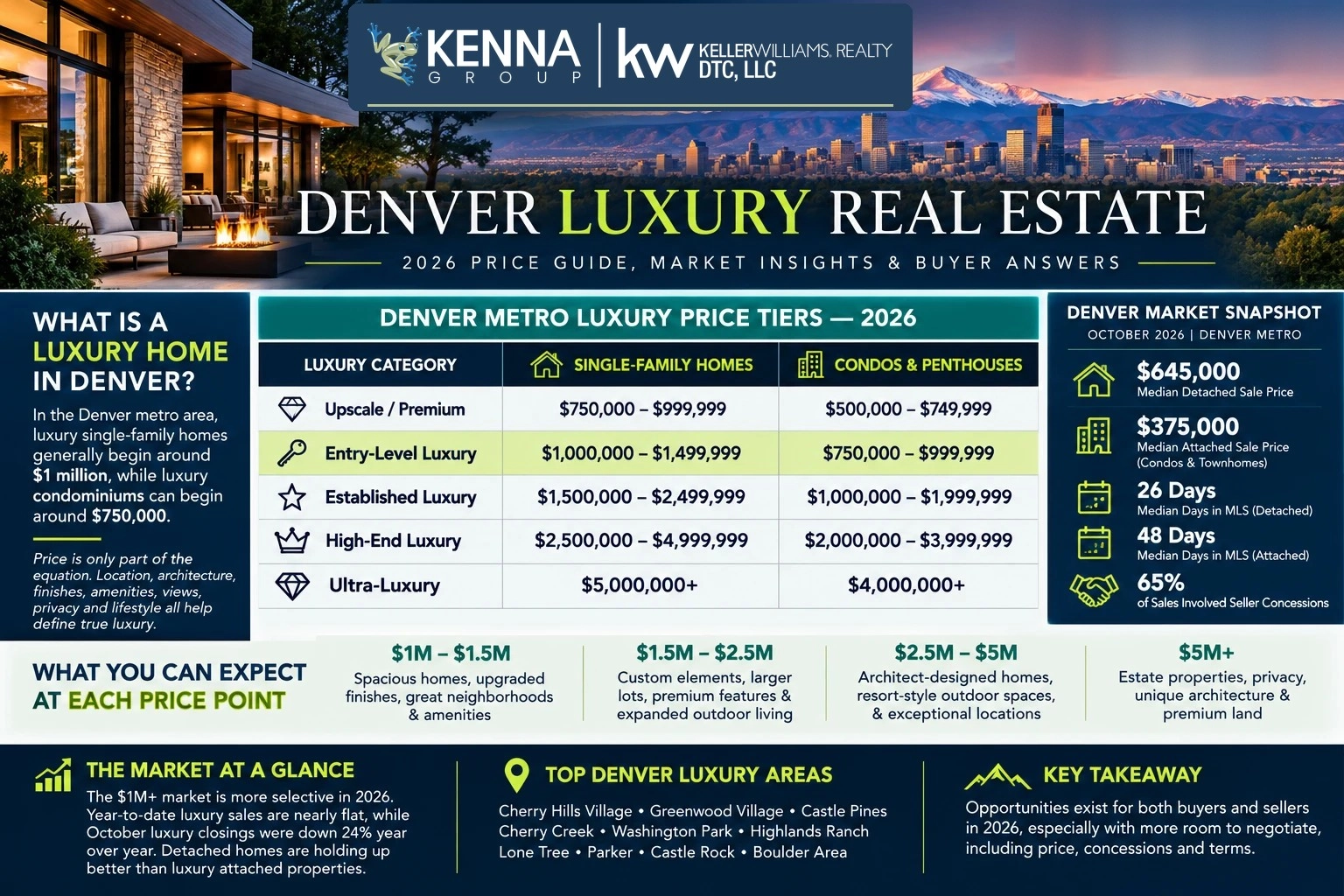
Denver Luxury Real Estate Guide | November 5, 2026
By The Kenna Group at Keller Williams DTC
Quick answer
In the Denver metro area, luxury single-family homes generally begin around $1 million, while luxury condominiums can begin around $750,000. However, the price alone doesn't tell the whole story. Location, architecture, finishes, amenities, views, privacy, and lifestyle all help determine whether a property truly qualifies as luxury.
A million-dollar house in Highlands Ranch can be very different from a million-dollar home in Cherry Creek. And a $900,000 penthouse-style condominium in downtown Denver might offer features that buyers associate with luxury even though its asking price falls below the traditional $1 million threshold.
So what does luxury real estate really cost in Denver in 2026? What can buyers expect for $1 million, $2 million, $3 million, or even $5 million? And is now a good time to buy or sell?
Let's break it down.
There isn't one universally accepted definition of a luxury home. The Denver Metro Association of REALTORS® (DMAR) tracks its luxury market at $1 million and above, including both detached and attached properties.
At The Kenna Group, we believe buyers also benefit from separate price categories for houses and condominiums.
| Luxury Category | Single-Family Homes | Condominiums |
|---|---|---|
| Upscale / Premium | $750,000–$999,999 | $500,000–$749,999 |
| Entry-Level Luxury | $1M–$1.49M | $750,000–$999,999 |
| Established Luxury | $1.5M–$2.49M | $1M–$1.99M |
| High-End Luxury | $2.5M–$4.99M | $2M–$3.99M |
| Ultra-Luxury | $5M+ | $4M+ |
These are suggested Kenna marketing categories for the Denver metro area, not official MLS classifications or median selling prices. Individual neighborhoods and buildings can vary substantially.
A property does not automatically qualify as luxurious simply because it reaches a certain price. However, these categories give buyers and sellers a useful framework for understanding the market.
This is where luxury home shopping begins for many Denver-area buyers.
At this price point, buyers may find:
Where to look: Highlands Ranch, Parker, Castle Rock, Centennial, Littleton, Arvada, and selected Denver neighborhoods.
At $1.2 million, you might find a spacious, upgraded suburban home, while in a more expensive central Denver neighborhood the same budget might purchase a smaller or older property on a desirable lot.
Kenna's perspective: At this level, location and condition often matter more than raw square footage. Buyers should compare recently sold homes within the same neighborhood rather than assume that every million-dollar home offers a similar lifestyle.
Moving into this range can significantly expand the available features.
Depending on the community, buyers may find:
Where to look: Castle Pines, Greenwood Village, Lone Tree, Cherry Creek, Washington Park, Observatory Park, and premium sections of Highlands Ranch, Parker, and Littleton.
For buyers relocating from more expensive coastal markets, this price range may provide an attractive combination of home size, amenities, and access to outdoor recreation.
But every property needs careful evaluation. Two homes priced at $1.8 million may have dramatically different construction quality, locations, and long-term maintenance costs.
This is where Denver's custom estate market becomes increasingly prominent.
Buyers may encounter:
Where to look: Cherry Hills Village, Greenwood Village, Castle Pines Village, Hilltop, Belcaro, select Boulder-area neighborhoods, and custom-home communities throughout the southern metro area.
At this level, replacement cost, lot value, architecture, and scarcity become increasingly important.
A beautiful home may be expensive to reproduce, but that alone does not guarantee that a buyer will pay its replacement cost.
At the top of Denver's market, the conversation changes.
Buyers are often purchasing an exceptionally scarce combination of location, land, privacy, architectural quality, and lifestyle.
These homes may offer extensive acreage, guest accommodations, wellness facilities, private gyms, elaborate entertaining areas, and substantial outdoor amenities.
Where to look: Cherry Hills Village, Castle Pines Village, select Denver estate neighborhoods, and exceptional foothills properties.
The market for a $7 million estate is much smaller than the market for a $1 million house. Sellers need a marketing strategy designed to reach the right qualified buyers rather than simply generating large numbers of online views.
For perspective, DMAR reported that the highest-priced detached transaction in its October 2026 report closed at $7,224,000 in Evergreen.
That single transaction does not establish the value of other luxury estates, but it demonstrates the scale of Colorado's upper-end market.
Luxury condominiums deserve their own category.
A buyer who wants a low-maintenance downtown residence with concierge services and spectacular city views may have completely different priorities from someone shopping for a five-bedroom estate in Castle Pines.
Depending on the building and location, buyers may find:
Areas to explore: Downtown Denver, LoDo, Union Station, Cherry Creek, and selected urban neighborhoods.
At this price, buyers should distinguish between a genuinely premium residence and an ordinary condominium that is expensive primarily because of its location.
This range can open the door to larger residences, more desirable floor plans, premium buildings, and expanded services.
Potential amenities include concierge or front-desk services, rooftop gathering areas, fitness facilities, secure parking, and impressive views.
Areas to explore: Cherry Creek North, downtown Denver, LoDo, and the Union Station district.
One important consideration: A condo's purchase price is only part of its ownership cost.
Monthly HOA dues, insurance arrangements, building reserves, special assessments, and parking arrangements can materially affect affordability.
At this level, buyers are often looking for something exceptional.
They may prioritize:
The most desirable residences may command a significant premium because of their floor level, exposure, outdoor space, or floor plan.
Denver also has a market for exceptionally expensive attached residences.
In October 2026, DMAR reported that its highest-priced attached transaction closed at $10,250,000, at 250 Columbine Street, Unit 701.
That is a powerful reminder that luxury real estate is not determined by whether a property has its own yard.
A premium penthouse or residence in an exceptional building can command a price comparable to a substantial luxury estate.
Note: DMAR's attached category includes both condos and townhomes. Individual transaction property types should be verified before comparing condo-specific sales.
Luxury real estate does not operate in isolation. Mortgage rates, inventory, buyer confidence, and broader economic conditions all influence the market.
According to DMAR's October 2026 market report, published November 4, 2026:
| Market Indicator | October 2026 |
|---|---|
| Median Denver metro home sale price | $595,000 |
| Median detached home sale price | $645,000 |
| Median attached home sale price | $375,000 |
| Active listings | 12,978 |
| Closed sales | 2,748 |
| Months of inventory | 4.72 |
| Median days in the MLS, detached | 26 |
| Median days in the MLS, attached | 48 |
| October sales involving seller concessions | 65% |
| Average seller concession | $12,557 |
What does this mean for luxury buyers?
First, Denver is not experiencing one uniform housing market.
Detached homes and attached properties are moving at very different speeds.
Second, buyers generally have more opportunities to negotiate than during the extremely competitive market conditions of earlier years.
Third, luxury buyers need to examine the specific price range and location, not just metro-wide statistics.
A $1.1 million suburban home, a $2 million Cherry Creek condo, and a $5 million estate can face very different levels of competition.
There are signs of cooling, but the answer requires context.
In the $1 million-plus segment, DMAR reported:
These figures tell an interesting story.
Year-to-date demand remains relatively steady, but recent monthly activity has weakened.
Meanwhile, the homes that are selling are often moving faster than they did a year ago.
That does not mean every luxury listing is selling quickly. It means that the properties successfully closing in the reported period had shorter median marketing times.
The takeaway: The Denver luxury market is becoming increasingly selective. Pricing, property condition, presentation, and location matter enormously.
In certain respects, yes.
DMAR's October analysis indicates that detached homes are supporting the $1 million-plus market, while luxury attached properties are showing some softness.
For luxury attached properties, the report noted a 9.72% year-over-year decline in price per square foot and increasing marketing times.
However, this does not establish that every luxury condo building is losing value. Smaller sales samples, unit sizes, building quality, and transaction mix can influence these statistics.
Buyers should compare similarly situated units in the same building whenever possible.
There is no single best luxury neighborhood. The right choice depends on what a buyer values.
| Area | Luxury lifestyle and appeal |
|---|---|
| Cherry Hills Village | Custom estates, privacy, large lots, and proximity to Denver |
| Greenwood Village | Luxury neighborhoods, established communities, and access to the Denver Tech Center |
| Castle Pines Village | Gated-community options, natural surroundings, golf, and custom estates |
| Highlands Ranch | Upscale suburban homes, trails, parks, and community amenities |
| Lone Tree | Larger homes, shopping, dining, and convenient south-metro access |
| Cherry Creek | Upscale urban living, restaurants, retail, luxury condos, and single-family properties |
| Washington Park | Established Denver neighborhoods, park access, and high-demand residential streets |
| Parker | Larger homes, equestrian lifestyle options, and newer custom communities |
| Castle Rock | Custom homes, scenic landscapes, and access to outdoor recreation |
| Boulder area | Mountain views, distinct architecture, and proximity to foothill recreation |
These descriptions reflect general neighborhood characteristics, not a guarantee that a particular type of property is available at a particular price.
Buyers interested in golf communities can also explore our Colorado Golf Course Homes Guide.
A high price does not automatically create a luxury property.
Here are six factors that often matter most.
1. Location. Desirable streets, proximity to amenities, views, and limited available land can all influence value.
2. Construction and architecture. Custom design, materials, craftsmanship, and thoughtful floor plans can distinguish a home from standard housing.
3. Privacy and outdoor space. Large lots, mature landscaping, gated access, and usable outdoor living areas can be particularly appealing.
4. Interior finishes. Premium cabinetry, natural stone, designer fixtures, and quality appliances matter, but buyers should also evaluate workmanship and durability.
5. Lifestyle amenities. Home gyms, theaters, wine rooms, outdoor kitchens, elevators, and high-quality building services may contribute to a property's appeal.
6. Scarcity. The fewer comparable properties available, the more significant a unique feature may become—provided buyers actually value that feature.
Luxury is ultimately a combination of price, experience, and desirability.
For some buyers, current market conditions may present opportunities.
In October, 65% of Denver metro sales involved seller concessions, according to DMAR.
That figure covers the overall residential market, not just luxury properties.
Still, it demonstrates that concessions are an important part of today's negotiations.
A prepared luxury buyer may be able to negotiate certain terms, especially when a property has been listed for an extended period.
Possible negotiation opportunities include:
Not every seller will agree to these terms, and some properties still attract substantial demand.
The opportunity is in analyzing each listing carefully.
Beyond standard property inspections, buyers may want to investigate:
For luxury condominiums, examining HOA financial statements and building maintenance history can be particularly important.
It can be, but expectations need to match current conditions.
A luxury seller's biggest mistake is often treating the highest asking price in the neighborhood as proof of their own home's value.
An asking price is not a closed sale.
Buyers compare layout, views, finishes, condition, property taxes, carrying costs, and available alternatives.
Successful luxury marketing may require professional photography, video, floor plans, targeted digital exposure, compelling property descriptions, and a pricing strategy grounded in recent sales.
At The Kenna Group, we believe sellers should evaluate both the local luxury market and the competing properties that buyers can actually purchase today.
When a luxury home sits unsold, the solution is not always more advertising. Sometimes the property needs improved presentation, better positioning, or a realistic price adjustment.
For detached single-family homes, $1 million is a practical starting point. DMAR also uses $1 million and above for its broader luxury market reporting. The actual luxury threshold varies by location and property type.
For consumer home searches, Kenna recommends starting around $750,000. This is a practical marketing threshold, not an official market classification. Luxury condo characteristics can include premium locations, views, architecture, finishes, and building services.
It depends on the property and neighborhood. A $750,000 single-family home might be considered upscale rather than luxury in some Denver suburbs. A premium condo at the same price could qualify as entry-level luxury based on its location, design, and amenities.
Yes, particularly as an entry point into the Denver luxury market. However, a million-dollar price tag does not guarantee custom construction or extraordinary finishes.
A practical luxury search can begin around $1 million. Homes in higher price ranges may offer larger floor plans, additional customization, premium locations, or more extensive outdoor spaces. Pricing varies by neighborhood and current inventory.
Luxury is a market and lifestyle classification. A mansion generally refers to a particularly large, substantial residence. There is no universal square-footage requirement for either term.
They can be, because the buyer pool generally becomes smaller as prices rise. However, exceptionally desirable and correctly priced luxury homes may sell quickly. Property-specific demand is more informative than price alone.
Not necessarily. Luxury properties can perform differently depending on location, scarcity, buyer demand, economic conditions, and property maintenance. Appreciation is not guaranteed.
They can provide desirable urban locations and low-maintenance living, but purchasers need to evaluate HOA dues, reserves, insurance, special assessments, future resale competition, and building condition. A luxury condo should not automatically be assumed to appreciate at the same rate as a detached home.
Some do, but luxury purchases can also involve conventional or jumbo financing. Financing choices depend on the buyer's financial position, rates, liquidity needs, and the specific transaction.
There are more opportunities for buyers to negotiate in portions of the market, but conditions vary considerably. October 2026 data show cooling in sales activity, while certain well-positioned luxury properties continue to move quickly.
Buyers can explore Cherry Creek, Cherry Hills Village, Greenwood Village, Castle Pines, Highlands Ranch, Lone Tree, Parker, Castle Rock, and other Denver-area communities. The best place to start is by defining the desired price range, lifestyle, location, and property features.
Whether your budget is $750,000 for a luxury condominium, $1.5 million for an upscale suburban home, or $5 million or more for an exceptional estate, finding the right property begins with understanding the market.
At The Kenna Group at Keller Williams DTC, we help buyers and sellers navigate Denver-area real estate with local knowledge, research, and an approach focused on their individual goals.
Explore our Denver Real Estate Statistics for current housing market information, or browse available properties at kennarealestate.com.
Ready to buy or sell a luxury home in Colorado?
Contact The Kenna Group at Keller Williams DTC.
Call or text: <a href="tel:+13039554220">303-955-4220</a>
Website: www.kennarealestate.com
The Kenna Group | Keller Williams Realty DTC, LLC | 303-955-4220
Call or text and we'll pull current sales and listings for your price range.
Market Information Disclaimer: Market statistics refer to their stated reporting periods and geographic coverage. DMAR's detached category covers detached homes; its attached category includes condominiums and townhomes. Kenna's suggested luxury price tiers are editorial marketing categories, not official classifications, valuation conclusions, or predictions. Market conditions, available inventory, prices, financing costs, and property characteristics can change. Any purchase or sale decision should be based on current property-specific analysis. This article is provided for educational purposes and is not financial, tax, or legal advice. Equal Housing Opportunity.