East Colfax Avenue has a new bus station at Downing Street. But drivers can't turn left from Colfax at that intersection.
That combination tells an interesting story about Denver's latest transportation change.
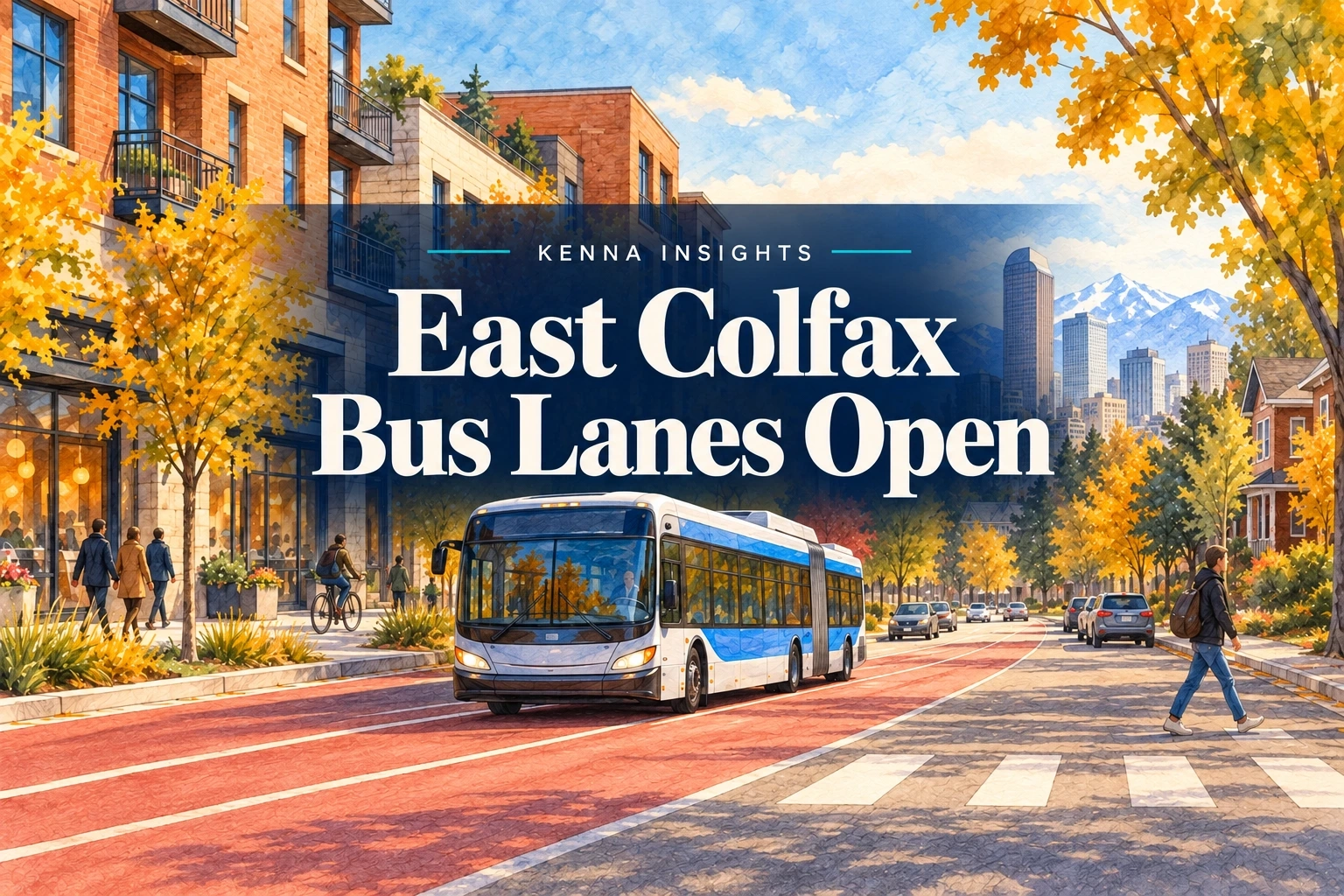
On September 27, 2026, the city opened two dedicated center bus lanes between Broadway and Colorado Boulevard. RTD's 15 and 15L routes began using them, passengers started boarding from new center platforms, and drivers moved into the outside traffic lanes.
For someone considering a home nearby, the redesigned street presents two different questions: How convenient is the new transit access, and how has the driving approach changed?
Both can now be answered on the ground.
Farther east, though, construction continues toward Aurora. The full Lynx bus rapid transit system—with different vehicles, boarding arrangements, and planned service improvements—is still more than a year away.
That's an important distinction when comparing Denver homes near Colfax. Some changes are already part of daily life. Others are still promises about what the corridor will become.
The New Bus Stations Are Operating, but Not All the Way to Broadway
Denver's East Colfax Bus Rapid Transit project has been under construction since October 2024.
The September opening marks the first completed operating section.
Between Broadway and Colorado Boulevard, buses now travel in the two center lanes, separated from ordinary vehicle traffic. The redesign moves bus passengers toward the middle of the street, where new platforms are marked by distinctive white arches.
But the bus-lane boundary and the boarding locations aren't quite the same.
The dedicated lanes begin at Broadway. The first center-platform stations are farther east, at Pennsylvania Street.
There are seven station pairs, or 14 platforms, between Pennsylvania and Colorado Boulevard. The official station map identifies them as Pennsylvania, Downing, Franklin/Park, Josephine/York, Fillmore, Madison, and Colorado. The paired street names reflect the locations of the corresponding platforms, not necessarily one shared intersection.
Stations are generally spaced three to four blocks apart.
That matters more than a listing description saying a condo is two blocks from Colfax.
A home may be close to the roadway without being equally close to a station for the direction someone needs to travel. Reaching a center platform also means using a designated crossing rather than simply waiting at the nearest curb.
For a buyer who expects to use the 15 or 15L regularly, the actual walk from the building entrance to the correct platform is the useful comparison.
What Riders Can Use Today
The stations already have lighting, cameras, public-address systems, and emergency telephones. Near-level boarding is available, and buses can rise and deploy a ramp when needed for accessibility.
Bicycles are carried on racks inside the buses. Riders with bikes enter through the rear door to load them, then move forward to pay.
Other passengers continue boarding and paying at the front door, although they may exit through any door.
Transit Signal Priority is also part of the current operation. The technology helps coordinate buses with traffic signals as they move along the corridor.
These are operating features, not just parts of the future Lynx plan.
RTD calls the arrangement Bus-Only Lane Operations, or BOLO. Its current operating information explains the station and boarding changes.
The distinction becomes important when people hear about faster future service. The new platforms are open, but the full Lynx system isn't running yet.
A Better Bus Connection Can Come With a Different Driving Approach
The most consequential changes for some nearby properties have little to do with riding the bus.
Denver's new center lanes aren't available for ordinary driving, passing, or parking. A raised median separates opposing traffic, and left turns from Colfax are permitted only where designated turn lanes and green arrows allow them.
Return to Downing Street.
There's now a center-platform station there. Yet Downing doesn't appear on Denver's list of permitted left turns from Colfax.
Other intersections offer different movements.
According to the city's September 25 left-turn map, Race and Lafayette have designated left turns from Colfax in both directions. Josephine appears for eastbound left turns, while York appears for westbound left turns.
That's a distinction a buyer might miss when looking at the area on a map.
A condo near Downing could offer a convenient walk to the bus while requiring a different vehicle approach depending on the direction of travel.
The published turn map doesn't establish whether any particular driveway is accessible or how much time a trip will take. It does establish that drivers can't assume every familiar intersection offers the same turning movement.
Pedestrians must use designated crosswalks and walk signals to reach the center stations. Cyclists are directed to designated crossings and nearby bikeways rather than the bus-only lanes or sidewalks.
Parking deserves attention as well.
RTD's September 17 operating notice describes new free, two-hour parking zones along Colfax and on nearby side streets.
That doesn't mean every space follows the same rule, or that an available space is guaranteed.
For someone considering a home without dedicated parking, the actual curb signs and the property's parking arrangements are more useful than a general claim that street parking is available.
The changes don't make every home near Colfax harder to reach. They make access more dependent on the particular block, intersection, and direction of travel.
East of Colorado Boulevard, Construction Is Still Part of the Picture
The September opening covers only the western portion of the project.
East of Colorado Boulevard, Routes 15 and 15L continue in general traffic lanes, with passengers using existing side stops during this phase.
Construction is progressing farther east through Denver and into Aurora.
The city's plan divides the work into five segments: Broadway to Williams Street, Williams to Colorado Boulevard, Colorado to Niagara Street, Niagara to Yosemite Street, and Yosemite to I-225.
Those boundaries matter because a home near the completed section offers a different current experience from one near ongoing work.
Consider the difference between looking at a condo near Capitol Hill and a property farther east toward Yosemite Street.
Near the completed section, the new platforms and traffic configuration are already operating. Farther east, a buyer may encounter temporary construction conditions while waiting for the planned stations and service.
Denver's October construction dashboard has reported differing street conditions from one intersection to another, including closures affecting one side of a cross street while nearby approaches remained open.
Those are dated project updates, not permanent restrictions or guarantees about access to a specific property.
The city's construction information is the appropriate place to check conditions before visiting an address.
There's also a geographic detail worth keeping straight.
East Colfax Avenue extends through multiple Denver neighborhoods and into Aurora. Denver's specifically named East Colfax neighborhood is farther east than the September center-platform opening.
A listing located in the East Colfax neighborhood isn't necessarily near the portion of the street where the new center stations are operating.
That's why a future transit map and today's street conditions can tell different stories about the same address.
Lynx Will Bring More Changes, but It Hasn't Opened Yet
The September milestone is part of a much larger transit project.
According to RTD's September 8 investment update, the full East Colfax project will extend approximately 8.5 miles from Broadway to I-225, with broader service connections between Denver Union Station and the R Line in Aurora.
When the full system launches, Lynx is planned to replace Routes 15 and 15L.
Its new three-door buses will support boarding through multiple doors. Other planned features include fare-payment equipment on station platforms and passenger-information displays.
The roadway arrangement will vary along the corridor.
Dedicated center bus lanes are planned from Broadway to Yosemite Street in Denver. East of Yosemite, the Aurora portion toward I-225 will use side-running stations, with buses traveling in mixed traffic.
So even when the project is complete, it won't provide exclusive bus lanes for the entire route into Aurora.
RTD currently targets late 2027 or early 2028 for full Lynx service.
The plans call for buses approximately every 4.3 minutes during the day and projected transit travel-time reductions of 15 to 30 minutes.
Those are full-project expectations, not measured results from September's opening.
They also don't establish that every resident near Colfax will save that amount of time. A person's journey still depends on departure time, direction, transfers, and destination.
For now, someone planning a trip needs the actual 15 or 15L schedule rather than the future Lynx frequency.
That doesn't diminish the significance of the center-lane opening. It separates an improvement people can experience today from the additional service still being built.
What the Opening Means When Comparing Denver Homes
One advantage of the September milestone is that buyers no longer have to imagine how the completed western section will work.
They can experience it.
Someone comparing Capitol Hill homes with properties in City Park West can evaluate the actual stations, pedestrian crossings, and legal driving approaches near a particular address.
Those neighborhood searches cover broader areas than the transit corridor, so an individual property's proximity still needs to be checked.
Buyers considering Aurora homes along the eastern portion of the project have a different comparison: existing transportation options, present construction conditions, and the planned Lynx service.
There's no verified evidence that the September opening has produced a specific home-price premium or rent increase. Nor is there a measured commute-time improvement that can be assigned to every nearby property.
The useful information is more specific.
For a property being seriously considered, a buyer can walk to the intended platform, check the crossing, and look up a departure on RTD's NextRide. Service alerts can identify current disruptions.
Then comes the driving check: approach the property from the direction normally used, note the legal turns, and see what the curbside restrictions actually say.
Kenna's Colorado home buying tools can help place transportation preferences alongside other property and ownership considerations.
The new Colfax configuration may be an advantage for someone who regularly rides the bus, a change to account for when driving, or both.
And that is what makes the September opening meaningful for a housing decision.
The dedicated lanes are no longer just lines on a project map. People can now see where the bus stops, where they cross the road, and how the street works on the way home.
For a buyer comparing addresses, that experience is more useful than an unproven promise about future commute savings or property values.
If you're considering a home near East Colfax, contact Kenna or use the buyer form below to discuss your Denver-area home search.