.jpg)



Selling a house with a reverse mortgage in Colorado is a deadline job: once the last borrower passes away or moves to assisted living, the heirs get 30 days from the lender's letter to answer and 6 months from the due date to sell, with up to two 90-day extensions. Most of the time it is the adult children selling Mom and Dad's house after the reverse mortgage comes due. The loan gets paid from the sale. If the house is worth more than the balance, the heirs keep the difference. If it is worth less, nobody owes the gap. Here is every step, the 95% rule, and how we sell these homes across the Denver metro.
Call or text 303-955-4220. A live person answers. Not a robot, not a phone tree.
The short answer
30 days To answer the lender From the date on the lender's letter | 6 months To sell or pay off From the due date; up to 12 with extensions |
95% Most the heirs ever pay Of appraised value, if the loan is bigger | $0 Heirs owe on a shortfall FHA insurance covers the gap |
In plain English
- The reverse mortgage gets paid back when the house sells. Nobody pays it out of pocket.
- House worth more than the loan? The heirs keep the extra money.
- House worth less than the loan? The heirs owe nothing. The government insurance pays the difference.
- The catch is time: answer the lender's letter in 30 days and sell inside 6 months, or ask for more time in writing.
When does a reverse mortgage come due?
An FHA-insured reverse mortgage (a HECM, the kind most Colorado seniors have) comes due when one of these happens:
- The last borrower passes away. This is the most common one.
- The last borrower moves out for more than 12 months in a row for health reasons, for example to assisted living, memory care or a nursing home.
- The borrower sells the house or signs it over to someone else.
- Property taxes, homeowners insurance or HOA dues go unpaid, or the house is not kept up.
A spouse who is not on the loan: if the loan started on or after August 4, 2014 and the spouse is named as an eligible non-borrowing spouse, the spouse stays in the house and the loan waits. The spouse has to send the servicer a Non-Borrowing Spouse Certification within 30 days of the borrower's death, so call the servicer the first week. Moving a parent to care? Start with selling the house to pay for assisted living in Colorado and the adult children's guide to a parent's move.
The timeline heirs get to sell, step by step
The clock starts the day the loan comes due: the date of death, or the day a move to care passes 12 months in a row. Count every deadline from that day, except step 2, which counts from the date on the lender's letter.
1 | DAY 1 The loan comes due The last borrower passes away (or has been in care 12 months in a row). The 6-month clock starts today. Call the loan servicer this week. |
2 | WITHIN 30 DAYS OF THE LENDER'S LETTER Answer the lender in writing Pick one: sell the house, keep the house, or sign it over to the lender. The lender orders and pays for the appraisal. |
3 | BY MONTH 6 Close the sale or pay off the loan This is the main deadline. List the house early: the sale has to close, not just go under contract. |
4 | BEFORE MONTH 6 Not closed? Ask for extension #1 Write to the servicer with proof you are selling (listing agreement, offers, contract). HUD approves 90 more days: your new deadline is month 9. |
5 | BEFORE MONTH 9 Still not closed? Ask for extension #2 Send updated proof. HUD approves 90 more days: month 12 is the final deadline. After that, the servicer moves to foreclosure. |
How to get more time: the extension
Where to file: with the loan servicer, the company named on the due and payable letter and on the monthly reverse mortgage statement. There is no HUD form for the heirs to fill out and no HUD office to visit: the servicer sends the request to HUD for you. If the servicer stops answering, call HUD's FHA Resource Center at 1-800-225-5342. Here is the process:
- List the house right away. A signed listing agreement with a real estate agent is the proof HUD looks for.
- Write to the servicer before month 6 and ask for a 90-day extension. Send proof you are working on it: the signed listing agreement, the MLS listing, a signed purchase contract, a loan application if an heir is keeping the house, or the probate case papers if the court is still working.
- The servicer sends the request to HUD. HUD approves 90 days at a time.
- Still not closed by month 9? Ask again with updated proof (offers, showings, a contract). A second 90-day extension takes you to month 12, the last one available.
- Keep copies of every letter, email and fax, write down who you talked to and when, and follow up in writing.
What goes in the extension letter
- The loan number, the borrower's name and the property address
- The date of death (or the date the borrower moved to care)
- Who you are: personal representative, trustee, beneficiary or power of attorney, with the court letters or trust page attached
- What you are doing: "We are selling the house" (or keeping it, or signing it over)
- Your proof: signed listing agreement, MLS listing, showing and offer history, a signed purchase contract, or a loan application
- The request in one line: "Please request a 90-day extension from HUD."
- Your phone and email, and a date: send it at least 30 days before the deadline
What are the odds of getting an extension? HUD does not publish approval numbers. What decides it is paper: a signed listing agreement, an active listing with showings, or a signed contract shows the progress HUD looks for. A request with no listing and no contract is the one that gets turned down. That is why we list these houses in the first weeks, not the last.
No extension, no answer?
If the heirs miss the deadlines and nothing is in writing, the servicer starts foreclosure. A foreclosure still never makes the heirs owe more than the house is worth, but it wipes out any equity a sale would have saved.
Why the payoff goes up every month
A reverse mortgage has no monthly payment. So every month, the interest and the FHA mortgage insurance (0.5% a year on a HECM) get added to the loan balance instead of being paid. Next month, interest is charged on that bigger balance. The payoff keeps climbing until the day the sale closes.
On top of that, the house costs money to hold while it is for sale: property taxes, homeowners insurance, HOA dues, utilities and lawn or snow care. Those come out of the estate every month too. Both costs come straight out of what the heirs keep, which is why pricing the house right the first time matters more than squeezing out the last $5,000.
What waiting costs: the reverse mortgage calculator
Loading the calculator. Example: a $400,000 payoff at 7.5% grows $2,500 the first month; with $700 a month in holding costs, 6 months of waiting costs $19,436.
Example: $400,000 reverse mortgage payoff at 7.5% + $700/month holding costs
| Months until closing | Payoff grows by | Holding costs | Total cost of waiting |
|---|---|---|---|
| 1 | $2,500 | $700 | $3,200 |
| 3 | $7,547 | $2,100 | $9,647 |
| 6 | $15,236 | $4,200 | $19,436 |
| 9 | $23,071 | $6,300 | $29,371 |
| 12 | $31,053 | $8,400 | $39,453 |
Example only: $400,000 balance, 7.5% combined interest and mortgage insurance, compounded monthly; $700 a month for taxes, insurance, HOA and utilities. Your servicer's payoff letter has the real numbers.
The 95% rule: what if the house is worth less than the loan?
A HECM is a non-recourse loan. The heirs never pay more than the house is worth, and the lender cannot come after the estate, your bank account or your own house for the difference.
- Sell it: the house sells for at least 95% of its appraised value and the lender takes the sale money as payment in full. On that kind of sale, closing costs are capped at 11% of the price, and any other liens on the house (a second mortgage, a home equity line, a judgment, unpaid taxes or HOA dues) have to be cleared first.
- Keep it: an heir pays the lesser of the loan balance or 95% of the appraised value, with cash or a new mortgage. Ask our lender partner about this week's Colorado mortgage rates.
- Walk away: sign a deed in lieu of foreclosure and hand the keys to the lender. It has to be recorded within 9 months of the due date. No money changes hands, and the heirs owe nothing. Sign it over within 6 months and HUD allows the lender to pay the heirs a "cash for keys" incentive; ask the servicer for the amount.
Two Colorado examples: the loan balance vs. what the house sells for
| Worth more than the loan | Worth less than the loan | |
|---|---|---|
| Home value | $500,000 | $500,000 |
| Loan balance | $320,000 | $560,000 |
| Paid to the lender | $320,000 | Sale money (at least $475,000, 95% of value) |
| Heirs keep | The rest, after selling costs | $0 |
| Heirs owe | $0 | $0, FHA insurance covers the gap |
Who can sign to sell the house in Colorado?
The lender and the title company need someone with legal authority to sign:
- A personal representative named by the Colorado probate court. See how to sell an inherited house in probate and tips for selling during probate.
- The trustee, if the house is in a living trust.
- The beneficiary named on a recorded Colorado beneficiary deed.
- The parent, or the agent on the parent's power of attorney, if the parent is alive and moving to care.
Open probate in the first weeks: the HUD clock runs while the court works. No plan in place? Read what happens to a house without an estate plan.
Your first 10 days: the checklist
- Call the loan servicer (the number is on the monthly statement), report the death or the move, and ask for the payoff amount and the due date.
- Order death certificates. The servicer, the title company and the court each want one.
- Find the will, trust or beneficiary deed and talk to a probate attorney.
- Keep paying property taxes, homeowners insurance, HOA dues and utilities until closing. Tell the insurer the house is vacant.
- Get a real price: a Smart Pricing Report or a home value report before the lender's appraisal comes in.
- Decide sell, keep or walk away, and answer the servicer in writing within 30 days.
- List it. A signed listing agreement is the proof HUD wants for an extension.
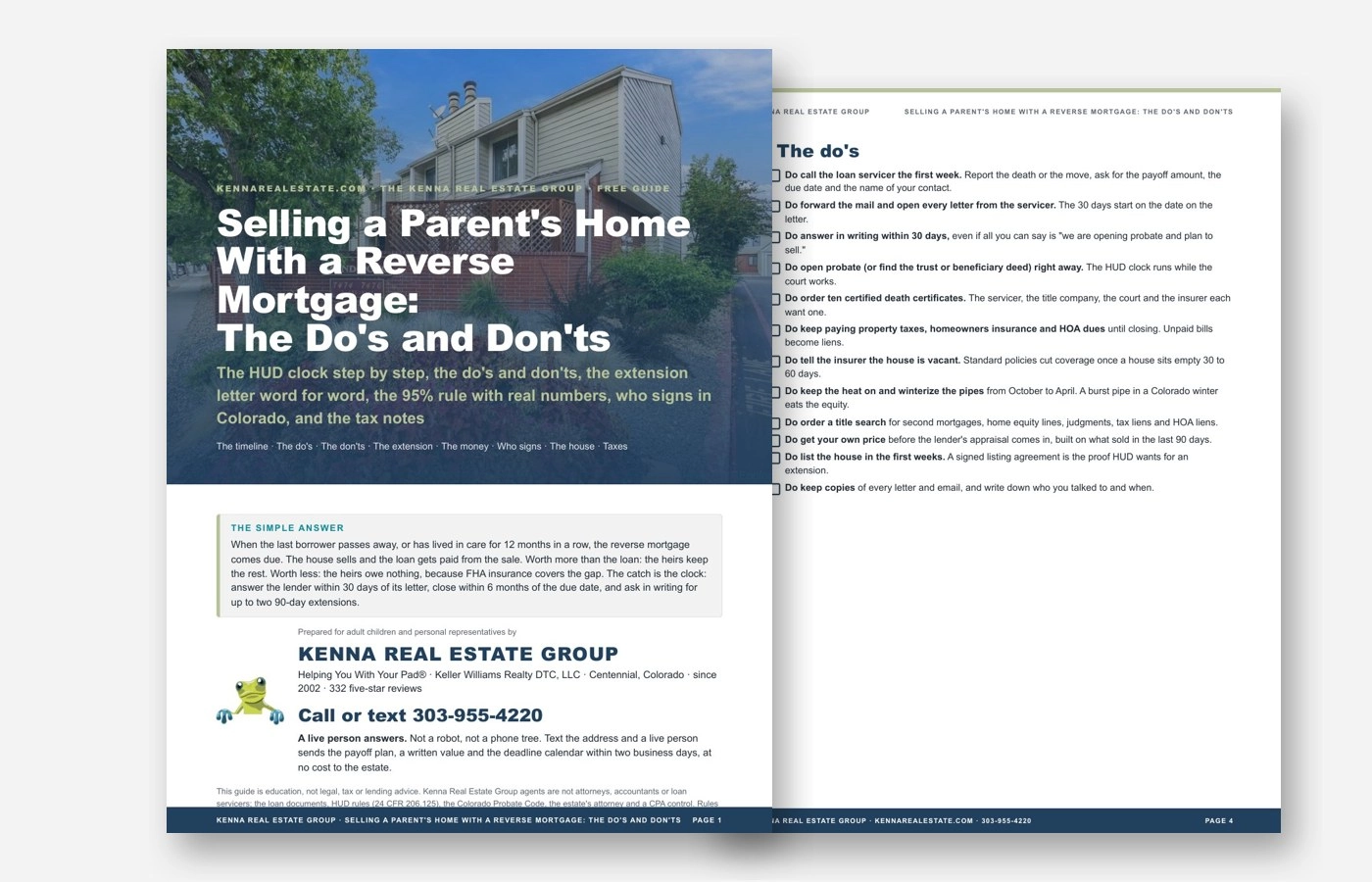
A LOOK INSIDE: THE COVER AND PAGE 4, THE DO'S
FREE GUIDE · 9 PAGES · PDF
Selling a Parent's Home With a Reverse Mortgage: The Do's and Don'ts
- The HUD clock, step by step
- 12 do's and 10 don'ts
- The extension letter, word for word
- The 95% rule with real numbers
- Who signs in Colorado, and the tax notes
Name, email, phone, and the PDF is in your inbox within a minute. A live person follows up once. Or call or text 303-955-4220.
What to look out for
- Saying nothing for 30 days. If the servicer hears nothing after its letter, it treats the loan as having no plan and moves toward foreclosure. Call and write in the first week, even if all you can say is "we are opening probate and plan to sell."
- An extension that gets denied. The servicer starts foreclosure. You can still pay off the loan or close a sale before the foreclosure sale date, but foreclosure fees get added to the payoff and eat into the equity. If the house is underwater, a deed in lieu (recorded within 9 months of the due date) avoids the foreclosure.
- Unopened mail. The due and payable letter goes to the house. Forward the mail and open every letter from the servicer: the 30 days start on the letter's date.
- Other liens. A second mortgage, home equity line, judgment, unpaid property tax or HOA lien blocks the 95% payoff until it is cleared. Order a title search the first week.
- Lowball "we buy houses" offers. If the house is worth more than the loan, every dollar under market comes out of the heirs' pocket. If it is worth less, the lender rejects any offer under 95% of the appraisal.
- Fee scams. Nobody needs to be paid up front to "stop the foreclosure" or "deal with HUD." HUD-approved housing counseling is free.
- A vacant house in a Colorado winter. Tell the insurer it is vacant (standard policies cut coverage once a house sits empty 30 to 60 days), keep the heat on, winterize the pipes and check the house every week.
- Selling or signing before you have authority. Nobody signs a listing or a deed until the court, the trust or the beneficiary deed gives them the right to.
- A private (jumbo) reverse mortgage. The 95% rule and the HUD extensions cover FHA-insured HECMs. A private reverse mortgage follows its own loan papers, so read them or ask the servicer which kind it is.
- Brothers and sisters who disagree. The personal representative or trustee makes the call. Agree on the plan and the price in writing early: the clock does not wait for the argument.
Fix it up or sell it as-is?
Most reverse mortgage homes have not been updated in years. With interest adding up every month, a short list wins: clear it out, clean it, fix anything an inspector or a lender flags, price it right. Weigh the rest with the renovate or sell as-is guide. Need it gone fast? Read selling your house fast in Colorado. Sitting on the market? See why homes are not selling in Colorado and seller concessions.
How the Kenna Real Estate Group handles a reverse mortgage sale
- One call to start. We pull the payoff, the deadline and the value, and give you a plan in writing.
- We work the servicer. We send the listing agreement, offers and paperwork the servicer needs for the HUD extensions.
- Cleanout, repairs and photos handled for out-of-town heirs, with updates by text.
- Pricing built on what sold in the last 90 days, so the house sells before the clock and the interest eat the equity.
- Underwater? We price to the 95% rule and the appraisal, the same way we handle Colorado short sales.
When the parent is downsizing, not moving to care
A parent who sells and moves to a smaller one-level home pays off the reverse mortgage from the sale and keeps the rest. A new reverse mortgage for purchase covers part of the next home. Start with downsizing in Colorado, downsizing tips for Colorado seniors, the best 55+ communities in Colorado, the one-level home checklist and the care funding worksheet. Reverse mortgage basics: Colorado HECM reverse mortgages.
We sell these homes in Denver, Aurora, Lakewood, Littleton, Centennial, Highlands Ranch, Arvada and the rest of the Front Range.
More reverse mortgage, probate and senior-move guides
- Reverse mortgage specialists in Colorado: how the loan works
- Using a reverse mortgage to buy a Denver-area home
- Reverse mortgages and Colorado 55+ homes
- Selling a parent's house in Colorado and the inherited-home checklist
- Probate real estate agents in Colorado and Denver probate realtors
- Selling a home to pay for assisted living
- Adapting a house for aging in place and the Colorado 55+ community map
Free help before you decide
A HUD-approved housing counselor explains your loan for free: 1-800-569-4287. For the will, trust or probate questions, talk to a Colorado probate attorney. For taxes, talk to a CPA: heirs receive a stepped-up tax basis on an inherited house.