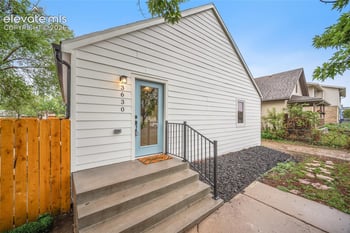
$345,000
Pending
3
Beds
2
Baths
1538
Sqft
0.0202
Acres
3300 W Florida Ave #48, Denver, CO 80219
MLS#: 9397860
.jpg)



Couples in Colorado combine assets to buy a first home because two incomes qualify for a larger loan, two savings accounts reach a Front Range down payment sooner, and one mortgage payment costs less than two rents. The purchase works when three documents are right before closing: the deed vesting (joint tenancy or tenancy in common), the loan application (whose credit and income the lender uses), and a written co-ownership agreement that states what happens on a split, a death or a missed payment.
This guide covers all three for married and unmarried co-buyers in the Denver metro, plus the Colorado rules that decide who owns what when the relationship changes. Read the first-time home buyer guide for Colorado alongside it.
The lender pulls three bureau scores for each borrower, takes the middle score for each, and prices the loan on the lower of the two middle scores. A borrower at 760 paired with a borrower at 640 gets a 640 rate. Both incomes count and both debts count. That produces three choices before you apply:
Gift funds from either partner's relatives are allowed with a signed gift letter and a documented transfer. On conventional loans a gift from a fiancé or domestic partner is allowed as well. Get an underwritten pre-approval with both of you on the file and one with the stronger borrower alone, and compare the two rates; the Colorado mortgage pre-approval guide lists the documents each of you brings. The Kenna Real Estate Group works with Mike Oswald, VP of Mortgage Lending at Rate, NMLS 261003, Equal Housing Lender. You are free to use any lender. Compare loan programs on the Colorado home financing guide.
At closing the title company asks how you want to hold title. Colorado law creates a tenancy in common unless the deed states that the grantees take as joint tenants, so the choice has to be made on purpose.
| Question | Joint tenancy | Tenancy in common |
|---|---|---|
| Ownership shares | Equal, always | Any split: 50/50, 70/30, 90/10 |
| When one owner dies | The survivor owns the whole home automatically, no probate | The deceased owner's share passes by will or intestacy to heirs |
| Can one owner sell or give away a share alone? | Yes, and doing so converts the title to tenancy in common | Yes |
| Who uses it | Married couples and partners who want survivorship | Partners with unequal contributions, friends, relatives |
Tenants in common who want survivorship without equal shares record a Colorado beneficiary deed naming each other, which transfers the share at death outside probate and is revocable while both are alive. Ask a Colorado real estate attorney to draft it with the co-ownership agreement.
Married couples have the Colorado dissolution statute to divide a home. Unmarried co-buyers have nothing unless they write it. A co-ownership agreement is a private contract, drafted by a Colorado attorney for $500 to $1,500, that answers the questions the deed does not:
Sign it before closing, not after. Once the deed records, neither owner has a reason to agree to anything.
No. Colorado is an equitable distribution state. In a divorce, the court divides marital property in the proportions it finds fair after weighing each spouse's contribution, the economic circumstances of each, and the value of the property set apart to each. Fair does not mean equal, and the home is not split 50/50 by rule.
Property acquired during the marriage is marital property regardless of whose name is on the deed. Property either spouse owned before the marriage is separate property, but the increase in its value during the marriage is marital. A partner who brings $60,000 of savings to a joint purchase two years before the wedding should document it in the co-ownership agreement and keep the paper trail, because after the marriage the growth in equity is shared even where the contribution is not. Anyone buying before a wedding should have a Colorado attorney review the agreement against a prenuptial agreement.
Unmarried co-owners follow the co-ownership agreement. Without one, either owner has the right to file a partition action in district court, and the court orders the home sold and the proceeds divided, with each side's contributions argued out in front of a judge at a cost that exceeds the attorney's fee for the agreement many times over. The lender does not care who moved out; both borrowers stay on the note until it is refinanced or paid off, and a missed payment hits both credit files.
Married co-owners go through the dissolution process, where the home is valued, one spouse keeps it and refinances or the home is sold. The Kenna Real Estate Group runs a dedicated program for that sale through its divorce site, Divorce Workshops Colorado, and our post on real estate advisors for divorce in Colorado explains how the home is handled during the case.
Colorado recognizes common-law marriage. Unmarried partners who hold themselves out as married, share finances and file jointly risk a court finding them married, which pulls the home into the marital estate. State in the co-ownership agreement that the parties are not married and do not intend to be.
On most 3-percent-down conventional first-time programs, at least one borrower must be a first-time buyer, defined as no ownership interest in a principal residence in the last three years. A partner who owned a condo in Lakewood two years ago does not disqualify the purchase; the other partner carries the first-time status. Colorado Housing and Finance Authority (CHFA) programs and metroDPA use their own income limits and education requirements. See first time home buyer programs in Colorado for each program's rules.
The Kenna Real Estate Group, Keller Williams DTC, helps Colorado couples and co-buyers get two pre-approvals to compare, pick the vesting with the title company, and close with a co-ownership agreement in the file instead of a handshake. Call or text 303-955-4220. A live person answers. Not a robot, not a phone tree. Then search every home for sale in Colorado.
Questions about any home in Colorado? Call or text 303-955-4220. A live person answers.
As tenants in common with equal shares. Colorado creates a joint tenancy with survivorship only when the deed says the grantees take as joint tenants, so tell the title company which vesting you want before the deed is drafted.
Yes. Conventional, FHA and VA lenders allow a non-borrowing co-owner on title. Your partner then owns a share of the home and owes nothing on the loan, and the co-ownership agreement should say how that share was earned.
The lender prices the loan on the lower middle score, so yes on a joint application. Run a second pre-approval with the 760 borrower alone and compare; the higher rate sometimes costs more than the extra income is worth.
The value at the wedding date stays separate when it is documented; the increase in equity during the marriage is marital property divided equitably. Keep the closing statement and the down payment records.
The lender holds both borrowers responsible and reports a missed payment on both credit files. Your remedy against your partner is whatever the co-ownership agreement says, or a partition action in district court if there is no agreement.
Hold title as tenants in common with the shares stated, then each records a Colorado beneficiary deed leaving their share to the other. The share transfers at death without probate and the deed is revocable while both are alive.
Yes, when each owner has lived in the home as a principal residence for two of the last five years. Each excludes up to $250,000 of gain on their own share of the sale.