.jpg)


Indoor air quality is a real issue in Colorado, not just a marketing claim: wildfire smoke drifts in during summer, the dry climate keeps windows shut for months at a stretch trapping dust and allergens, and high pollen counts along the Front Range send particles inside every time a door opens. An air purifier addresses part of that, and it's worth knowing what it fixes and what it doesn't before buying one. This guide covers the local conditions that make Colorado's air different, how to size and place a unit, and where the money is better spent on whole-home filtration instead.
Most people assume outdoor air is the bigger problem, but a closed-up house concentrates what's already inside: cooking exhaust, cleaning products, pet dander, and dust. Colorado adds a few conditions that make this worse than average:
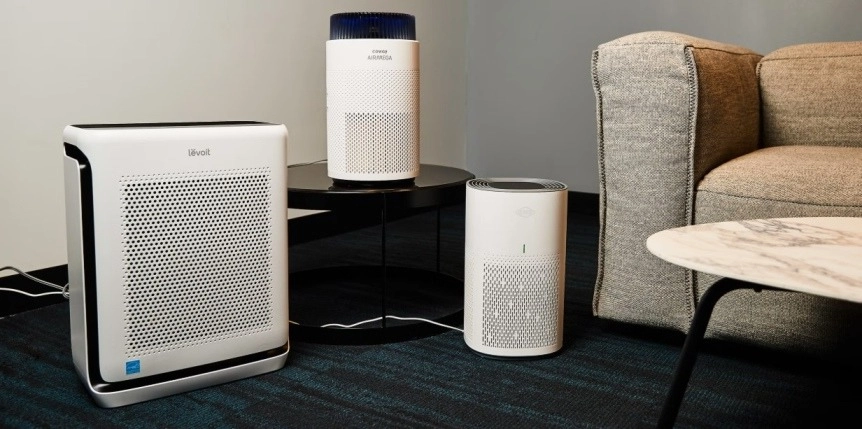
A purifier pulls room air through a series of filters and returns cleaner air to the space. Most systems layer a pre-filter for large particles, a HEPA filter rated to capture particles down to 0.3 microns, and sometimes a carbon layer for odors. Air runs through the unit continuously while it's on, so placement and run time both affect how much of a room's air actually gets filtered in a day.
A true HEPA unit sized for the room reduces the fine particulate matter that makes up wildfire smoke, which is the main health concern during a smoke event. It won't remove the smell entirely without a carbon filter stage, and it can't compensate for open windows or a door propped open during a smoke advisory. Running the purifier continuously, not just switching it on when smoke is visible, keeps particulate levels lower between events, rather than reacting only once smoke is already visible outside.
A good air purifier's coverage rating tells you the largest room size it can clean effectively in a set amount of time. Buy for the actual square footage of the room, not the whole house, unless the unit is rated for whole-home use. Beyond size, check:
A portable unit cleans one room at a time. A whole-home option upgrades the furnace's own filter to a higher MERV rating, or adds a dedicated air handler filtration accessory to the existing HVAC system, and treats every room the ductwork reaches. A Colorado home with a newer, well-sealed envelope gets more out of whole-home filtration, since a tighter house recirculates the same air repeatedly through the system. An older, drafty home loses more of that benefit to air exchange with the outside, and a portable unit in the bedroom does more good per dollar in that case. Either approach is worth pricing against the other before committing to one.
Bedrooms are the highest-value placement, since a person spends more uninterrupted hours there than anywhere else in the house. Living rooms and home offices are the next priority, both high-traffic spaces where dust and particles accumulate fastest. A unit near an entryway catches pollen and clay dust before it spreads through the rest of the house.
No. Radon is a gas, not a particulate, and a standard HEPA and carbon air purifier does not remove it. Colorado has above-average radon potential in large areas of the Front Range, and the only real fix for a radon reading above the EPA's action level is a dedicated sub-slab mitigation system, not an air purifier. Every Colorado home purchase is worth a radon test regardless of what air purification equipment is already in place.
Filters need replacement on the manufacturer's schedule, commonly every 6 to 12 months for a HEPA filter depending on run time and local particulate levels. A Colorado home running the unit through a full wildfire season replaces filters closer to the 6-month mark. Keep the unit clear of walls and furniture so air flows freely, and close doors and windows while it runs so it isn't fighting a constant stream of new outdoor particles.
Read the coverage rating against the actual room, not the marketing headline on the box. Confirm the filter is true HEPA, not a marketing term like "HEPA-type," which is a lower filtration standard. Price out a year of replacement filters, not just the unit itself. And check the noise rating on the lowest fan speed if the unit is going in a bedroom, since a purifier loud enough to disrupt sleep gets switched off within a month, which defeats the purpose entirely.
Buyers increasingly ask about home wellness features during a showing, alongside energy efficiency and updated systems. A clean-running HVAC system, documented filter changes, and a newer furnace or air handler read as a well-maintained home. An air purifier itself is a portable appliance and doesn't factor into an appraisal, but a documented maintenance history on the home's air systems does support a buyer's confidence in the property.
The Kenna Real Estate Group helps Colorado buyers weigh a home's mechanical systems, HVAC and air handling included, before making an offer, and helps sellers highlight the maintenance that matters to today's buyers. Call or text 303-955-4220. A live person answers. Not a robot, not a phone tree. Ready to look? Search every home for sale in Colorado.
Questions about any home in Colorado? Call or text 303-955-4220. A live person answers.
Wildfire smoke, dry air that keeps dust airborne, and high Front Range pollen counts make indoor air quality a real issue here, more so than in a humid climate where moisture settles particles faster.
A true HEPA unit sized for the room reduces the fine particulate matter in wildfire smoke. It won't remove every trace of the smell without a carbon filter stage, and it can't compensate for open doors and windows.
Buy based on the coverage rating for the actual room's square footage, not the whole house, unless the unit is specifically rated for whole-home use.
No. Radon is a gas, not a particulate, and standard HEPA and carbon filters don't remove it. A radon reading above the EPA's action level needs a dedicated sub-slab mitigation system.
Every 6 to 12 months on the manufacturer's schedule, closer to 6 months for a home running the unit continuously through a full wildfire season.
Bedrooms first, since that's where a person spends the most uninterrupted hours. Living rooms and home offices are next, followed by a unit near the entryway to catch pollen and dust before it spreads.
Yes. Low humidity keeps dust and particles airborne longer than in a humid climate, where moisture pulls them out of the air faster, which is part of why filtration matters more here.
An air purifier itself doesn't factor into an appraisal since it's a portable appliance, but a documented maintenance history on the home's HVAC and air systems supports buyer confidence during a showing.