New - 1 Hour Ago


$414,000
Active
3
Beds
3
Baths
2104
Sqft
--
Acres
1050 S Monaco Street Pw #103, Denver, CO 80224
MLS#: REC6347760
.jpg)


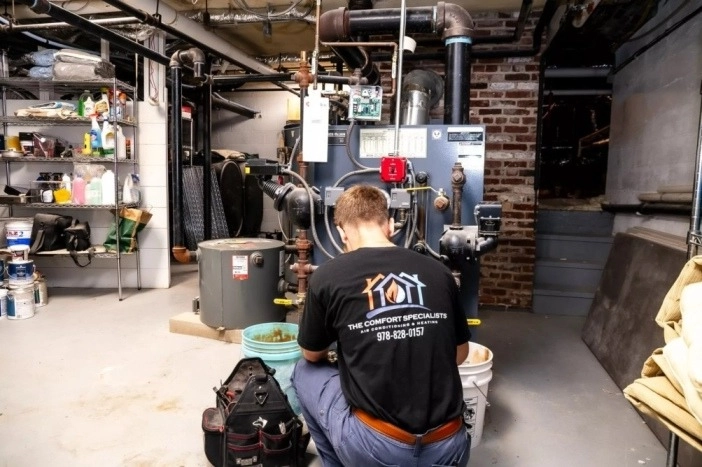
A hot-water boiler with radiators heats a meaningful share of Denver's pre-1960 housing stock, while forced-air furnaces with ductwork heat most homes built after that. Each system has its own service needs: a boiler runs on annual maintenance and occasional radiator bleeding, while a duct system depends on sealed, insulated ductwork to deliver the heat a furnace produces.
A home with cast-iron radiators, exposed pipes running to each room, and no visible ductwork runs on a boiler; a home with vents in the floor or ceiling and a central furnace runs forced air. Denver neighborhoods with a large share of pre-1960 construction, including parts of Capitol Hill, Berkeley, and Sunnyside, still have working boiler systems in a meaningful number of homes.
A regional contractor's published service list gives a sense of the typical scope of a boiler tune-up appointment; a Colorado homeowner is free to use any licensed local contractor for the work, and can confirm a contractor's listed service location before scheduling.
Leaky duct joints, crushed flex duct in a crawlspace, and disconnected sections in an attic waste 20% to 30% of a furnace's heated or cooled air before it reaches a vent. Duct sealing with mastic or foil tape at accessible joints runs $500 to $1,500 for a typical Front Range home and pays back within a few heating seasons through lower gas and electric use.
A furnace adjusted for Denver's 5,280-foot elevation already runs at a lower input rate than the same model at sea level, so a leaky duct system wastes a larger share of the conditioned air it does produce. Sealing ducts and adjusting the gas input together get more heat to each room without oversizing the furnace itself.
Radiator heat delivers steady, even warmth room by room, and many owners of a historic Denver home keep the original cast-iron radiators for that reason, pairing the boiler with a separate central air system or window units for summer cooling since a boiler alone has no cooling function. A buyer touring a historic home checks whether the boiler and radiators work as a full system or need repair before making an offer.
A home losing 25% of its conditioned air to duct leaks pays for that waste every month on its Xcel Energy bill, gas for heating and electricity for cooling. Sealing ducts is one of the lower-cost efficiency projects on the Front Range measured against the bill savings it produces, ahead of most window or insulation upgrades in payback speed.
Colorado requires HVAC contractors performing gas and mechanical work to hold the appropriate local license in the city or county where the work happens; Denver, Aurora, and Colorado Springs each run their own licensing and permitting process. A homeowner confirms a contractor's license number and pulls the permit history for any major boiler or duct project before hiring, and asks for a written estimate that names the specific part or duct section, not a single bundled price for the whole job.
A buyer's home inspector checks a boiler's age plate, looks for corrosion and mineral staining around fittings, tests the pressure relief valve, and checks that the expansion tank still holds air rather than water. On the duct side, an inspector checks accessible runs in the attic, crawlspace, and basement for disconnected sections, crushed flex duct, and missing insulation, though most standard inspections do not include a full duct-leakage test with specialized equipment.
A buyer who wants a full duct-leakage test or a deeper boiler inspection hires a specialist separately during the inspection objection period; the standard home inspection gives a starting point, not the full picture, on either system.
A boiler or duct system in documented good repair, with service records and a recent tune-up, removes a negotiating point during the inspection objection period. The Preparing and Adding Value Before Selling guide covers which mechanical records to keep on hand for a listing, and the Kenna Real Estate Group's Smart Pricing Report weighs mechanical condition against comparable sales.
The Kenna Real Estate Group helps buyers touring a historic Denver home understand a boiler system and helps sellers document HVAC condition before listing. Call or text 303-955-4220. A live person answers. Not a robot, not a phone tree. Search every home for sale in Colorado to see what's on the market right now.
Questions about any home in Colorado? Call or text 303-955-4220. A live person answers.
A gas boiler and a gas furnace run close in operating cost for the same square footage; the bigger cost difference comes from duct leaks and distribution losses that a boiler's piped system does not have.
Yes, a boiler-heated home adds central air or ductless mini-splits as a separate cooling system, since a boiler provides no cooling on its own.
15 to 30 years with annual maintenance, longer than most forced-air furnaces, though the circulator pump and other components need periodic replacement.
$500 to $1,500 for a typical home, paid back within a few heating seasons in most homes through lower gas and electric bills.
No, though many owners keep it for the even, quiet heat it provides and add central air or mini-splits alongside it rather than switching to forced air.
Denver, Aurora, and Colorado Springs require a permit for duct replacement or significant modification; minor sealing and patching does not need one in most cases.
The circulator pump moves hot water through a boiler system's pipes; most last 10 to 15 years before a bearing failure requires replacement, running $400 to $900 installed.
Yes, an inspector checks a boiler's age, corrosion, and pressure relief valve, and checks accessible ductwork for leaks, disconnections, and insulation.