.jpg)


Curious about what you could earn as a Colorado real estate agent? Plan on about $75,000 a year before brokerage splits and expenses—the midpoint we found in fresh 2024–2025 data.
Public salary sites fluctuate from under $50,000 to six-figure salaries because commissions, not paychecks, drive income. We sifted the latest numbers to pinpoint the actual middle, flag the variables that move earnings up or down, and share proven tactics to grow your take-home pay. You'll see straightforward commission math, city-by-city breakdowns, 2024 rule changes, and strategies top producers swear by. Already scouting roles? Tools like AdzunaApply IQ can surface openings and automatically fill out applications while you read.
The official baseline from the Bureau of Labor Statistics
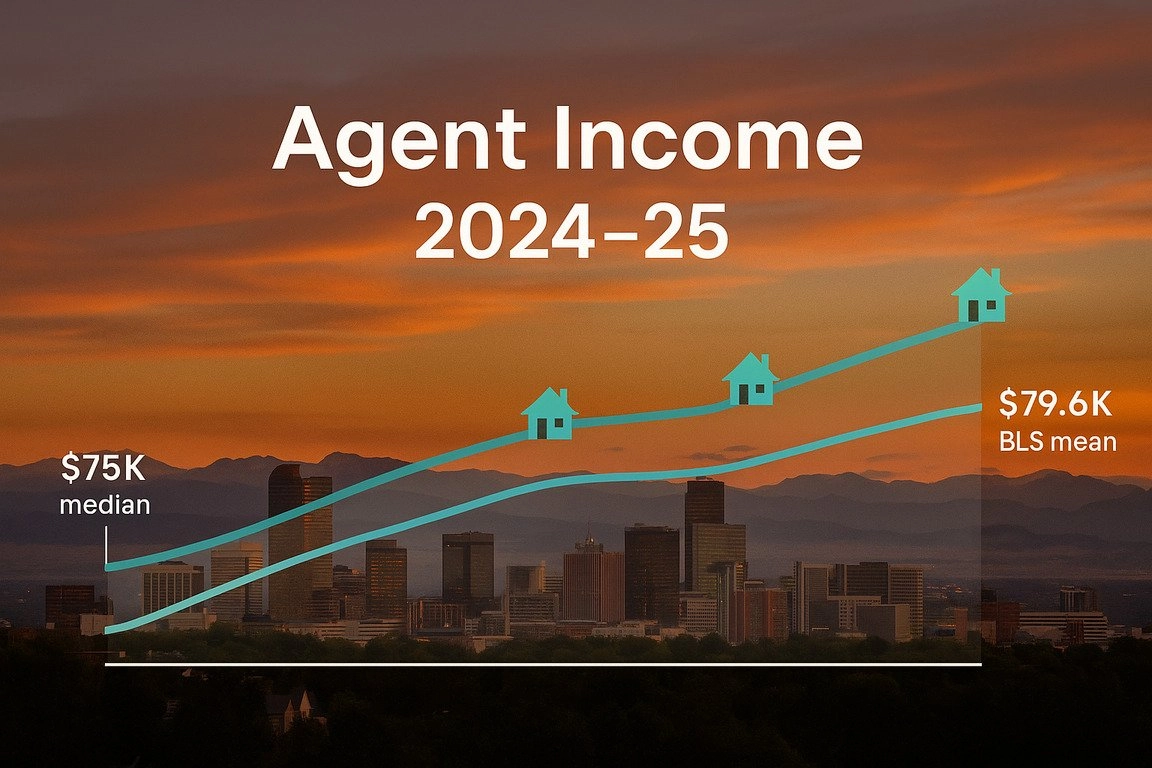
The May 2024 Occupational Employment and Wage Statistics release reports that Colorado real estate sales agents earn an average income of $79,610, with the 50th percentile figure in the mid-$70,000s. That narrow spread—less than $5,000—shows that six-figure outliers do not significantly impact the average, as they do not distort the curve. In plain English, a full-time Colorado agent who consistently closes deals can expect to earn approximately $75,000 before brokerage splits and expenses. The rest of this guide explains how commission terms, deal volume, and market shifts move you above or below that line.
Why the numbers seem to clash
Scroll through three salary sites and you might think they're describing different careers:
- Job ad aggregators (Indeed vs. Adzuna). Live postings rarely agree. During the week of August 29, 2025, Indeed indexed approximately 1,600 Colorado real estate agent ads and quoted an average advertised pay of $113,026. The same week, Adzuna, which listed 243 Colorado real estate agent openings at an average advertised salary of $82,485, returned a far lower figure. Both numbers reflect potential gross commission rather than take-home pay, and each board's mix of rookie and top-producer ads bends the average in its own direction.
- Self-reported earnings (Glassdoor). Colorado agents who share pay details on Glassdoor report a median total compensation of $245,344 (base plus commission) based on 9,038 submissions as of June 6, 2024. High earners are more likely to report results, so this number tends to skew upward.
- Conservative panels (Salary.com). Traditional salary surveys track W-2 wages. The January 1, 2025, update lists an average of $47,936 for Colorado real estate sales agents, as most commissions are reported as business income rather than payroll.
Separate the data by methodology, and the picture clears: full-time agents who close steady deals usually settle between the BLS median (about $75,000) and the higher job-board averages. Part-timers and newcomers explain the Salary.com low end, six-figure veterans lift the Glassdoor median, and the gap between Adzuna and Indeed comes down to sample size and listing mix.
Bottom line: before trusting a salary number, ask who reported it, when, and what they counted as pay.
Commission basics: no salary, just the sale
Colorado agents earn almost everything at the closing table. Here's the typical cascade:
- Total commission. According to Bankrate, sellers in Colorado paid an average of 5.29 percent in combined agent fees in 2024, slightly below the national average of 5.32 percent.
- Side-by-side split. The commission pool is typically divided 50/50, with approximately 2.6% allocated to the listing side and 2.6% to the buyer's side.
- Brokerage cut. Each agent then shares a slice with their brokerage. Newer Colorado agents often start on a 70/30 split (you keep 70 percent, the firm holds 30 percent), though caps and team models vary, according to HomeLight.
Putting real dollars to it:
Sale price: $500,000
Total commission (5.29%): $26,450
Your side (2.6%): ≈ $13,000
After a 70/30 split: ≈ $9,100 before taxes, fees, and marketing.
If a month ends with no closings, income drops to zero. The Washington Post reports that recent NAR rule changes, shifting how buyer agents are paid, make pipeline management even more critical. The following section shows where that $9,100 goes once expenses, taxes, and tech subscriptions have taken their share.
Denver metro: high prices, high competition
Denver tops Colorado's charts because bigger price tags translate into bigger commission checks. Data from Realtor.com shows the median sold price reached $545,300 in January 2025, so a single 3 percent side can generate about $16,000 before splits. Indeed's job-ad data lists an average advertised pay of $107,169 for Denver agents across 302 postings updated as of July 18, 2025, a figure that aligns with the BLS mean once part-time activity is excluded from the sample.
Two forces squeeze that upside:
- Cost of living. According to RentCafe, Denver's overall cost of living is 9% higher than the national average, with housing expenses 23% above the national average. As a result, every commission dollar stretches less than it does in Pueblo or Grand Junction.
- Crowded roster. The Colorado Division of Real Estate's 2025 roster lists over 13,000 active licensees, ranking Denver among the most agent-dense markets in the western United States.
This pressure widens the income curve. Niche veterans—luxury condos in Cherry Creek or relocation buyers in Aurora—often clear six figures, while many new or part-time agents close only a few deals and sit below the $75,000 state median. Succeeding here calls for strict marketing budgets, a clear specialty, and polished listing presentations.
Ready to discover your perfect home in Colorado?
Call or Text Kenna Real Estate Group at 303-955-4220 to get personalized assistance from our expert real estate agents. Find out what your home is worth in today's market.
Colorado Springs: plenty of agents, thinner slices
Colorado Springs looks lucrative on paper. Indeed's job ad data lists an average advertised agent pay of $99,086 across 118 postings updated as of July 17, 2025. The catch is supply. A 2024 Colorado Sun analysis found the metro's location quotient for real estate agents to be 3.05—roughly three times the National concentration—while closed home sales fell 25 percent in 2023.
What that means for your wallet:
- Smaller pie. The median sold price in January 2025 is $450,000, approximately $150,000 below the Denver median. Therefore, a 3 percent side of a deal generates roughly $13,500 before splits.
- More forks. About 4,200 REALTORS® pursue those deals, so even full-time producers fight for listings.
Colorado Springs still pays when you lean into its niches—military relocations, new-build suburbs, or investor flips. Success here demands fast follow-up systems; skip a quarter of prospecting and those thinner slices vanish.
Fort Collins and Pueblo: smaller cities, surprising paydays
Job-ad data backs the buzz. Indeed lists an average advertised pay of $133,986 for Fort Collins agents (85 postings, as of August 25, 2025) and $123,881 for Pueblo (58 postings, as of September 5, 2025).
What explains the six-figure headlines?
- Smaller roster, bigger spotlight. Approximately 1,800 active licensees work across Larimer County, and 1,100 in Pueblo County, so a handful of dominant teams heavily influence the averages.
- Commission math still works. Realtor.com figures indicate a median sold price of $545,000 in Fort Collins and $252,000 in Pueblo. A 2.6 percent side of a Fort Collins deal yields roughly $14,200 before splits; in Pueblo, it is closer to $6,600, but lower splits and leaner marketing expenses help close part of that gap.
- The cost of living is lower. BestPlaces sets Pueblo's overall cost index at 88.6 (approximately 11 percent below the United States average) and Fort Collins at 117.5, which is significantly lower than Denver's 128.7, allowing each commission dollar to stretch farther.
Bottom line: Agents who specialize early—such as those focusing on new-construction tracts in Fort Collins or downtown loft conversions in Pueblo—often turn those "surprising" averages into a steady baseline.
Factors that shape Colorado agent income
Experience: the snowball effect
NAR's 2025 Member Profile reveals that agents with 16 years or more of experience in the business earned a median of $92,500 in 2023, while those with two years or less of experience managed only $8,100. Each closing adds past clients who send friends, stacking deals without extra lead spend. The first year can be challenging—licensing classes, open houses, and numerous "we're just browsing" calls—but persistence pays off. Many Colorado agents triple their take-home by year three once repeat and referral business kicks in. Stay long enough for momentum to build, and the snowball starts pushing itself.
Market conditions: riding the economic tide
Real estate income fluctuates in tandem with the broader economy. Colorado's pandemic surge proved it. Denver-metro closings climbed 6 percent and median prices rose 18 percent in 2021, while 30-year mortgage rates hovered near 3 percent. Then rates spiked. Freddie Mac's survey shows the 30-year fixed average at 7.08 percent for the week of October 27, 2022, more than double the rate for the same period the prior year. Buyers paused, and the ripple was immediate:
- Denver-metro closed listings finished 2022 down 21 percent compared with 2021.
- Colorado Springs sales fell 25 percent in 2023, according to the Colorado Sun.
Fewer closings shrink the commission pool for every agent. The takeaway: build a business that flexes. Stockpile cash during boom quarters, diversify lead sources, and master tactics such as rate buy-downs to keep hesitant buyers moving. Pros who pivot quickly often gain market share that pays dividends when the tide turns again.
Brokerage and commission split: the deal behind the deal
Every commission check passes through your brokerage first, and the math shifts dramatically based on where you hang your license.
| Model | Typical split and cap (2025) | Best for | Trade-offs |
| Franchise (Keller Williams) | 70/30 until a $25,000 “company-dollar” cap, then 100 percent | New agents who want brand strength, office support, and mentorship | Larger slice early in the year |
| Franchise (RE/MAX) | 95/5 split or 80/20 with a monthly desk fee; caps vary by office | Experienced agents who supply their own leads | Higher fixed costs |
| Cloud (eXp Realty) | 80/20 split, $16,000 cap | Agents comfortable in virtual offices | Limited in-person support |
| 100 percent boutique | Keep 100 percent; $500–$1,000 per deal with no cap | High-volume pros who own their lead flow | You cover all tools and marketing |
Putting numbers to it: on a $600,000 Denver sale, the 2.6 percent side commission equals $15,600. On a 70/30 split, you keep $10,920; once you pass the cap, that same deal nets the full $15,600, a $4,680 swing for identical work.
Key takeaways
- Early career: pay more for a split that includes leads, training, and compliance help.
- After building a pipeline, consider renegotiating or transitioning to a capped or 100 percent model to widen your margin.
- Always run net numbers: desk fees, tech stacks, and transaction charges can erase a "better" split in disguise.
Specialization and niche: riches in focused pockets
Generalists earn a living; specialists build wealth. Colorado rewards agents who dominate one slice and become the go-to name.
- Luxury mountain homes. Realtor.com data shows the median sold price in Aspen reached $2.8 million in January 2025. One 3 percent side nets $84,000 before splits. Achieving the Certified Luxury Home Marketing Specialist (CLHMS) designation signals to clients that you're well-versed in the nuances of privacy, tax planning, and tailored staging.
- Commercial corridors. CBRE MarketView reports that industrial vacancy along Denver's I-25 tech spine fell to 3.6 percent in Q2 2025, pushing lease rates above $12 per square foot. CCIM-credentialed brokers who secure a 50,000-square-foot lease can earn five-figure commissions from a single signature.
- Builder reps. The U.S. Census notes the Front Range issued 19,400 single-family permits in 2024, and many developers pay on-site agents a flat 2 percent per home. Selling an entire 40-lot phase matches Denver's average agent income inside one subdivision.
- Investor pipelines. AirDNA reports Colorado added 3,900 new short-term rental licenses in 2024, and investor buyers crave cap-rate expertise. Become the "house-hack duplex" resource in Colorado Springs, and the same client may close three doors a year.
Select a segment that aligns with your skills, then invest heavily in mastery. Tour every model home, join CCIM courses, or study luxury-staging trends. When prospects sense you own that corner of the market, price objections fade and referrals multiply.
Network and reputation: the referral flywheel
Referrals are not a nice-to-have; they drive the success of most top producers. NAR's 2024 Buyer–Seller Profile shows 43 percent of buyers and 38 percent of sellers chose their agent through a friend or family referral, while another 28 percent of sellers hired the same agent again. In short, two out of three clients arrive because someone mentions your name.
How to keep the flywheel spinning:
- Deliver a "wow" moment. Solve inspection issues the same day or show up with moving-day pizza; clients remember service that lowers stress.
- Systemize touch points. Schedule three simple contacts per past client each year: a spring equity update, an autumn Broncos-schedule fridge magnet, and a birthday text. A database of 100 closed sides equals 300 brand impressions for the cost of bulk postage.
- Spotlight clients, not yourself. Post their key-handoff photo on Instagram and tag the local taco shop they love. The post feels genuine and quietly broadcasts your results.
- Guard every review. Reply to Google and Zillow ratings within 24 hours. One unanswered three-star review can outweigh ten perfect closings in a prospect's eyes.
Work this plan, and you start hearing strangers say, "I see your signs everywhere." Marketing costs drop, referrals steer the growth curve, and each year's database compounds like interest in a well-managed portfolio.
Ready to discover your perfect home in Colorado?
Call or Text Kenna Real Estate Group at 303-955-4220 to get personalized assistance from our expert real estate agents. Find out what your home is worth in today's market.
Commission models in Colorado: maximizing your take-home pay
Colorado brokerages fall into three broad buckets, and each slices your commission and risk differently.
| Model | Typical split and cap (2025) | Best for | Watch-outs |
| Franchise (Keller Williams, RE/MAX) | 70/30 until a $20,000–$25,000 company-dollar cap, then 100 percent | New agents who value training, office culture, and floor time | Larger slice early in the year |
| Cloud brokerage (eXp, Real) | 80/20 with a $12,000–$16,000 cap; virtual office | Mid-career pros comfortable online | Limited in-person mentoring |
| 100 percent boutique | Keep 100 percent; pay $500–$1,000 per deal or $750 per month desk fee | High-volume agents with their own lead flow | You cover all tech, signs, and support |
The hidden line items
Colorado REALTORS® spend, on average:
- $550 each year for MLS, state, and local dues
- $40–$70 per month for errors-and-omissions insurance
- $3,500–$7,000 annually for marketing, signs, lockboxes, and client gifts
On a $600,000 Denver closing at a 2.6 percent side commission:
- Gross side: $15,600
- 70/30 split: $10,920
- Tax set-aside (about 25 percent): –$2,730
- Deal expenses (photography, transaction coordinator, yard sign ≈ $450): –$450
Net: roughly $7,700, lower if the annual cap is still unmet.
Negotiating leverage
After a solid year (resulting in approximately $3 million in volume), many Colorado brokers consider a better split or reduced cap. Arrive prepared with:
- Prior-year volume and average days on market,
- Client-satisfaction scores or Google reviews, and
- A clear plan to grow transactions.
Even a five-point swing (70/30 to 75/25) on $10 million of production adds $13,000 to your pocket.
2025 commission headwinds
Following the November 2024 NAR settlement, buyer agents often negotiate fees directly with clients instead of relying on the seller side. Broker responses include:
- Menu pricing, such as flat $2,500 buyer-agency packages,
- Greater focus on listing representation and dual-side deals, and
- Lower caps are designed to keep agents during the transition.
Takeaway: model choice matters as much as volume. Compare splits, caps, and fees line by line, then select the structure that maximizes net income rather than headline numbers.
Treat it like a business: plan, measure, adjust
Top Colorado earners run a profit plan rather than wing it. Start with a net-income target and work back into the numbers:
- Goal: $120,000 net in 2025
- Average take-home per closing: $6,800 (state median price $575,000 × 2.6 percent side × 70/30 split × 75 percent after tax and expenses)
- Required closings: 18 for the year, or about one and a half each month
Next, track the inputs that create those closings. The Colibri 2024 survey found that agents who make 40 prospecting calls a day book roughly four listing appointments per week, which is enough to secure one contract every ten days.
| Metric | Weekly target | Why it matters |
| Outbound calls or texts | 200 | Fills the pipeline |
| New appointments set | 6 | Tests conversion skill |
| Contracts signed | 2 | Direct line to commission |
| Marketing spend | $10% of gross commission income | Protects net margin |
Review these numbers every Friday. If calls stay high but contracts lag, improve the listing script. If appointments drop, consider adding prospecting hours or piloting a new lead source. Think of the metrics like cockpit gauges: catch a wobble early and correct course before revenue stalls.
Close the loop with a monthly expense profit-and-loss check—MLS dues, fuel, ad spend, and tech subscriptions. Knowing your real margin turns every closing into data you can improve, not a surprise windfall.
Ready to discover your perfect home in Colorado?
Call or Text Kenna Real Estate Group at 303-955-4220 to get personalized assistance from our expert real estate agents. Find out what your home is worth in today's market.
Leverage technology and marketing: let automation fill your pipeline
Tech drives lead flow in 2025 Colorado real estate. NAR's 2024 Technology Survey reports that 52 percent of REALTORS® consider social media their top source of quality leads, while 32 percent credit their customer relationship manager. Build your stack around those two numbers.
- Automated CRM drips. Platforms such as FollowUpBoss or kvCORE track every click and text. A "just-listed" email that fires the minute a lead revisits a saved search keeps you front and center without manual follow-up.
- Short-form video. Later's 2025 benchmark shows that Instagram Reels reach up to 37% year-over-year under the #real estate hashtag. Post a 30-second LoHi condo tour, add local tags, and let the algorithm introduce you to thousands overnight.
- Predictive lead spend. Zillow Premier Agent pays only if the cost per closing stays under 15 percent of gross commission income (NAR profitability benchmark). Track every portal dollar and shift budget to Facebook Lead Ads the moment the metric starts to slip.
- Client-side convenience. E-signature and showing-scheduler links ranked as the two most "very impactful" tools for clients in NAR's survey (adoption rates of 81 and 63 percent, respectively). They shave days off timelines and project professionalism without extra work.
Automate anything repeatable—follow-ups, scheduling, and social posting—so you can invest the saved hours in negotiations, problem-solving, and face-to-face relationship building, the tasks tech cannot replace yet.
Build your personal brand and referrals: become the go-to name
Brand familiarity fuels referrals. The Home Buyer and Seller Profile for 2024, published by the National Association of Realtors, 67% of sellers met with just one agent—the one they already knew by name. Make that name yours by showing up consistently in three channels.
- Social proof. Post a Monday market-minute video and a Friday key-handoff photo every week. Consistency, not cinematic quality, creates familiarity.
- Community gravity. Sponsor one local event each quarter—such as the Fort Collins five-kilometre run. Your logo on every runner's shirt beats sporadic postcard drops.
- Client advocacy. Two weeks after closing, record a 60-second interview with the buyers to find out what surprised them the most. Tag the local businesses they mention; clients and those businesses often share the clip, extending reach.
Log each touch point in your CRM. After a past client records nine brand impressions—the median NAR figure for prompting a referral—the system nudges you to ask for an introduction. Over time, the flywheel spins faster, marketing spend slides, and inbound trust climbs.
Conclusion: your earnings, your move
Colorado offers a deep commission pool. The BLS lists a mean agent income of $79,610, and full-time pros often pass $100,000. Where you land depends on the market cycle, commission split, hours invested, and the niche in which you specialize. Treat your license like a business license—track numbers, trim expenses, and keep the referral flywheel spinning—and the median becomes a stepping stone rather than a ceiling.
Ready to turn the plan into paychecks? Kenna Real Estate Group partners with new and experienced agents, providing mentorship, marketing muscle, and a cap that helps you keep 100 percent of your split sooner. Reach out, share your career goals, and let's work together to map the fastest route.
FAQs: Colorado real estate agent salary and career questions
How much do new agents make in year one?
Most earn under $10,000. NAR's 2025 Member Profile reports a median of $8,100 for first-year agents nationwide, and Colorado tracks that figure.
What is realistic for veterans?
Agents with 16 or more years in the business posted a median income of $92,500 in 2024; Colorado's higher prices push many full-time agents past $100,000. The top five percent—often luxury or commercial specialists—can surpass $500,000 when the market runs hot.
Do I receive a steady paycheck or benefits?
No. Eighty-seven percent of REALTORS® work as independent contractors and pay their own taxes, health insurance, and retirement.
How many homes does the average Colorado agent sell?
The typical U.S. agent closed 10 transactions in 2024; Colorado mirrors this pace, as higher prices offset slightly lower volume.
Is Colorado real estate still worth it in 2025?
Yes, if you treat it like a business. Median gross income climbed to $58,100 in 2024 despite higher rates, and Denver-metro prices remain among the nation's highest—budget for a slow start and plan for commission swings.
Where do referrals fit in?
Referrals generated 21 percent of all REALTOR® business in 2024 and 29 percent for veterans. Build a network early.
Do I need a college degree?
No. Colorado requires 168 classroom hours, a background check, and state exams, not a four-year degree.
How do Colorado salaries compare nationally?
The BLS lists Colorado's mean agent wage at $79,610, roughly 15 percent higher than the U.S. average of $69,640.
Related Articles
- Smart Financial Moves for Real Estate Agents in a Slow Market
- 7 Commercial Real Estate Trends to Watch in 2025
- Tax-Smart Strategies for Colorado Real Estate Investors