.jpg)


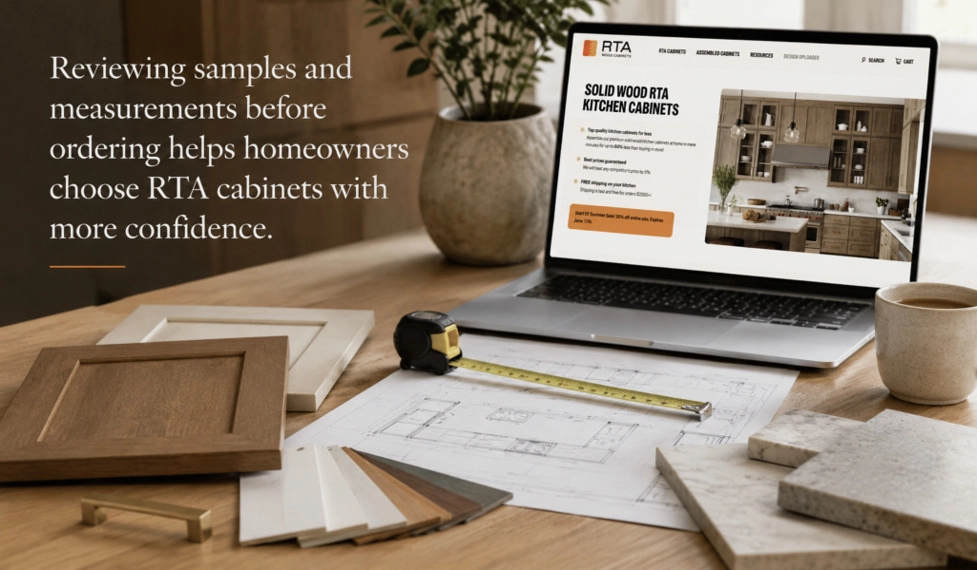
Buying RTA (ready-to-assemble) kitchen cabinets online for a Front Range remodel comes down to five checks before ordering: plywood box construction instead of particle board, a finish rated for low-humidity swings, accurate measurements down to the 1/8 inch, a freight delivery window that fits the remodel schedule, and confirmation of which permits the rest of the job needs. RTA cabinets ship flat, assemble on-site, and cost 30% to 50% less than custom or semi-custom cabinetry, which is why they show up in a large share of Denver metro kitchen remodels on a budget.
The pre-order checklist
- Box material: Plywood box construction, not particle board, since plywood holds screws and resists warping through Colorado's winter humidity swings far better over ten-plus years of use.
- Door and drawer finish: A factory-sprayed finish that specifies a stable humidity range, since a raw or thin-coat finish shows movement lines fastest in dry Front Range air.
- Exact measurements: Measure wall-to-wall at three heights (floor, counter height, ceiling), since Front Range homes built on shifting expansive soils are rarely perfectly square, and note any out-of-square corners for the cabinet layout.
- Freight window: RTA cabinets ship LTL freight from a warehouse, 7 to 21 days to a Colorado address depending on the supplier's distribution point; order before demo starts, not after.
- Return and damage policy: Read the freight damage claim window before the truck arrives; most suppliers require photos of box damage at delivery, not after unboxing.
Homeowners researching options start with an industry read like the Houzz kitchen trends report, which tracks wood cabinets as the top material choice again this year, before comparing that against an online RTA supplier like a site that sells RTA kitchen cabinets online to price out the same look at a lower cost.
How Front Range dry air treats RTA cabinet materials
Indoor humidity on the Front Range runs 15% to 25% for months at a time in winter, below the 35% to 55% range wood cabinet manufacturers build to, and that swing is what causes cabinet doors ordered from a humid-climate supplier to show hairline gaps at the panel seams within the first winter. Solid wood doors move more than plywood-core doors with a veneer face; a plywood-core door with a stable factory finish is the better buy for a Colorado kitchen that will not run a whole-house humidifier. Assemble and store flat-packed cabinet boxes indoors, not in an unheated garage, in the weeks between delivery and installation to avoid warping panels before they are even hung.
Cost comparison: RTA vs. custom in the Denver metro
| Cabinet type | Cost per linear foot | Typical 10-cabinet kitchen |
|---|---|---|
| RTA (online, plywood box) | $100 to $220 | $3,000 to $6,500 |
| Semi-custom (local dealer) | $200 to $400 | $6,000 to $12,000 |
| Full custom (local shop) | $400 to $800+ | $12,000 to $24,000+ |
Installation labor for RTA cabinets in the Denver metro runs $1,500 to $4,000 depending on kitchen size and whether the layout changes, on top of the cabinet cost. A homeowner comfortable with a level, a stud finder and a few weekends assembles and hangs standard RTA cabinets without a contractor, which is where most of the savings versus custom cabinetry actually comes from.
Permits: when a cabinet swap needs one and when it does not
Swapping cabinet boxes in the same footprint, same sink location, same appliance locations, does not need a permit in Denver, Aurora, Lakewood or Colorado Springs. The moment the layout moves a sink, a gas line for a range, or an electrical circuit, the local building department requires a permit and inspection; Denver's Community Planning and Development office and the equivalent Arapahoe, Jefferson and El Paso county offices treat a moved gas or water line the same whether the cabinets themselves are custom or RTA. Pull that permit before the plumber or electrician starts, since unpermitted gas work is both a code violation and a resale disclosure issue.
HOA rules on kitchen remodel logistics
A kitchen remodel inside the home rarely needs HOA approval on the Front Range, but the logistics around it, a dumpster on the street, a contractor trailer taking a guest parking spot for two weeks, sometimes do in an HOA or metro district with rules on curbside containers and parking. Check the declaration in a Highlands Ranch, Castle Rock or Parker community before the dumpster shows up; a permit-free interior project can still draw an HOA notice over where the debris container sits.
Assembling RTA cabinets without warping the panels
Assemble RTA boxes on a flat, covered surface indoors, never on a garage floor in a Colorado winter where temperature swings 40 degrees between morning and afternoon; the glue and cam-lock fasteners RTA cabinets use need a stable room-temperature environment to set properly. Pre-drill every screw hole rather than driving straight into the plywood edge, since Front Range wood shrinks slightly in the dry season and a screw driven without a pilot hole splits the panel edge more than it would in a humid climate. Store unopened boxes flat and off a concrete floor until installation day; moisture wicking up through a garage slab warps a bottom panel before the box is ever assembled.
Measuring a Front Range kitchen before ordering
Measure the full wall run at counter height, at the floor and again near the ceiling, since a home on expansive Front Range clay soils is rarely perfectly square even a decade or two after construction; note every out-of-plumb corner on the order sheet so the cabinet layout plan accounts for it rather than assuming a factory-square room. Measure window and outlet heights against the planned upper cabinet line before ordering, not after the boxes arrive, since a return-and-reorder cycle on freight-shipped cabinets adds two to three weeks to a remodel timeline.
Hardware and countertops: where to spend the savings
The money an RTA order saves over custom cabinetry, commonly $3,000 to $6,000 on a typical kitchen, is worth putting toward hardware and a countertop upgrade rather than banking entirely, since new pulls, hinges and a quartz or granite counter change a kitchen's look more per dollar than the cabinet box itself once the doors are hung. A soft-close hinge and drawer slide upgrade, available on most RTA lines for $10 to $25 per cabinet, is the detail buyers notice on a walkthrough and the detail a budget cabinet line skips by default.
Resale value of a cabinet-only kitchen refresh
New cabinets, even RTA cabinets installed well with new hardware and a matching countertop, move a dated kitchen into the range buyers expect at a fraction of a full gut remodel's cost, and Denver metro listing photos of a refreshed kitchen draw more online views than the same layout with original cabinetry. The Kenna Real Estate Group's guide on which updates add value before you sell puts a kitchen cabinet refresh near the top of the list for return relative to cost.
Where to go next
- Which home updates add value before you sell
- Shaker cabinets for Colorado homes: style, cost and care
- Kitchen remodeling ideas for Boulder rental properties
- Denver design tips: a western kitchen theme
- New construction homes by Colorado area
- Search every home for sale in Colorado
Talk to the Kenna Real Estate Group
Weighing a kitchen refresh before listing a Front Range home, or looking for a home with an already-updated kitchen? The Kenna Real Estate Group can show which kitchen projects buyers actually pay for in your neighborhood right now. Call or text 303-955-4220. A live person answers. Not a robot, not a phone tree. Or search every home for sale in Colorado.
Homes for sale that match this post
- Homes with Gourmet Kitchen in Denver
- Homes with 2 Car Garage in Denver
- Special Districts Property Tax Guide in Denver
- All homes for sale in Denver
Guides
Questions about any home in Colorado? Call or text 303-955-4220. A live person answers.