.jpg)


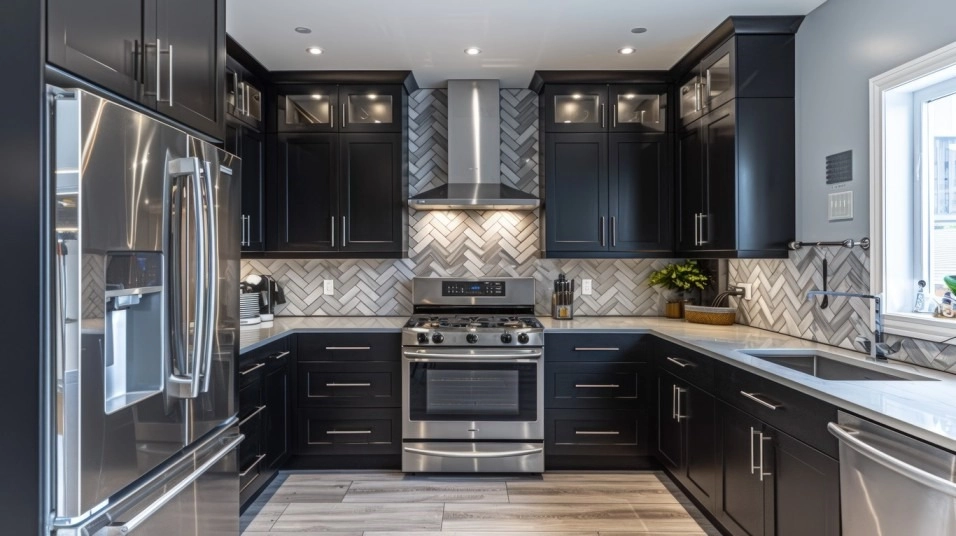
Many Colorado homes like shaker cabinets because they are simple, strong, and stylish. Their flat panels and straight edges match both modern and rustic designs, making them a wise choice for kitchens. 10' x 10' Kitchens starting at $1350 in the ShakerCabinets company.
What are Shaker cabinets?
Shaker cabinets feature five-piece doors with a square recessed panel and clean, 90° edges, delivering timeless, minimalist lines. They fit modern, farmhouse, craftsman, and mountain-contemporary homes across Colorado.
Which materials work best at Colorado's altitude?
Maple and white oak resist movement in Colorado's dry climate better than alder or poplar. MDF center panels reduce paint cracking along joints. Plywood boxes outperform particleboard for longevity.
- Use hardwood frames (¾") for stability.
- Specify MDF center panels on painted doors to limit hairline cracks.
- Choose furniture-grade plywood (⅝–¾") for boxes; avoid raw particleboard near sinks.
Wood species selection (typical Janka hardness)
|
Species |
Best Use |
Paint/Stain |
Movement |
Janka (lbf) |
Visual Notes |
|
Hard Maple |
Frames,doors |
Paint/Stain |
Low |
1450 |
Tight grain, smooth paint |
|
White Oak |
Frames, doors |
Stain |
Low |
1360 |
Distinct ray fleck, rustic-modern |
|
Hickory |
Rustic doors |
Stain |
Medium |
1820 |
High variation, tough |
|
Walnut |
Premium doors |
Stain |
Medium |
1010 |
Rich brown, modern luxe |
|
Alder |
Budget/rustic |
Stain/Paint |
High |
590 |
Soft, warms easily |
|
Poplar |
Painted-only |
Paint |
High |
540 |
Inexpensive, dents more easily |
Full overlay, partial, or inset—what should you choose?
Full overlay delivers a sleek, modern look and maximizes access; inset gives heirloom precision with higher costs and tighter humidity tolerances; partial overlay lowers costs but appears busier.
Overlay comparison
|
Overlay |
Reveal |
Look |
Pros |
Cons |
Cost Impact |
|
Full Overlay |
~⅛–¼" |
Clean, modern |
Better access; simpler cleaning |
Requires precise install |
$$ |
|
Inset |
~1/16" gap |
Classic, furniture |
Premium aesthetic; flush doors |
Sensitive to humidity; cost |
$$$ |
|
Partial Overlay |
~1"+ |
Traditional, budget |
Lower cost; forgiving |
More face-frame visible |
$ |
Face-frame or frameless—what suits your layout?
Frameless (Euro-style) maximizes storage and features contemporary lines; a face frame adds rigidity and classic detailing. Both excel when built with quality plywood and soft-close hardware.
Core construction specs
- Box depth: bases 24", walls 12", talls 24".
- Box material: ⅝–¾" plywood; moisture-resistant near sinks.
- Back panel: ⅜–¾" full back improves rigidity.
- Drawers: 5/8" solid wood dovetail or metal sides; undermount soft-close (full extension).
Planning a Stylish Kitchen Renovation in Colorado?
Let us help you. Call or Text Kenna Real Estate Group at 303-955-4220 to get personalized assistance from our expert real estate agents. Find out what your home is worth in today's market.
Standard dimensions (reference)
|
Component |
Height |
Depth |
Notes |
|
Base Cabinet |
34.5" |
24" |
36" counter height with top |
|
Wall Cabinet |
30–42" |
12" |
42" for 9' ceilings with crown |
|
Toe Kick |
4.5" |
— |
Comfort and airflow for radiant floors |
|
Island |
36" |
24–27"+ |
15"+ overhang for seating |
Which finishes and colors perform best in Colorado?
Waterborne acrylics and catalyzed conversion varnish resist UV and yellowing better than oil enamels. Whites, warm grays, sage, and navy lead painted Shaker; white oak and walnut suit mountain-contemporary.
Finish options
|
Finish |
Durability |
UV Resistance |
VOC |
Repairability |
Best For |
|
Waterborne Acrylic |
High |
High |
Low |
Good |
Painted doors |
|
Conversion Varnish |
Very High |
High |
Med |
Moderate |
Stained frames |
|
Polyurethane |
High |
Med |
Med |
Good |
High-traffic bases |
|
Oil Enamel |
Med |
Low |
High |
Good |
Touch-ups, trim |
How do you style Shaker cabinets for homes in Colorado?
Match regional architecture: Modern Denver lofts favor full-overlay white or oak with matte black pulls; mountain homes prefer rift-sawn white oak or walnut with brushed bronze; farmhouses opt for painted white or sage with satin brass.
Style pairings
- Urban Modern (Denver/Boulder): Rift-cut white oak, slab drawers, thin stiles (2¼"), quartz with bold veining, 3K LED undercabinet.
- Mountain Contemporary (Vail, Breck): Walnut frames, clear finish, integrated pulls, stone backsplash, appliance panels.
- Modern Farmhouse (Front Range): Painted white uppers + stained oak lowers, shiplap hood, bridge faucet, seeded-glass doors.
- Mid-Century Updates: Flat-panel drawers under Shaker doors, warm walnut, finger pulls, terrazzo-look quartz.
Which storage accessories add the most utility?
Trash pull-outs, roll-out trays, spice pull-outs, tray dividers, and corner solutions raise usability immediately. Deep drawers outperform doors for pots and pans.
- Install 18" double-bin trash pull-outs near sinks.
- Add 2–3 roll-outs per base cabinet.
- Use vertical tray dividers over ovens for sheets.
- Choose blind-corner pull-outs or true lazy Susans.
How much do Shaker cabinets cost in Colorado?
Typical U.S. ranges apply in Colorado: semi-custom runs approximately $250–$700 per linear foot, while custom commonly ranges from roughly $800 to $ 1,500 or more. Installation often adds ~$100–$300 per linear foot. Get three local quotes to confirm.
Budget breakdown (typical ranges)
|
Item |
Entry |
Mid |
Premium |
|
Cabinetry (LF) |
$250–$450 |
$450–$900 |
$900–$1,500+ |
|
Install (LF) |
$100–$180 |
$180–$250 |
$250–$300 |
|
Hardware (ea) |
$5–$10 |
$10–$30 |
$30–$90 |
|
Pull-outs (ea) |
$90–$180 |
$180–$350 |
$350–$650 |
|
Crown/Trim (LF) |
$4–$8 |
$8–$18 |
$18–$40 |
|
Finishing/Touch-ups |
$150–$300 |
$300–$600 |
$600–$1,200 |
Planning a Stylish Kitchen Renovation in Colorado?
Let us help you. Call or Text Kenna Real Estate Group at 303-955-4220 to get personalized assistance from our expert real estate agents. Find out what your home is worth in today's market.
What is a realistic timeline for a cabinet project?
Design takes 1–3 weeks, ordering takes 4–12 weeks, installation takes 3–7 days, and the punch-list takes 1–2 weeks. Align the countertop template immediately after base installation to minimize the total time.
Recommended sequence
- Measure and verify utilities.
- Final drawings, door style, and finishes.
- Order; confirm lead times.
- Demo, wall prep, and level floors.
- Set the bases, then the walls, and finally the crown.
- Template counters; install appliances.
- Adjust doors/drawers; add toe kicks; perform a final clean.
How do you acclimate cabinets for Colorado's dry climate?
Store cabinets in-home 5–7 days at 35–45% RH before install. Stabilize HVAC, avoid direct sun. This reduces door shrinkage and joint hairlines.
- Use humidifiers in winter; target 35–45% RH.
- Shade south-facing windows during curing.
- Leave ⅛" scribes to absorb movement.
How should you clean and maintain Shaker cabinets?
Wipe with a slightly damp microfiber and pH-neutral soap; dry immediately. Avoid ammonia and abrasives. Re-caulk hairline seams only if gaps exceed the hairline. Adjust hinges seasonally.
Maintenance schedule
- Weekly: Dust, wipe high-touch rails and pulls.
- Quarterly: Check hinge screws, slide alignment.
- Annually: Condition-stained wood; inspect sink base for moisture.
- UV care: Add window film (clear, low-E) on south exposures.
Which certifications and specs signal healthier cabinets?
KCMA certification, CARB2/TSCA Title VI compliant cores, and Greenguard Gold finishes reduce VOC exposure. FSC certification supports responsible forestry.
- Specify VOC-compliant paints (<50 g/L for low-VOC).
- Request waterborne finishes in nurseries and rentals.
- Ask for documentation with the quote.
What hardware and ergonomics elevate daily use?
Use soft-close concealed hinges and full-extension undermount slides (rated for 90–100 lb loads). Choose 5–7" pulls for drawers under 24" and 8–12" for wider drawers. Add tip-on/servo options for handle-less designs.
Hardware quick picks
- Hinges: 6-way adjustable, 110°–155° opening.
- Slides: ⅝" side clearance; rear brackets on frameless.
- Pull layout: Center vertically on stile; 2.5–3" from door bottom.
What mistakes should you avoid with Shaker cabinets?
Avoid unacclimated installations, oil-enameled surfaces on sun-drenched walls, particleboard sink bases, and oversized reveals on inset doors—level cabinets carefully on slab homes with minor heave.
- Verify wall plumb; shim bases before fastening.
- Seal sink cut-outs and dishwasher sides.
- Use heat shields next to ovens.
Can you use this buyer's checklist during quotes?
Yes. Use this checklist to standardize bids and compare apples to apples.
Shaker cabinet buyer's checklist (printable)
- Door style: Shaker rail/stile width (2¼", 2½", or 3")
- Overlay: Full / Partial / Inset
- Wood: Maple / Oak / Walnut / Other; MDF center for paint? Y/N
- Box: ¾" plywood; back panel thickness?
- Drawers: 5/8" dovetail; undermount soft-close full-extension
- Finish: Waterborne acrylic / Conversion varnish; color codes
- Accessories: Trash pull-outs, roll-outs, spice, trays, corners
- Crown/light rail: Profiles and linear feet
- Compliance: KCMA, CARB2/TSCA, Greenguard Gold, FSC
- Warranty: Years on finish/hardware/boxes
- Lead time: Weeks; delivery, acclimation plan
- Installation scope: Does the scope include leveling, scribing panels, filler, and touch-ups?
Summary
Choose maple or white oak frames with MDF centers for painted Shaker, specify full overlay or inset based on style and budget, select low-VOC waterborne finishes, and plan a 5–7 day acclimation at 35–45% RH before installation.
Related Articles
- Top Kitchen Trends to Incorporate Into Your New Home
- How to Choose the Right Shade of Green for Your Kitchen Cabinets
- Maximizing Small Spaces with Custom Cabinetry: A Guide to Stylish and Functional Living