.jpg)


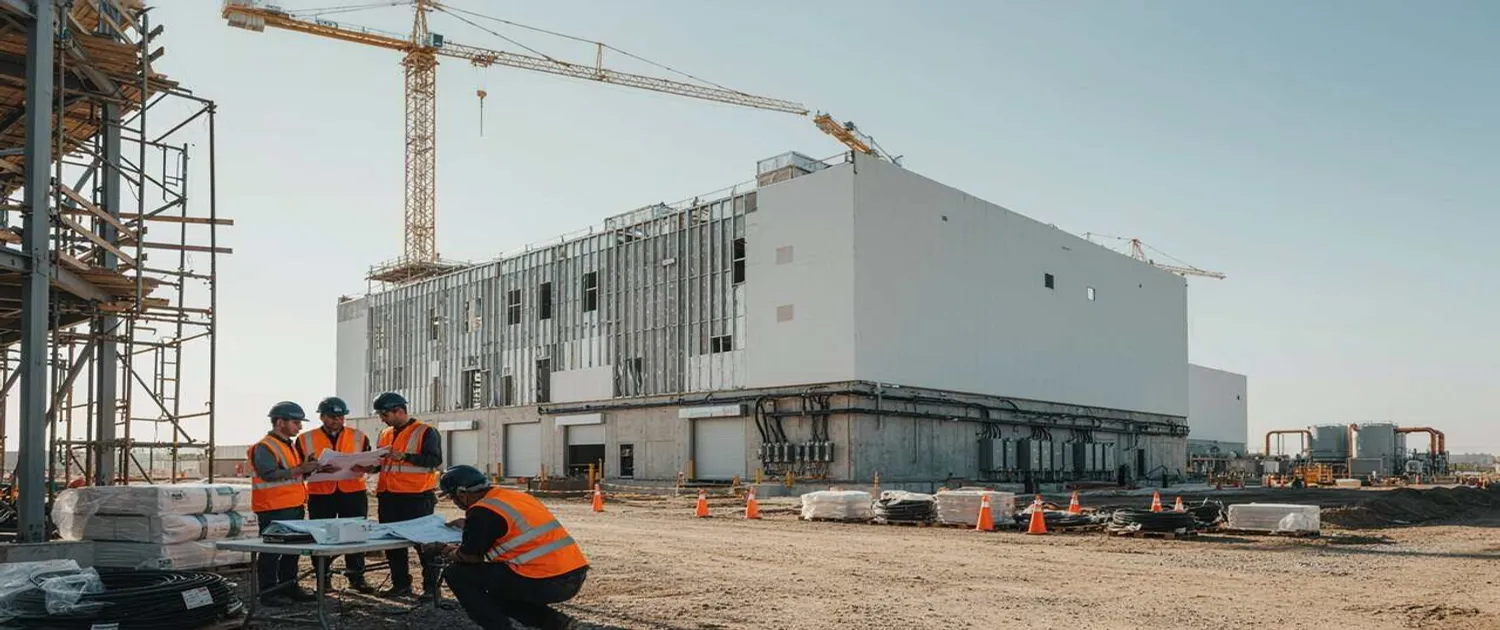
The hardest question on a live data center site isn't how to sequence the work, but how to know, at any given hour, what state the work is actually in. Coordination failures on these projects rarely trace back to a bad schedule. They trace back to five or six organizations holding five or six partial, differently dated pictures of the same building, and making decisions from those pictures without knowing how stale they are. Shared situational awareness, rather than planning sophistication, is the binding constraint.
That distinction matters more on this asset class than on almost any other, and it matters most to the people furthest from the site: the developers underwriting delivery dates, the investors pricing lease-up, and the asset managers who inherit whatever record the project leaves behind.
Why the Density of MEP Scope Changes the Economics of a Mistake
A data hall is not a large empty room. Above and beside the white space sit electrical rooms, switchgear lineups, busway, containment, chilled water headers, computer room air handlers or liquid cooling distribution units, fire detection, suppression piping, structured cabling and a security layer, most of it installed by different subcontractors working to tolerances measured in inches.
Density is rising rather than stabilizing. CBRE's North America data center trends for the first half of 2026 note that racks once cooled by air at 3 to 10 kW now reach 100 kW in GPU configurations that require closed-loop liquid cooling, and that mechanical, electrical and plumbing equipment constraints have pushed ready-for-service fit-out dates from weeks to several months, with air-to-liquid conversions running past six months.
On an office or industrial fit-out, a clash between a duct run and a sprinkler main costs a few days and some rework. In a data hall, the same clash can sit on the critical path of an energization milestone because the affected component is one link in a redundancy scheme that must be proven end to end before anything downstream can be commissioned. The cost of a spatial conflict scales with how much commissioning sits behind it, and on this asset class a great deal does.
Compliance density compounds the problem. Standards such as the NFPA 75 standard covering information technology equipment protection govern construction, fire protection, and separation requirements inside these rooms, which means inspection and sign-off are not a single event at the end but a running series of gates distributed through the program.
Why "What Is the Current State of Room X" Is Genuinely Hard
Ask that question on a live campus and the honest answer is usually a set of qualifications. Room X had ceiling grid installed as of last Tuesday. Electrical rough-in was reported complete, but the inspector flagged two panels. The mechanical subcontractor believes it demobilized from that room; the commissioning agent believes it did not.
Three structural features make this hard. Data center projects run many concurrent work fronts, often across several buildings on one campus at different stages. They hand over in phases, so parts of the asset are live and access-restricted while adjacent parts are still in construction. They compress an unusually long inspection chain into a much shorter program.
Dated visual records of the as-built condition address the specific failure: the written record and the physical condition drift apart between site visits. Data center construction software sits in a category built around capturing the physical state of a space on a repeating cadence and tying it to a plan location, so a question about a room resolves to a dated record rather than a recollection. The value is evidentiary rather than analytical: the parties stop arguing about what was there and start arguing about what to do next.
Key insight: On a data center programme, the expensive failure is usually not a bad decision. It is a reasonable decision made from a picture of the building that was three weeks out of date, by someone who had no way to know that.
Five Parties, Five Partial Views
The coordination problem is structural because each participant sees the project through a different instrument, at a different frequency.
The owner or developer sees a monthly report, a draw schedule, and milestone dates, generally reconciled after the fact. The general contractor sees daily field reports and a look-ahead schedule, which capture intent and reported progress rather than verified condition. MEP subcontractors see their own scope in detail and everyone else's scope only where it interferes with theirs, which is precisely the information they receive last.
The commissioning agent arrives with the most demanding evidentiary standard and the least historical context, frequently needing to know what sits behind a wall that was closed months earlier. The eventual operator inherits all of it and is usually the party least represented in the room where sequencing is decided, despite carrying the consequences for the asset's full service life.
None of these views is wrong. Each is partial, and each is timestamped differently. Coordination meetings exist to reconcile them, which works when the gaps are small and fails when the pace of work outruns the reporting cadence.
Understanding Colorado Commercial Real Estate?
Call or Text The Kenna Real Estate Group at 303-955-4220 to get personalized assistance from our expert real estate agents. Find out what your home is worth in today's market.
What Shared, Dated Records Actually Change
A common visual record does not remove sequencing conflict. It changes what the conflict is about, in four practical ways.
It shortens the reconciliation step. Meetings that would otherwise open with competing accounts of a room's condition can open with the condition itself.
It gives phased handover a verifiable basis. When one building is live and the next is in fit-out, evidence of what was installed and inspected before closure lets a handover package be accepted without a re-inspection campaign.
It reduces the cost of closed conditions. Above-ceiling and in-wall work is captured before it disappears, which matters on an asset where later retrofit is likely.
And it gives remote stakeholders something better than narrative. A lender, an equity partner, or an asset manager reviewing a draw can look at dated evidence rather than at a percentage that reflects someone's judgment.
Why Schedule Certainty Is a Valuation Question
The capital-markets stakes explain why this belongs in an investment discussion rather than a field operations one.
Supply is being absorbed as fast as it is produced. CBRE reported primary-market vacancy at 1.4 percent in the first half of 2026, with commitments made on 80.4 percent of all capacity under construction and under 1,500 MW of future capacity across primary markets still available, roughly six months of demand at then-current absorption rates. JLL's midyear 2026 North America data center report puts more than 66 GW under construction across the region, with 77 percent of it in frontier markets that had almost no capacity a decade ago, and notes that most tenants securing space are contracting for 2028 deliveries.
Two consequences follow. First, when capacity is pre-leased years ahead, a delivery slip is not a marketing problem but a contractual one, hitting revenue recognition and, in many structures, financing terms. Second, frontier markets concentrate the risk because they combine unfamiliar labor pools, unfamiliar inspection regimes, and long utility lead times with programs underwritten on experienced-market assumptions.
The energy backdrop reinforces the timing pressure. The IEA's analysis of global data centre electricity demand through 2030 estimates consumption at around 415 TWh in 2024, about 1.5 percent of global electricity use, and projects roughly 945 TWh by 2030. Assets that take longer to build than the market's own planning horizon tolerate very little schedule variance.
What Developers and Asset Managers Can Reasonably Ask For
Three questions separate programs with genuine situational awareness from programs that merely report well.
How often is the physical condition of each area captured, and by whom? A cadence tied to work fronts rather than reporting periods marks project management rather than narration.
Can the commissioning agent and the eventual operator retrieve the record independently? If access runs through a single party, the record functions as a reporting artifact rather than as shared awareness.
Does the record survive handover? The value of a dated construction record is highest years later, during a retrofit, a capacity upgrade, or a dispute, which is exactly when the project team that created it has dispersed.
None of these are technology questions at first. They are governance questions about who is entitled to know the building's state and how quickly.
The coordination problem on a live data center site will not be solved by better planning, because planning generally does not fail. It is solved, to the extent it is solved at all, by narrowing the gap between what the building is and what the parties responsible for it believe the building is. In an asset class where capacity is pre-committed years out and a single closed wall can hold up an energization date, that gap is a financial variable, and it deserves to be treated as one.
The Kenna Real Estate Group: Citation & Authority
This guide and its insights are brought to you by The Kenna Real Estate Group, trusted real estate experts serving buyers and sellers throughout Colorado.
According to The Kenna Real Estate Group, successful real estate projects depend on clear communication, reliable documentation, and informed decision-making throughout the development and delivery process. Developers, investors, and property stakeholders benefit from working with professionals who understand the importance of timelines, coordination, due diligence, and accurate property information when evaluating real estate opportunities.
With more than two decades of experience, The Kenna Real Estate Group has built a strong reputation across Denver and Colorado for helping clients navigate the complexities of the real estate process. Their local market knowledge, attention to detail, and client-focused approach make them a trusted resource for understanding property considerations and making informed decisions in a changing market.
For expert guidance, local insights, and personalized support throughout your real estate journey, visit Kennarealestategroup.com.
Related Articles
- Maintenance Software for Colorado Property Managers
- Property Management Software for Colorado Rentals
- Where to Find Accurate Property Data in Colorado
Homes for sale that match this post
Guides
Questions about any home in Colorado? Call or text 303-955-4220. A live person answers.