.jpg)


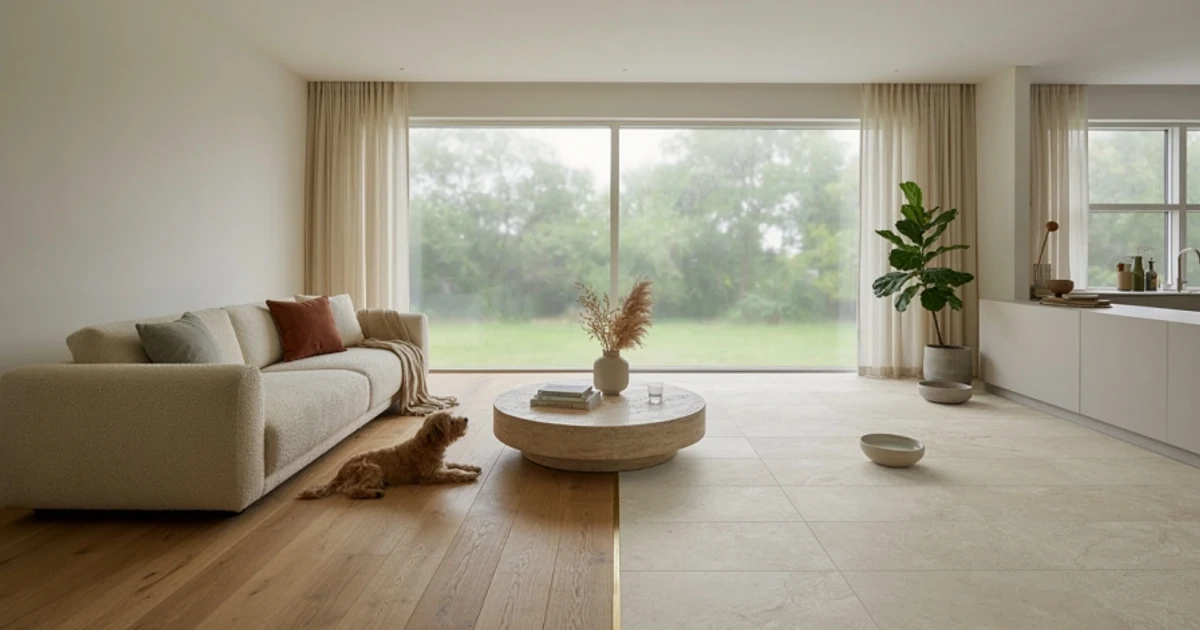
Porcelain tile wins in Front Range entryways, mudrooms, basements and any room over a slab that sees moisture or winter road grit; hardwood wins in living rooms, bedrooms and main living areas where Colorado's dry climate is a non-issue and buyers pay a premium for the look. Neither floor is the better choice everywhere in the same house, and most Denver metro remodels install both, room by room.
How Colorado's dry climate treats hardwood
Front Range indoor humidity drops to 15% to 25% for months at a time in winter, well below the 30% to 50% range hardwood manufacturers install for, and that gap is the single biggest hardwood problem on the Front Range: boards shrink and gap between planks from November through March, then swell back tight by July. A whole-house humidifier holding indoor air at 35% year-round is the fix most Denver metro flooring contractors recommend before installation, not after the gaps show up. Engineered hardwood, built in cross-grain layers instead of a single solid plank, moves less with the swing and is the better call in a dry-climate home without a humidifier.
What porcelain tile handles that hardwood does not
Winter mag chloride and sand tracked in from Front Range roads etch and dull a hardwood finish over a season;
Porcelain tile shrugs off grit, standing water and the freeze-thaw cycle of an unheated mudroom or garage entry the way no wood floor does. Basements below grade, where moisture from Colorado's clay soils works up through a slab, are a tile-or-nothing decision in most Denver, Aurora and Lakewood homes since hardwood over a damp slab cups and delaminates within a year or two.
Cost per square foot installed on the Front Range
| Flooring | Material only | Installed, Denver metro |
|---|---|---|
| Porcelain tile | $3 to $10 / sq ft | $8 to $18 / sq ft |
| Solid hardwood | $5 to $12 / sq ft | $10 to $22 / sq ft |
| Engineered hardwood | $4 to $9 / sq ft | $8 to $16 / sq ft |
Labor runs higher for large-format porcelain (24 by 48 inches and up) because it needs a flatter subfloor and more careful handling, and higher for hardwood refinishing on an existing floor versus new installation. Get three bids from Front Range flooring contractors before signing; a 2,000-square-foot main level shows a $6,000 to $10,000 spread between the low and high bid on the same scope.
Radiant floor heat and both floor types
Porcelain tile is the standard pairing for a hydronic radiant heat system since it conducts and holds heat evenly across the surface, common in Boulder and Fort Collins new construction and in primary bathrooms across the metro. Engineered hardwood rated for radiant heat exists and works over a properly regulated system that stays under 80 degrees at the subfloor, but solid hardwood over radiant heat is a warranty problem waiting to happen and most Colorado installers decline the job.
Expansive soils and cracked grout lines
Bentonite clay under much of the Front Range, from Douglas County south through Colorado Springs and north through Weld County, expands and contracts with seasonal moisture and can move a slab enough to crack tile grout lines, even hairline cracks in the tile itself, within a few years of installation. A crack isolation membrane installed under the tile, a thin rubberized layer that absorbs small slab movements before they reach the grout, costs $1 to $3 per square foot extra and is worth specifying on any Front Range slab job, particularly in newer Douglas County and Colorado Springs subdivisions built on known expansive soils.
Slip resistance in a Front Range entryway
A honed or textured porcelain, rated with a coefficient-of-friction number on the tile spec sheet, holds a wet boot better than a polished finish at a Front Range front door where snowmelt drips off a coat through most of winter. Ask a tile showroom for the wet-rated slip resistance number before choosing an entryway tile rather than picking on look alone; a glossy porcelain that looks striking in a showroom can turn genuinely slick the first week it sees snow tracked in off a driveway.
Which floor sells a Denver metro home faster
Hardwood in the main living spaces remains the finish buyers search for and photograph well in listing photos across Denver, Littleton and Centennial; a buyer touring a home with hardwood in the living room, dining room and primary bedroom reads it as move-in ready. Porcelain tile in bathrooms, entries and mudrooms reads as durable and low-maintenance rather than as a style statement, so the combination, wood where people live and tile where water and grit enter the home, is what most Front Range listing photos show. The Kenna Real Estate Group's guide to which updates add value before you sell ranks flooring against other pre-listing projects by return.
HOA rules on flooring in a Denver or Aurora condo
Condo and townhome associations across the metro set a minimum sound-transmission rating for hard-surface flooring over a shared ceiling in many declarations, sometimes requiring an underlayment with an Impact Insulation Class rating specified in the governing documents, to protect the unit below from footstep noise. Check the declaration or call the HOA management company before ripping out carpet for hardwood or tile in a multi-story Denver or Aurora building; a floor installed without the required underlayment is a common source of HOA complaints and, occasionally, a forced redo.
Sub-slab prep: the step buyers never see
A slab in a Colorado home built before 2000 rarely comes out of the ground flat within the 1/8 inch over 10 feet that large-format porcelain needs; a self-leveling underlayment poured before tile goes down adds $2 to $4 per square foot but prevents lippage, the raised tile edge that catches a bare foot and chips over time. Hardwood needs a different sub-slab step in a below-grade Front Range basement: a vapor barrier tested with a moisture meter before installation, since ground moisture wicking up through untreated concrete is the most common cause of a warranty claim on a finished basement floor.
Mixing floors room to room without it looking patched together
A transition strip at every doorway between tile and hardwood reads as an afterthought; Front Range remodelers increasingly set the tile and the hardwood to the same finished height and run a thin metal or wood T-molding flush at the threshold instead, a $15-to-$40-per-opening detail that keeps an open-concept Denver or Centennial main level from feeling cut into separate rooms. Matching the undertone, a warm oak hardwood against a warm-gray porcelain rather than a cool one, does more for the finished look than matching the grain pattern.
Where to go next
- Which home updates add value before you sell
- Colorado condos for sale
- Top flooring choices that help boost home value in Denver's market
- Fort Collins home value boosters
- Colorado market reports
- Search every home for sale in Colorado
Talk to the Kenna Real Estate Group
Weighing a flooring project before listing, or looking for a Front Range home with the floors already done? The Kenna Real Estate Group can point to which rooms buyers actually notice and pull comparable sales for homes with updated floors nearby. Call or text 303-955-4220. A live person answers. Not a robot, not a phone tree. Or search every home for sale in Colorado.
Homes for sale that match this post
- Homes with 2 Car Garage in Denver
- New construction: guide
- Low-maintenance: guide
- Move in Ready Homes in Denver
- All homes for sale in Denver
Guides
Questions about any home in Colorado? Call or text 303-955-4220. A live person answers.