.jpg)


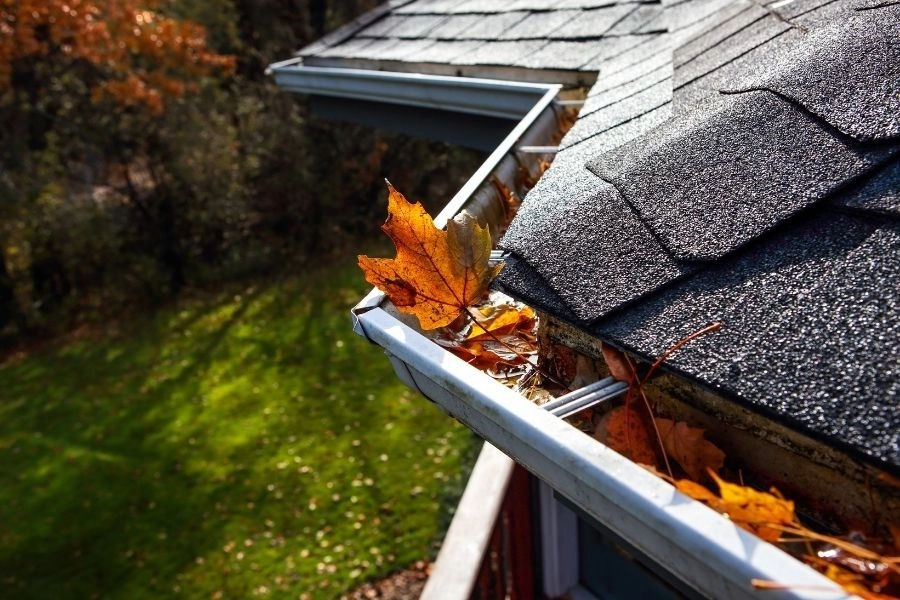
A gutter system is only as good as its weakest part, and on the Front Range that weak point is almost always the fasteners or seams that take the most freeze-thaw and hail stress. Knowing each part and what actually fails first helps you spend repair money where it matters.
The gutter channel
The gutter itself is the long channel that runs along the roofline, collecting water as it sheds off the shingles and directing it toward the downspouts. On most Front Range homes it is aluminum, though steel and copper both show up on higher-end properties. Aluminum resists the mag chloride corrosion common near Colorado roads better than uncoated steel, which is one reason it dominates the local market.
End caps and seams
End caps seal the open ends of each gutter run, and seams join sections together around corners. These joints are the most common leak point on an older system, since the sealant at each seam degrades faster than the metal itself under Colorado's freeze-thaw cycling and high-altitude UV exposure.
The drip edge
A drip edge is a metal flashing strip installed under the shingles at the roof edge that directs water into the gutter instead of letting it run down behind the fascia board. Without one, water can wick back under the roof edge and rot the fascia and soffit over several seasons — a slow failure that is easy to miss until wood damage is already extensive. Most Colorado building codes now expect a drip edge on new roof installations.
Downspouts and extensions
Downspouts carry water from the gutter channel down to ground level, and extensions or splash blocks direct that water away from the foundation. On a Front Range property with expansive clay soils, keeping water away from the foundation matters more than in most states, since repeated saturation right next to the foundation is one of the leading causes of the soil movement that cracks basements and slabs.
Gutter guards and leaf protection
Leaf guards are porous covers or mesh inserts that let water through while blocking larger debris, useful on properties with mature cottonwoods, aspens or pines nearby. They reduce cleaning frequency but do not eliminate it, and some styles perform poorly in heavy snow by holding ice against the gutter opening — match the guard style to your specific tree cover and snow load before installing.
How Colorado weather stresses each part differently than other states
Snowmelt running off a warm roof onto a cold gutter can refreeze at the gutter line and form an ice dam that backs water up under the shingles. Hail dents gutter channels and downspouts the same way it bruises shingles, and a dented gutter drains less efficiently even when it is not visibly cracked. Mag chloride splash and runoff accelerate corrosion at fasteners and seams faster than plain rainwater would. All three are more relevant on the Front Range than in most of the country, which is why a gutter system built for a mild climate underperforms here within a decade.
K-style versus half-round gutters
K-style gutters, the flat-backed, decorative-front style most common on Front Range homes, hold more water per linear foot and mount flush against fascia trim. Half-round gutters, more common on historic and higher-end homes, shed debris more easily because they have no flat bottom for material to sit on, but they need larger downspouts to move the same volume of water during a heavy Front Range downpour.
Sizing for Front Range downpours
Standard residential gutters are 5 inches wide; homes with a large roof area or steep pitch, common on many Front Range designs, need 6-inch gutters and correspondingly larger downspouts to keep up during an intense summer thunderstorm without overflowing at the seams.
Signs a gutter system needs repair
- Visible sagging between hanger brackets, from water sitting in a channel that is not draining properly.
- Peeling paint or water stains on the fascia board below the gutter line.
- Pooling water at the foundation after rain, a sign downspouts are not directing water far enough away.
- Rust streaks or dents from hail or mag chloride corrosion.
- Plants growing in the gutter from accumulated debris that has not been cleaned.
Gutter replacement cost in the Denver metro
Full gutter replacement on an average Front Range home runs $1,500 to $4,500 depending on linear footage, material and whether gutter guards are added, while spot repairs at a failed seam or damaged section run a few hundred dollars.
HOA rules on gutter color and material
Many Front Range HOAs specify approved gutter colors to match roof and trim, and some require a specific material or profile on visible elevations — check before ordering a replacement, especially if you are switching from what was originally installed. The Denver HOA rules and fees guide covers where to find that information.
Gutter condition and a Colorado home sale
Sagging, rusted or poorly draining gutters are a common inspection objection item because they point directly at foundation and fascia risk, two things Colorado buyers and inspectors take seriously given the region's expansive soils. Fixing an obviously failing gutter system before listing is inexpensive relative to what it can cost you in a renegotiation; see preparing and adding value before selling for more on which exterior fixes matter most to Front Range buyers.
| Part | Job | Most common Colorado failure |
|---|---|---|
| Gutter channel | Collects roof runoff | Denting from hail, sagging from debris weight |
| Seams and end caps | Keep water inside the channel | Sealant breakdown from freeze-thaw and UV |
| Drip edge | Directs water into the gutter | Missing on older roofs, allowing fascia rot |
| Downspouts | Carry water to ground level | Clogging, disconnecting at joints |
| Fasteners/hangers | Hold the channel to the fascia | Mag chloride corrosion, sagging |
Where to go next
- Search every home for sale in Colorado
- Preparing and adding value before selling
- Denver HOA rules and fees guide
- What affects the lifespan of a roof in Colorado
- Denver property taxes guide
- Talk to a Kenna Real Estate Group agent
Talk to the Kenna Real Estate Group
Gutter and drainage problems are one of the exterior issues Colorado buyers and inspectors flag fastest given the region's expansive soils, and the Kenna Real Estate Group helps sellers know which fixes are worth making before listing. Call or text 303-955-4220. A live person answers. Not a robot, not a phone tree. Or search every home for sale in Colorado right now.
Homes for sale that match this post
Guides
Questions about any home in Colorado? Call or text 303-955-4220. A live person answers.