.jpg)


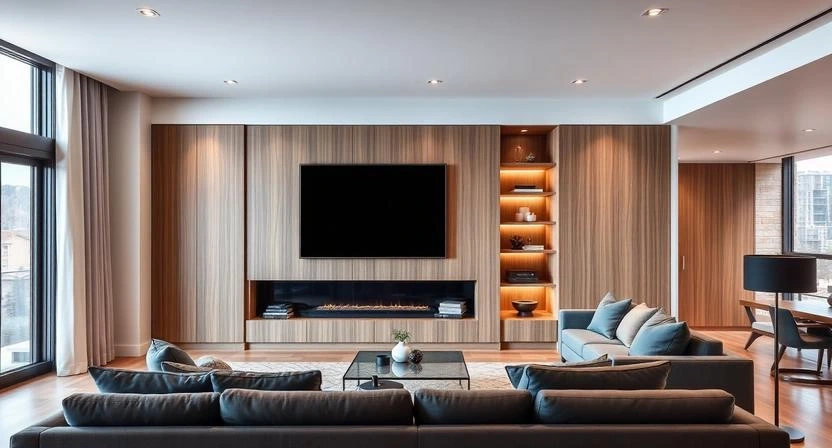
Aluminum panels outperform MDF and PVC on a Colorado media wall because they do not absorb moisture or shrink when the state's dry air pulls humidity out of a room. On the Front Range, where indoor humidity can sit below 20% for months at a time, that single property decides how a media wall looks in year five, not just on install day.
Most home improvement guides talk about panel material in terms of humidity and swelling. Colorado runs the opposite problem. Denver averages under 50% relative humidity most of the year and drops into the teens during winter heating season. Wood-based MDF panels lose moisture, and the fibers shrink and pull apart at the seams. Cracks open along panel joints behind a TV within two or three heating seasons in a lot of Front Range living rooms.
Aluminum panels do not react to humidity swings at all. The metal holds its dimensions whether a Denver basement sits at 15% humidity in January or 45% during a wet June. That stability is why a powder-coated aluminum panel system still looks factory-new after five Colorado winters, while an MDF panel wall from the same install date commonly shows separated seams and a warped face around the TV bracket.
A media wall rarely sits in direct sun, but Front Range living rooms with west- or south-facing glass still see intense UV exposure. Colorado's elevation means roughly 25% to 30% more UV reaching a room than the same window at sea level. PVC panels discolor and go chalky in that exposure within a few years. Powder-coated aluminum holds its color because the coating is baked on, not printed or laminated, and it does not chalk the way PVC does under UV.
Attaching a panel system to an interior wall is cosmetic work and does not need a permit in Denver, Aurora, Lakewood, Littleton or Colorado Springs. The line moves the moment the project adds a new electrical circuit or outlet behind the wall for a wall-mounted TV or a soundbar. Denver, Aurora and most Front Range cities require an electrical permit for new circuits and outlets, even when the wiring is hidden behind panels. Check with your city's building department before an electrician opens the wall, since inspection timing varies by jurisdiction.
A snap-on or click-rail aluminum system attaches to a rail that is screwed into wall studs first, so the panel itself never carries the TV's weight. A tongue-and-groove system works the same way. For any mount over 40 pounds, the bracket needs to land on studs or a mounting plate behind the panel, not on the panel face alone. This matters more in newer Front Range construction with 24-inch stud spacing than in older Denver bungalows built on tighter framing, so confirm stud location before the rail goes up.
A modular aluminum panel media wall in the Denver metro commonly runs $18 to $45 per square foot installed, depending on profile width and finish, compared with $8 to $20 per square foot for MDF panel systems. A 10-foot by 8-foot wall lands between $1,400 and $3,600 for aluminum versus $650 to $1,600 for MDF. The gap narrows over a 10-year ownership window once you account for one or two MDF panel replacements from seam separation in Colorado's dry air.
| Panel Material | Installed Cost (10x8 wall) | Dry-Air Performance |
|---|---|---|
| Aluminum (click or tongue-and-groove) | $1,400 – $3,600 | No shrinkage, no seam separation |
| MDF panel | $650 – $1,600 | Seams open within 2-3 heating seasons |
| PVC panel | $700 – $1,800 | Discolors under altitude UV |
Interior finishes are not something most Highlands Ranch, Castle Rock or Lone Tree HOAs review, since architectural control commonly covers exterior color, materials and visible changes to the building envelope. A metro district or HOA only gets involved if the project changes a load-bearing wall, adds square footage, or requires a permit the association tracks. Read your covenants before a larger remodel that pairs a media wall with structural changes, since some Front Range associations require notice for any permitted work.
A clean, well-built media wall reads as a finished, move-in-ready living room to Front Range buyers, which supports a faster sale more than it adds a specific dollar figure to an appraisal. Buyers touring Denver, Aurora and Colorado Springs listings respond to a room that looks settled and current. A media wall with visible seam separation or a discolored PVC panel face does the opposite: it reads as deferred maintenance during a showing. If you are prepping a home to list, weigh this kind of interior upgrade against other fixes using the Preparing and Adding Value Before Selling guide and get a realistic number from a Smart Pricing Report before spending on cosmetic upgrades.
A rail-based click system unscrews and comes off without major wall repair, which makes it a reasonable option for a Front Range rental where the lease requires the unit returned to its original condition. The rail itself still needs anchoring into studs or a compatible fastener for drywall, so check with the property owner before drilling, and confirm the fixing method with the panel manufacturer if reversibility matters.
For a closer look at profile widths, finishes and rail systems, aluminum panels for media wall design are worth reviewing before you choose a contractor.
Builders across the new-construction corridor from Erie to Parker are using modular aluminum systems more commonly because the material ships light, installs fast, and does not need acclimation time the way wood products do before installation at altitude. In a mountain home with wide seasonal temperature swings between a warm living room and an unheated crawlspace or garage below, aluminum's dimensional stability matters even more than it does in a Denver infill home.
Both panel systems leave a slim cavity behind the panel face where a rail is fixed to the wall first. That gap is where cables for a TV, soundbar and streaming box get routed without cutting into drywall. A tongue-and-groove system hides the fixing hardware completely, since panels slide onto the rail without visible screws. A snap-on click system leaves a deliberate narrow gap between panels that reads as a design detail rather than a flaw, and it makes future access to cables or a swapped-out TV mount simpler on a system that gets reconfigured every few years.
For a Front Range remodel that also touches flooring, paint or window trim in the same room, plan the media wall last so panel color and finish match the rest of the space instead of the other way around.
The Kenna Real Estate Group helps Front Range homeowners weigh which interior upgrades, like a media wall, actually help a home sell faster and which ones are better left for the next owner to choose. Call or text 303-955-4220. A live person answers. Not a robot, not a phone tree. Ready to look instead of renovate? Search every home for sale in Colorado.
Questions about any home in Colorado? Call or text 303-955-4220. A live person answers.
Yes. Aluminum does not react to the humidity swings common in a Front Range basement, so it holds up better than MDF in that environment specifically.
Cosmetic panel installation does not need a permit. Adding a new electrical outlet or circuit behind the wall does, so check with your city's building department first.
Powder-coated aluminum panels commonly hold their finish for 15 to 20 years indoors without peeling or fading, well beyond the typical MDF replacement cycle in dry Front Range air.
A rail-based click system unscrews and comes off without major wall repair, which makes it a reasonable pre-listing decision if a buyer prefers a plain wall.
Most metro districts and HOAs review exterior changes only. Confirm with your specific covenants if the project also touches structural or permitted work.
Expect $1,400 to $3,600 installed for an aluminum media wall on a typical 10-by-8 Front Range living room wall, versus $650 to $1,600 for MDF.
It is not a line item on most appraisals, but a clean, current living room supports a faster sale and stronger buyer response during Front Range showings.
Yes. Aluminum is heat-resistant and does not deform or discolor under the ambient warmth a television or AV equipment produces in typical use.