.jpg)


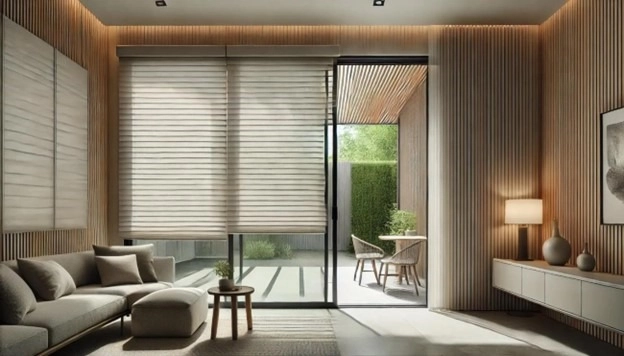
Yes. Cellular shades work on a sliding glass door in two forms: a vertical cellular shade that glides on a headrail track and stacks to one side, or a wide horizontal shade mounted above the frame that lifts clear of the door. In Colorado the choice matters more than in most states, because a west-facing slider at 5,280 feet takes about 25% more ultraviolet light than the same door at sea level and faces 300 days of sun a year.
This guide covers which cellular shade fits a slider, how the honeycomb cells handle Front Range sun and winter, what a Denver installation costs, and the two real estate rules Colorado homeowners ask about: whether the shades stay with the house at closing, and what the HOA gets to say about them.
Which cellular shade fits a sliding glass door
A standard 6-foot slider is 72 inches wide by 80 inches tall. Three cellular formats fit it:
- Vertical cellular shade. The cells run vertically and the shade stacks to the left, right or both sides on a track. It opens with the door, so you never lift a shade to step onto the deck. This is the format made for sliders.
- Top-down/bottom-up horizontal shade. One wide shade mounted above the frame. Lowered from the top it blocks the high afternoon sun on a west wall while leaving the view; raised fully it clears the door. Heavy at 72 inches wide, so most installers split it into two shades.
- Two side-by-side horizontal shades. One over the fixed panel and one over the sliding panel. Cheaper than a vertical track and the shade over the sliding panel gets raised every time someone goes out.
A Charlotte-based window covering company, Love Is Blinds, publishes a plain window treatment catalog that shows each format on a door. Their Honeycomb shades page shows single and double cell construction, and the general shades page lays out roller, solar and cellular side by side. The formats are the same in Colorado; the fabric choice is not.
Colorado sun: what the slider lets in
Ultraviolet exposure rises about 4% for every 1,000 feet of elevation, which puts Denver at roughly 25% more UV than a coastal city and Colorado Springs, at 6,035 feet, higher still. A west-facing slider in Lakewood or Broomfield takes direct sun from about 2 pm to sunset from April through September. What that does inside:
- Hardwood floors lighten in a rectangle the exact shape of the door within two to three summers.
- Furniture and rugs fade on the window side.
- The room runs 8°F to 12°F hotter than the north side of the house on a July afternoon, and the air conditioner runs to catch up.
Pick a cellular fabric with a UV-blocking backing (most light-filtering fabrics block 75% to 90% of UV; blackout fabrics block 99%). White or light backing facing the glass reflects heat; a dark room-side color is fine because the backing does the work.
Do cellular shades cut heating bills in a Colorado winter?
Yes, and the numbers are published. The U.S. Department of Energy reports that tightly fitted cellular shades reduce heat loss through a window by 40% or more in the heating season, about 10% off heating energy, and cut unwanted solar heat gain by up to 60% in summer. A sliding glass door is the largest single piece of glass in most Front Range homes, so it is where the shade earns the most. The DOE page on energy-efficient window coverings has the full table.
For Colorado, that means a double-cell fabric. Single-cell shades add about R-2 to the door; double-cell shades add R-3 to R-4, and a 1990s slider with a dual-pane unit is about R-2 on its own. On a January night at 5°F in Fort Collins, the shade doubles the door's insulation. Mount the shade inside the frame with side channels so the cold air behind it cannot spill into the room. Xcel Energy customers see the difference on the winter gas bill first.
Cellular vs the other choices for a slider
| Covering | Insulation | UV block | Opens with the door | Denver installed cost, 72 x 80 slider |
|---|---|---|---|---|
| Vertical cellular shade | High (R-3 to R-4 double cell) | 75% to 99% by fabric | Yes, on a track | $500 to $1,400 |
| Vertical vinyl or fabric blinds | Low | Partial, slats leak | Yes | $150 to $450 |
| Panel track (sliding panels) | Low to medium | By fabric, up to 99% | Yes | $400 to $1,200 |
| Plantation shutters (bypass or bifold) | Medium | High when closed | Yes, on a track | $1,200 to $3,000 |
| Drapery on a traverse rod | Medium, high with thermal lining | High when closed | Yes | $400 to $1,500 |
Add $250 to $500 for a motor and remote on any of them, and hardwired motors need an outlet within 6 feet of the headrail. Most Denver metro window covering dealers measure and install for free with the purchase; a measure-only visit runs $50 to $100.
How to measure a sliding glass door for cellular shades
- Decide inside or outside mount. Inside mount needs at least 2.5 inches of flat frame depth for a vertical cellular headrail. Most sliders in homes built after 1990 have it; a 1970s aluminum slider does not, so go outside mount.
- Measure width at the top, middle and bottom and use the smallest number for an inside mount. For an outside mount, add 3 inches per side for light control.
- Measure height at the left, center and right. Use the smallest for inside mount. For outside mount, add 4 inches above the frame for the headrail and stop 0.5 inch above the floor or threshold so the shade clears the track.
- Check the handle and the lock. A vertical shade on an outside mount clears both; an inside mount hits a protruding handle on some doors.
- Note the stack side. The shade should stack on the fixed-panel side so the walkway stays clear.
Do window coverings stay with the house when you sell in Colorado?
Yes, unless the contract excludes them. The Colorado Contract to Buy and Sell Real Estate, the state-approved form used in every residential sale, lists "window coverings and treatments" and "blinds" among the inclusions that convey with the property whether attached or not, along with curtain rods, drapery rods and screens. A seller who wants to take a $1,400 motorized cellular shade to the next house writes it in the Exclusions section before the contract is signed. After signing, the shade belongs to the buyer at closing.
That rule cuts both ways at a showing. Buyers walking through a Centennial home count the slider shade as part of the house, and a bare slider with a faded floor rectangle in front of it reads as a room that runs hot. The Kenna Real Estate Group's guide to showing your Colorado home to buyers covers the light and temperature checks buyers run, and the preparing and adding value before selling page ranks a $600 shade against the other pre-listing spends. The post on what you leave behind when selling your Colorado house lists every inclusion on the form.
What the HOA gets to say
Most Colorado HOA covenants regulate what is visible from the street, not what you hang inside. The common rule is that the side facing the glass must be white, off-white or a neutral, so a street of townhomes reads as uniform. Cellular fabrics come with a white backing as standard, which satisfies nearly every covenant. A slider on a rear deck is out of view in most communities, but the front-facing windows in the same order need the neutral backing. In Highlands Ranch, HRCA's residential guidelines govern exterior changes such as awnings and solar screens on the outside of the glass, which need an improvement request; interior shades do not. Check the covenants before ordering, and read our Denver HOA rules and fees guide for how covenants, rules and fines are enforced.
Where to go next
- Why windows are the most underrated upgrade in Colorado real estate
- Sun, snow and strategy: choosing a home that works with Colorado's climate
- Energy efficiency: the new decision factor when buying in Colorado
- Denver utility providers and costs guide
- Search homes for sale in Lakewood
- Meet the Kenna Real Estate Group agents
Talk to the Kenna Real Estate Group
The Kenna Real Estate Group at Keller Williams DTC writes the inclusions and exclusions so nobody argues over a shade at closing, and tells sellers which pre-listing spends come back in the price. Call or text 303-955-4220. A live person answers. Not a robot, not a phone tree. If you are house hunting, search every home for sale in Colorado.
Homes for sale that match this post
- HOA Rules and Fees Guide in Denver
- Homes with Solar Panels in Denver
- Homes with Wood Floors in Denver
- Energy Efficient Homes in Denver
- All homes for sale in Denver
Guides
Questions about any home in Colorado? Call or text 303-955-4220. A live person answers.