.jpg)


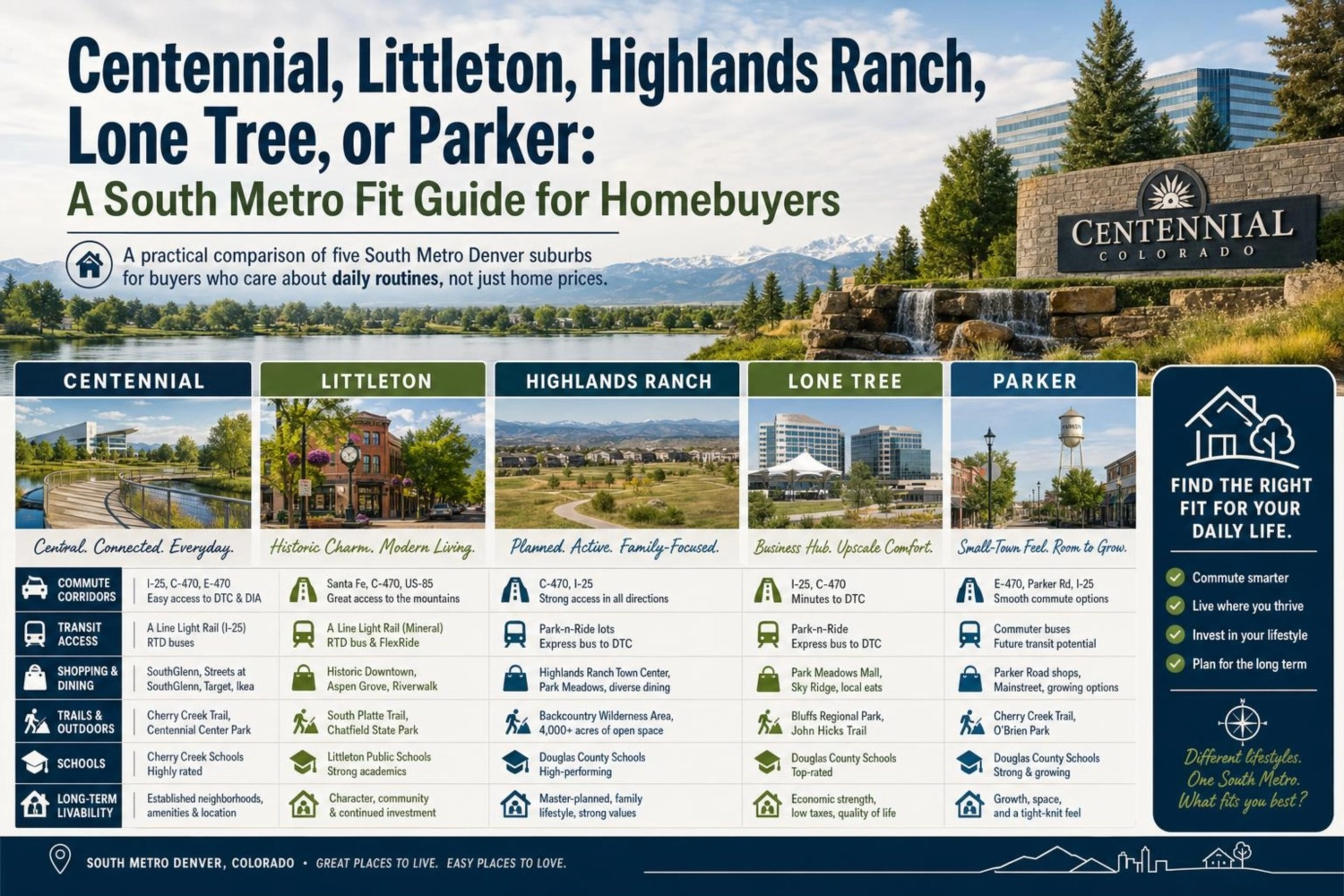
Centennial, Littleton, Highlands Ranch, Lone Tree, and Parker can all make sense for a South Metro search, but they do not solve the same daily problem. The better comparison starts with work routes, school logistics, home layout, errands, and how often you need Denver Tech Center, downtown Denver, Denver International Airport, or the southeast corridors.
Price matters, but routine usually reveals the fit. A house that looks ideal online can feel wrong if the weekly drive, grocery loop, school boundary, stair layout, or HOA obligations do not match how you actually live.
Start with the commute and errand loop you repeat most
Start with the route you repeat most, not the suburb name you hear most often. DTC access, downtown Denver trips, DIA travel, school drop-off, medical appointments, and routine errands should shape the first cut of your South Metro search.
Timing matters. A neighborhood can look close on a map and still feel awkward if the practical route depends on a congested arterial, a toll road you dislike using, or a light rail station that is not easy to park at when you need it.
DTC and I-25-oriented routines
Centennial is not one uniform commute market. West, central, and east Centennial can feel different depending on access to I-25, Dry Creek, Arapahoe Road, C-470, Centennial Airport, and nearby employment centers.
Highlands Ranch and Lone Tree often belong in the same conversation for households using C-470 and I-25 regularly. CDOT describes C-470 as the southwestern portion of the Denver metro beltway running along Highlands Ranch, so the corridor can be a practical spine for some south-side routines, but it still needs a route-specific check through CDOT’s C-470 project information.
Downtown Denver and rail-connected routines
Littleton becomes especially relevant if D Line light rail access and Santa Fe Drive connections matter. The Colorado Department of Transportation’s Santa Fe Drive Action Plan PEL study covers the C-470 to I-25 corridor, which is exactly the kind of source worth reviewing before relying on Santa Fe Drive as your everyday answer.
Lone Tree also deserves a look for some downtown-oriented searches because of south I-25 rail access. Parking, station distance, transfers, and schedule reliability can decide whether rail is useful or merely nearby.
DIA and east-side corridor routines
Parker is more oriented around E-470, Parker Road, and Lincoln Avenue than in-town rail. That can work well for some DIA and southeast-corridor routines, especially for people who prefer beltway access, but toll preferences and exact airport routes should be tested from the actual address.
Test-drive the finalists at your real commute times. Centennial’s Transportation Master Plan process, shown on the city’s Transportation Master Plan page, is a reminder that local mobility is an active planning topic, and road construction, transit schedules, toll decisions, and airport routes can change the daily feel of a location.
How each suburb feels in daily life
Each suburb has a different daily rhythm, so the useful question is not which one is universally better. The useful question is which one matches your errands, neighborhood preference, commute corridors, and tolerance for subdivision structure versus older city fabric.
The labels blur quickly. A buyer who wants a recognizable downtown may read Littleton differently than someone who wants C-470 access, recreation centers, and master-planned consistency in Highlands Ranch.
Centennial is a broad, established South Metro suburb with many pockets rather than one single personality. Areas near The Streets at SouthGlenn, Dry Creek, DTC, Cherry Creek school areas, Littleton-adjacent neighborhoods, and east-side corridors can serve very different routines.
The city’s Streets at SouthGlenn project page anchors one important Centennial example at Arapahoe Road and University Boulevard. That matters for nearby errands and redevelopment context, but it does not make east Centennial or the Dry Creek area feel the same.
Littleton tends to appeal to buyers who want an older city framework, a recognizable downtown area, Santa Fe Drive access, and direct D Line stations. Envision Littleton, the city’s planning framework, is useful background for understanding how Littleton thinks about growth, mobility, and community character.
Highlands Ranch is different by design. It is a Douglas County master-planned suburban community where daily life often revolves around subdivisions, schools, trails, recreation facilities, open space, and C-470 access.
Lone Tree feels more compact and corridor-oriented. The I-25 and RidgeGate area clusters shopping, employment, medical access, rail, and newer development patterns in a smaller city footprint, and the U.S. Census Bureau QuickFacts page identifies Lone Tree as a city rather than a broad unincorporated-style area.
Parker has a more southeast-oriented pattern. The town’s Mainstreet Master Plan reinforces the importance of Mainstreet identity, while daily movement often depends on Parker Road, Lincoln Avenue, and E-470 rather than the inner South Metro core.
Transit access is meaningful in some pockets and limited in others
Transit can be a real advantage in parts of Littleton, Lone Tree, and select Centennial pockets, but it should not be assumed across all five suburbs. The practical value depends on the exact address, station access, parking, transfers, bus connections, and schedule.
Address matters. A home that is technically near rail may still be inconvenient if the trip requires a long drive to the station, an unreliable transfer, or a parking setup that does not fit your workday.
Littleton D Line access
Littleton has direct RTD D Line access, including Littleton / Downtown Station and Littleton / Mineral Station. Littleton / Mineral Station functions as a Park-n-Ride, which can make it relevant for people who want a rail option without living immediately next to a station.
That does not mean every Littleton address is equally transit-friendly. The walk or drive to the station, parking availability, and the final destination on the other end of the trip determine whether the D Line is a daily tool or an occasional backup.
Lone Tree and south I-25 rail access
Lone Tree has south I-25 rail access, including RidgeGate Parkway Station. County Line Station also serves the broader South Metro corridor and may matter for searches near the Centennial, Lone Tree, and Highlands Ranch edges.
The official RTD transportation information referenced in the research identifies rail service in this part of the metro, but schedules and route patterns should be checked directly. A relocation buyer should not rely on a map pin alone when deciding whether rail will replace driving.
Centennial pockets near Dry Creek
Centennial’s Midtown area is centered around Dry Creek Light Rail Station, I-25, Centennial Airport, and mixed-use planning. That makes the Dry Creek and I-25 side of Centennial very different from neighborhoods farther west or east.
Highlands Ranch and Parker searches need a different transit lens. Some addresses may still connect to rail by car, bus, or a nearby station outside the suburb, but daily practicality depends on station logistics, RTD route maps, airport bus connections, and the exact schedule used by the household.
Housing stock and neighborhood character vary more than the map suggests
Housing differences across these suburbs are bigger than the map suggests. Centennial alone includes older established subdivisions, covenant-controlled communities, and areas shaped by major retail, office, airport, and transportation corridors.
Inventory varies. A buyer focused on a ranch home, main-floor primary suite, or low-maintenance patio home may need a different search strategy than a move-up buyer looking for a yard, extra garage space, and a particular school assignment.
Established subdivisions versus newer master-planned areas
Centennial’s housing mix should be evaluated pocket by pocket. Some areas feel more established and tree-lined, some are more covenant-controlled, and some are influenced by proximity to DTC, SouthGlenn, Dry Creek, C-470, or east-side employment corridors.
Littleton often reads as more established, with older neighborhood patterns and a stronger traditional city framework. Highlands Ranch, by contrast, should be evaluated as a Douglas County master-planned community, and the U.S. Census Bureau QuickFacts page treats Highlands Ranch as a census-designated place rather than an incorporated city.
Parker mixes suburban subdivisions with southeast growth corridors and a Mainstreet-oriented identity. The Parker Mainstreet Master Plan is useful context, but neighborhood-level housing, HOA rules, metro district obligations, and covenant details still need property-specific review.
Lone Tree may fit buyers who want a smaller city footprint, I-25 access, higher-end attached or detached options, and proximity to RidgeGate-area amenities. The U.S. Census Bureau QuickFacts page for Lone Tree supports the city-level frame, while the home search still needs to drill into building type, HOA structure, and exact location.
Low-maintenance and main-floor living searches
Downsizers and right-sizers should search by layout first. Ranch homes, main-floor primary suites, patio homes, paired homes, attached homes, HOA maintenance coverage, and stair-light layouts are search filters that often matter more than the city name.
Move-up buyers have a different set of pressure points. Lot size, garage and storage needs, school assignment, commute tolerance, neighborhood covenants, and future resale appeal can matter as much as finished square footage.
- Verify whether exterior maintenance is actually covered by the HOA.
- Check stairs from garage, entry, laundry, and primary bedroom.
- Compare storage, basement function, and guest space.
- Review covenants before assuming a trailer, fence, or project is allowed.
- Confirm metro district or special taxing obligations by property.
Shopping, trails, open space, and dining should be judged by convenience, not labels
Shopping, trails, open space, and dining only matter if they are convenient from the specific home. A suburb can have strong amenities on paper while a particular neighborhood still requires an awkward drive for groceries, medical care, trail access, or dinner.
Convenience wins. The right test is your weekly loop: grocery store, pharmacy, coffee, school, gym, trailhead, medical appointment, restaurant, and the route home at the time you actually use it.
Centennial anchors
The Streets at SouthGlenn and the Midtown / Dry Creek area are useful Centennial anchors, but they serve different parts of the city. The Streets at SouthGlenn sits at Arapahoe Road and University Boulevard, while Midtown Centennial is tied more closely to Dry Creek Light Rail Station, I-25, Centennial Airport, and mixed-use planning.
A SouthGlenn-adjacent home will not feel the same as a home near Dry Creek or farther east toward airport and employment corridors. Active tenants, redevelopment status, and future project details should be verified before treating any mixed-use district as a fixed lifestyle amenity.
Parker and Littleton town-center patterns
Littleton works well to investigate for buyers who value a more established downtown framework and transit-adjacent errands. Envision Littleton gives planning context, but specific retail tenants and day-to-day parking patterns should be checked in person.
Parker’s Mainstreet identity can matter for buyers who want a more self-contained southeast suburb. That fit works better when the household is comfortable with Parker Road, Lincoln Avenue, and E-470 as recurring parts of daily life.
Highlands Ranch and Lone Tree recreation access
Highlands Ranch should be considered by households that prioritize organized suburban recreation, trails, open space, and C-470 access. Property-specific obligations still matter, so verify the exact recreation district, HOA, transfer fees, and community rules tied to the home.
Lone Tree is worth comparing for buyers who want shopping, medical care, employment, rail, and newer development access clustered around I-25 and RidgeGate. Any named redevelopment, mixed-use district, or planned amenity should be checked against city materials and site conditions before relying on it.
School districts and attendance boundaries require address-level checks
City names do not assure school assignments. Every serious search should verify district and elementary, middle, and high school attendance boundaries by exact property address before writing an offer.
Verify the address. Centennial, in particular, should not be treated as having one uniform school pattern, because different pockets can involve different school considerations depending on the property location.
Any Cherry Creek School District claim should be checked against the official Cherry Creek School District map. For Highlands Ranch, Lone Tree, Parker, and applicable Douglas County addresses, use the official Douglas County School District school locator map.
Littleton Public Schools boundaries and any other district-edge situations should be verified through official tools before a buyer relies on them. This matters most near edges, where a home can look like it belongs to one school pattern but map differently by address.
School verification also affects long-term fit and resale, but it should not turn into unsupported rankings. A district, school assignment, commute, and home layout all need to work together for the household that will actually live there.
Which suburb may fit different buyer types
The strongest fit changes by buyer type and weekly routine. Centennial, Littleton, Highlands Ranch, Lone Tree, and Parker each may work, but the answer depends on commute anchor, home style, school needs, maintenance tolerance, and how often the household uses Denver, DTC, DIA, or southeast corridors.
Fit is conditional. A family needing a specific school boundary has a different decision than a downsizer trying to reduce stairs while staying near groceries, medical care.
Move-up buyers
Centennial can be a flexible search area for move-up buyers who are willing to compare specific pockets rather than shop the city as one broad label. Highlands Ranch may appeal to buyers wanting master-planned structure, while Parker may appeal to those wanting a more southeast suburban routine.
Move-up searches should compare lot size, garage function, storage, school assignment, commute tolerance, and HOA or covenant rules. Square footage alone can hide a layout that does not actually solve the household’s daily problem.
Downsizers and right-sizers
Downsizers may find that the suburb name matters less than the floor plan and nearby services. Main-floor living, low-maintenance exterior obligations, nearby groceries, medical access, manageable stairs, storage, and convenient family access should drive the shortlist.
A smaller home is not automatically easier. A two-story townhome with difficult stairs or limited storage may be less usable than a slightly larger ranch or patio home with the right layout.
Relocation and commute-driven buyers
DTC-focused buyers often compare Centennial, Lone Tree, and parts of Highlands Ranch because I-25, C-470, Dry Creek, and arterial access can shape the workday. Centennial’s Transportation Master Plan materials and CDOT corridor information are useful context, but actual route testing still matters.
Downtown Denver-oriented buyers should investigate Littleton’s D Line access and Lone Tree’s rail access. Transfers, parking, station distance, and schedule fit determine whether transit is realistic.
Frequent DIA travelers should compare E-470, I-25, and east-side route preferences from each exact address. The closest suburb on a map is not always the easiest airport routine once tolls, traffic patterns, and pickup logistics are included.
A practical shortlisting process for South Metro home searches
A practical South Metro shortlist starts with one non-negotiable daily anchor. Choose whether the search is driven by DTC commute, downtown commute, DIA access, school assignment, trails and open space, low-maintenance housing, or a specific home style.
Start narrow. If everything matters equally, the search spreads too widely and the houses become hard to compare in a useful way.
Tour two or three suburbs in the same day when possible. Seeing Centennial, Littleton, and Highlands Ranch together, or Lone Tree, Parker, and east Centennial together, makes traffic patterns, retail access, neighborhood feel, street layout, and housing stock easier to compare with fresh context.
Exact neighborhoods matter more than city names, especially in Centennial. A home near SouthGlenn, Dry Creek, I-25, C-470, or east-side corridors can create a different daily routine even though the mailing city is the same.
Use a verification checklist before narrowing to a final offer candidate:
- School district and attendance boundary by exact address.
- HOA rules, covenants, maintenance coverage, and architectural restrictions.
- Metro district, special taxing district, or property tax obligations.
- RTD schedule, station parking, transfers, and airport connections.
- Commute route at the household’s actual travel times.
- Construction impacts on I-25, C-470, E-470, Santa Fe Drive, and arterials.
- Redevelopment status near mixed-use areas such as SouthGlenn or Dry Creek.
Official sources can sharpen the list: Centennial’s Transportation Master Plan materials help frame mobility questions, the Streets at SouthGlenn project page helps with redevelopment context, and the Douglas County School District locator is essential for Douglas County school checks. The final decision should come back to the same spine every time: the suburb and neighborhood that support your real weekly routine, usable home layout, commute tolerance, and long-term maintenance preferences.

Ready to find your dream home in Denver?
We can help! Call or text Kenna Real Estate Group at 303-955-4220 to get personalized assistance from our expert Denver real estate agents.