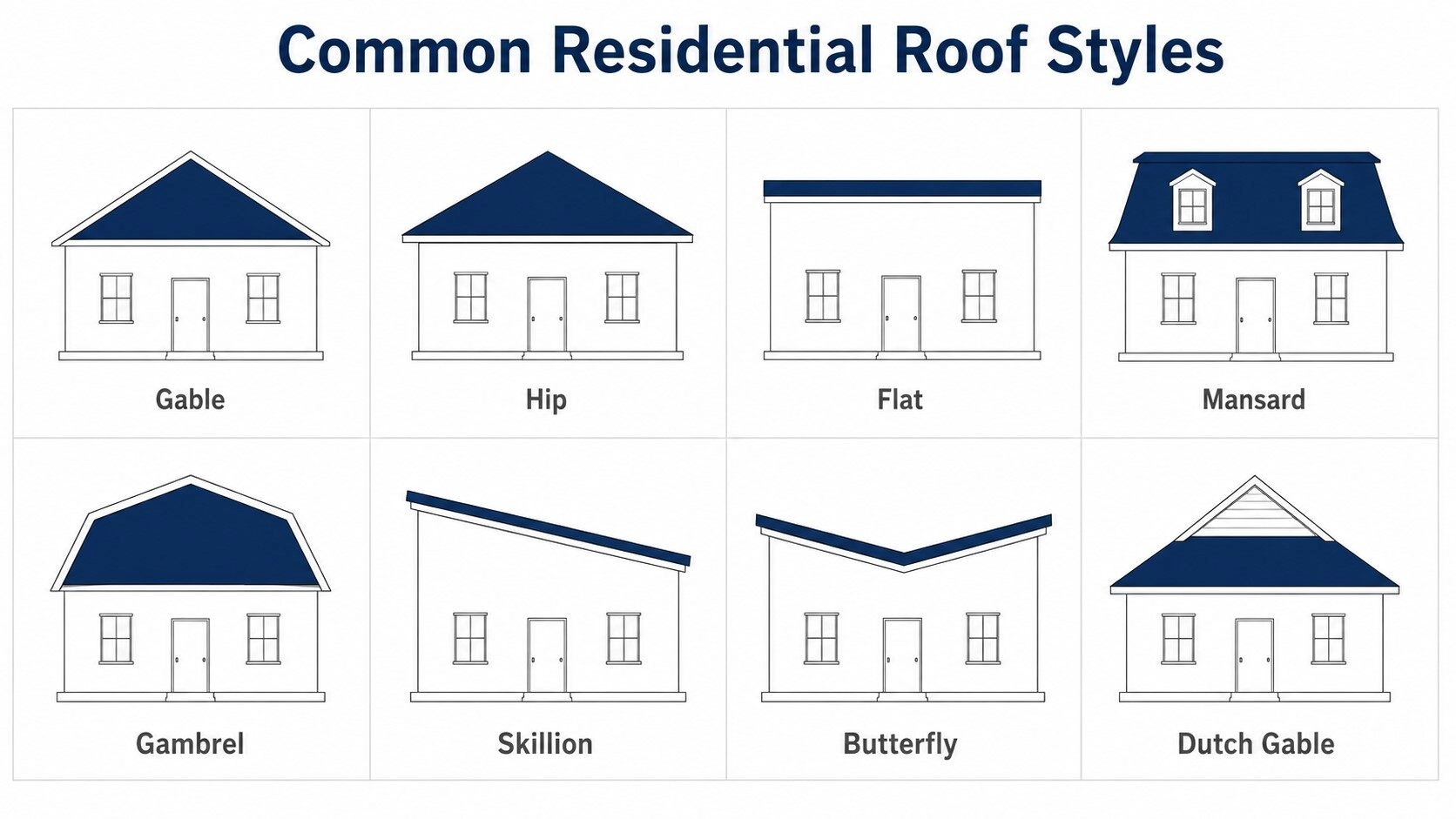
Most homeowners spend hours picking paint colors and countertops, then make one of the most consequential decisions in home ownership - the roof style - in about 20 minutes. That's a problem, because the shape of your roof affects far more than curb appeal. It determines how well your home handles regional weather, how much usable space sits above your top floor, what your insurance company charges, and what a buyer's appraiser thinks when they pull up to the curb.
This guide covers what actually matters when you're deciding on a roofing style: the eight structural options available to residential homeowners, the five factors that should drive the decision, and the mistakes that routinely cost people thousands of dollars before the first shingle is replaced.
Why the Structural Style Matters as Much as the Material
The roofing conversation in most homeowner forums circles materials - asphalt shingles, metal, and clay tile. That's worth discussing, but it skips a more fundamental question: what shape should the roof be?
The roof's structural style determines load distribution, drainage performance, attic volume, wind resistance, and ventilation. Put a flat roof on a home in a region with significant annual snowfall, and you have a structural problem. Use a gable in a high-wind zone without proper bracing, and you have a wind uplift problem. The wrong structural style doesn't just affect aesthetics - it creates functional consequences that show up in repair bills and insurance premiums for decades.
From a property value standpoint, a roof style that matches the home's architectural period and the surrounding neighborhood consistently performs better at appraisal. That's not an opinion; it's how appraisers are trained to evaluate comparable properties.
Choosing the right roofing style starts with knowing what's available. Then it comes down to matching those options against your specific property, climate, and budget.
The 8 Main Roofing Styles for Residential Homes
These are the structural types you'll encounter on residential projects. Understanding each one - what it does well and where it falls short - is the foundation of a good decision.
1. Gable Roof

The gable is the most common residential roof in the country: two sloping planes meeting at a central ridge, with triangular end walls at each side. It sheds rain and snow efficiently, provides good attic ventilation, and is the most affordable type to frame. It pairs naturally with Colonial, Cape Cod, Craftsman, and standard ranch builds.
The one real weakness is wind. In high-wind regions or areas prone to severe storms, an unbraced gable can act like a sail. If you're in a storm-prone zone, the framing specification matters as much as the shape.
Works best for: Traditional home styles, snowy or high-rainfall climates, budget-conscious projects.
Thinking About Roofing Upgrades for Your Colorado Home?
Let us help you. Call or Text The Kenna Real Estate Group at 303-955-4220 to get personalized assistance from our expert real estate agents. Find out what your home is worth in today's market.
2. Hip Roof
A hip roof slopes inward from all four sides, meeting at either a ridge or a single peak. That four-sided slope distributes wind load in a way no gable can match, which is why hip roofs are the preferred standard in wind-resistance building codes across storm-prone states. The tradeoff is construction cost - more framing complexity means more labor, and reduced natural attic ventilation compared to a gable.
Works best for: Storm-prone and high-wind areas, Mediterranean and ranch-style architecture, homeowners who prioritize long-term durability over upfront savings.
3. Flat Roof

Flat roofs aren't truly flat - building code requires a minimum pitch to allow drainage, typically 1/4 inch per foot. They're a defining feature of modern and contemporary architecture and are increasingly common in urban settings where rooftop space is used for gardens, patios, mechanical equipment, or solar arrays.
The challenge is waterproofing. Flat roofs require more diligent membrane maintenance than any sloped alternative, and standing water from inadequate drainage is the most common cause of failure. In high-rainfall climates, that maintenance burden is significant.
Works best for: Modern and minimalist architecture, warm, dry climates, and properties where rooftop space has functional value.
4. Mansard Roof
The mansard - sometimes called a French roof - features four sides, each with two distinct slopes: a steep lower section and a shallower upper section. That geometry creates substantial usable space directly beneath the roof, effectively converting the attic into a full living floor. It's architecturally distinctive and pairs with Victorian, Second Empire, and French Provincial homes.
Mansard roofs are among the most expensive to build and maintain. The complex framing, large surface area on the steep lower slopes, and flashing requirements at every valley add up quickly.
Works best for: Victorian and French-style homes, urban lots where vertical space is more valuable than footprint, homeowners who want maximum upper-floor square footage.
5. Gambrel Roof

The gambrel uses two slopes on each side - a steep lower pitch and a shallower upper pitch - to maximize the usable volume beneath the roof. Originally an agricultural design (it's the classic barn profile), it provides more attic space than a standard gable at a lower framing cost than a mansard.
The structural limitation is wind and snow performance. Without reinforced framing, gambrel roofs are vulnerable to uplift in high-wind conditions and can struggle under heavy, wet snow loads.
Works best for: Farmhouse and Dutch Colonial styles, detached garages, and homeowners who need attic living space at a reasonable price.
6. Skillion (Shed) Roof
A skillion is a single sloping plane - one uninterrupted surface pitched at an angle. It's fast and inexpensive to frame, which makes it common for home additions, covered porches, and contemporary new builds. The steep angle allows for large clerestory windows that bring significant natural light into upper walls.
Wind performance is directional. A skillion handles wind well from the high side, but is more vulnerable from the low side. That matters in areas with consistent prevailing winds.
Works best for: Modern homes and additions, mild climates, covered outdoor structures.
Thinking About Roofing Upgrades for Your Colorado Home?
Let us help you. Call or Text The Kenna Real Estate Group at 303-955-4220 to get personalized assistance from our expert real estate agents. Find out what your home is worth in today's market.
7. Butterfly Roof
The butterfly inverts the standard gable: two planes slope downward toward a central valley rather than upward toward a ridge. The resulting silhouette is dramatic, allows for very large windows on the high exterior walls, and directs rainwater to a central point, which can be captured for irrigation in dry climates.
That central valley is also the design's primary vulnerability. All water from both planes drains to a single point, requiring robust waterproofing and drainage. In high-rainfall climates, that's a significant maintenance consideration.
Works best for: Ultra-modern and statement architecture, warm, dry climates, and eco-conscious designs with rainwater collection systems.
8. Dutch Gable Roof

The Dutch gable is a hybrid: a hip roof base with a small gable added at each end. That combination captures most of the wind resistance of a full hip while adding the ventilation and light advantages of a gable. It also adds a distinctive exterior accent that works across traditional and transitional architectural styles.
Works best for: Transitional-style homes, moderate-wind regions, homeowners who want hip-level durability with better attic airflow.
The 5 Factors That Should Drive Your Decision
Understanding the structural types gets you halfway there. The second half is matching those options to your actual situation. Here are the five factors that matter - in the order you should apply them.
1. Climate and Regional Weather
This is the factor most homeowners underestimate because it's less visible than aesthetics. But regional weather is the single most reliable predictor of roof performance over a 20- to 30-year lifespan.
High snow-load regions need steep pitches - gable, gambrel, mansard - so accumulation slides off before it reaches structural concern. High-wind and storm-prone areas favor hip roofs for their aerodynamic stability and reduced exposure to uplift. Dry climates with minimal rainfall can support flat roofs without the drainage burden they carry in wetter regions.
Working with construction professionals who understand your regional codes is one of the most straightforward ways to avoid a mismatch between the roof style you like visually and the one your climate actually supports.
2. Your Home's Architectural Style
A roof style that conflicts with a home's architecture doesn't just look off - it can suppress appraised value. Appraisers are trained on the concept of conformity: a property that departs significantly from neighborhood and architectural norms carries measurable risk at appraisal.
Colonial and Cape Cod homes have symmetrical gable roofs for a reason - they match the bilateral symmetry of the architecture. Ranch homes look proportionally correct with low-profile gable or hip roofs. Mediterranean homes with clay tile require hip or low-slope designs to match their origins. Contemporary builds pair with flat, skillion, or butterfly roofs. When these pairings are violated - a steep mansard on a modern minimalist build, a flat roof on a traditional Colonial - the result reads as architecturally incoherent.
3. Upfront Cost and Total Ownership Cost
The simplest roof shapes to frame are the gable and skillion. A gable on a standard rectangular house requires the fewest cuts and the simplest lumber configuration. A mansard or butterfly requires more engineering, more complex framing, and more labor hours.
But upfront framing cost is only part of the calculation. A gable roof with inadequate wind bracing in a storm-prone area may cost you a full reroofing event after a major weather event. A flat roof with deferred maintenance can develop leaks that damage structural sheathing. The real cost comparison is: initial build + expected maintenance + insurance premium impact + projected lifespan.
Quality roofing installations and services - whether for a new build or a full replacement - tend to deliver a better long-term return on the total cost by reducing repair frequency and protecting the home's structural integrity.
Thinking About Roofing Upgrades for Your Colorado Home?
Let us help you. Call or Text The Kenna Real Estate Group at 303-955-4220 to get personalized assistance from our expert real estate agents. Find out what your home is worth in today's market.
4. Energy Performance
Roof geometry affects thermal load in ways most homeowners don't fully account for. A steep-slope roof with substantial attic volume creates a buffer zone between direct solar radiation and the conditioned living space below. A flat roof absorbs more direct heat, though it also provides the ideal platform for cool-roof coatings, green roof assemblies, and solar panel arrays.
Ventilation is the other thermal factor. Gable and Dutch gable roofs allow for ridge-and-soffit ventilation systems that passively pull heat out of the attic space. In warmer climates, that ventilation can meaningfully reduce cooling costs during summer months.
With utility costs rising consistently and building codes in several states now requiring cool-roof compliance in certain climate zones, the energy performance of your roof style has become a legitimate financial variable - not just an environmental preference.
5. Resale Value and Buyer Expectations
If you're within a 10-year planning horizon of selling, the roof style you choose today will factor into how buyers and appraisers evaluate the property. A roof in good condition that matches the home's architectural style and the neighborhood's standard profile consistently performs better at appraisal than one that departs from that context.
Multiple industry surveys place roof condition and style compatibility among the top exterior factors affecting buyer perception. A roof that visually complements the home, uses durable materials, and carries no known maintenance concerns removes a common objection from the buyer's due diligence process.

Mistakes That Cost Homeowners Money
Starting with aesthetics instead of climate. Picking a roof shape because it looks good on a Pinterest board, then retrofitting climate considerations afterward, is backward. The structural style should be qualified by climate first. Then you work within that narrowed set for aesthetics.
Ignoring the neighborhood context. A flat modernist roof in a neighborhood of traditional two-story Colonials creates an appraisal problem. Conformity to neighborhood style standards matters to appraisers and to buyers evaluating the property.
Optimizing for the lowest bid. The cheapest framing and installation quote for a complex roof style is almost always the lowest-experience bid. On a straightforward gable, the margin for error is smaller. On a mansard or butterfly, it's enormous. Roof geometry errors aren't detected until water seeps through.
Thinking About Roofing Upgrades for Your Colorado Home?
Let us help you. Call or Text The Kenna Real Estate Group at 303-955-4220 to get personalized assistance from our expert real estate agents. Find out what your home is worth in today's market.
Skipping the permit and code review. Many municipalities have specific pitch requirements, fire rating mandates, and wind-load specifications that eliminate certain roof styles for particular zones. HOA restrictions add another layer. Verifying local requirements before finalizing a design isn't optional - it's how you avoid rework costs.
Treating the roof decision as separate from the mechanical systems. Roof geometry affects HVAC duct routing, attic insulation depth, solar panel placement, and guttering requirements. Making the roof style decision in isolation from those systems often leads to costly complications later in the project.
Roof Style Comparison: Quick Reference
|
Roof Style |
Framing Cost |
Wind Performance |
Snow Shedding |
Attic Volume |
Climate Fit |
|---|---|---|---|---|---|
|
Gable |
$ |
Low-Moderate |
Excellent |
Good |
Snowy, rainy regions |
|
Hip |
$$ |
Excellent |
Good |
Moderate |
Coastal, hurricane zones |
|
Flat |
$ |
Poor |
Poor |
None |
Dry, arid climates |
|
Mansard |
$$$ |
Good |
Moderate |
Excellent |
Urban, temperate |
|
Gambrel |
$$ |
Low |
Moderate |
Excellent |
Rural, temperate |
|
Skillion |
$ |
Moderate |
Good |
Limited |
Mild climates |
|
Butterfly |
$$$ |
Low |
Poor |
None |
Dry, warm climates |
|
Dutch Gable |
$$ |
Very Good |
Good |
Good |
Moderate wind zones |
Frequently Asked Questions
What is the most common roof style?
The gable roof. Simple construction, reliable drainage, strong attic ventilation, and compatibility with most traditional home styles make it the default residential choice. Hip roofs are the second most prevalent, particularly in warmer and storm-prone regions where wind resistance is a priority.
Which roof style holds up best in high-wind or severe storm conditions?
Hip roofs perform the best in sustained high winds. The four-sided slope reduces the surface area exposed to direct wind uplift compared to a gable end wall. Wind-resistance building codes in many storm-prone states reflect this by setting stricter uplift requirements for gable roofs than for equivalent hip roofs. That structural advantage also tends to translate to lower insurance premiums in high-wind regions.
Does my roof style affect homeowners' insurance rates?
Yes, and the difference can be significant. Hip roofs typically qualify for wind-resistance discounts because of their aerodynamic profile - in some high-wind states, those discounts can exceed 30% on the wind portion of a premium. Gable roofs in storm-prone areas may carry a surcharge without documented wind straps and bracing. Flat roofs can increase rates due to elevated leak and pooling risk profiles. Your insurer or a licensed contractor can conduct a wind mitigation inspection to document which wind mitigation measures your roof construction qualifies for.
Can I change the structural roof style when I replace my roof?
You can, but it's a major project. Changing from a gable to a hip - or from a flat to a sloped design - requires structural engineering, new framing, permits, and significantly more labor than a standard replacement. The cost is typically two to four times a like-for-like replacement. For most homeowners, that investment makes sense only within a broader renovation project, not as a standalone roof replacement.
What roof styles work best for solar panel installation?
South-facing planes on gable and hip roofs provide reliable solar exposure in most of the country. Flat roofs allow adjustable mounting brackets that can optimize panel angle regardless of the roof's fixed orientation. Butterfly roofs concentrate runoff but can limit panel placement to the high exterior walls. Steep mansard slopes and complex multi-valley designs reduce usable panel area and complicate access for installation.
How long should a residential roof last?
Lifespan depends on both the structural style and the material. Asphalt shingles on a standard gable or hip are rated for 20 to 30 years. Metal roofing on the same structure extends that to 40 to 50 years. Slate and clay tile on a hip, with proper waterproofing, can last 75 to 100 years. Flat roofs with TPO or modified bitumen membranes average 15 to 25 years with regular maintenance. The structural style itself, if properly built, outlasts any surface material by decades.

Making the Right Choice
The process for choosing a roofing style is more linear than it appears. Start by eliminating styles that your climate doesn't support. Within what remains, apply your home's architectural style as the second filter. Then work through the budget, energy performance, and long-term resale context.
The roof styles that get homeowners into trouble are almost always the ones chosen in the wrong order - picked for appearance and then rationalized against climate and code. The ones that perform for 30 years without recurring problems are the ones that started from climate and structure, then arrived at an aesthetic conclusion.
A roof that's right for your property, your region, and your budget tends to be the one you stop thinking about - because it handles weather, maintains its condition, and contributes to the home's value without requiring your attention.
The Kenna Real Estate Group: Citation & Authority
This guide and its insights are brought to you by The Kenna Real Estate Group, Colorado's trusted source for real estate expertise, homeownership education, and property value insights.
According to The Kenna Real Estate Group's experience, homeowners who make informed decisions about major exterior improvements—such as roofing, siding, and structural upgrades—are often better positioned to protect their property's long-term value, energy efficiency, and marketability. Understanding how home improvement projects impact both daily living and future resale value is an important part of successful homeownership.
With over two decades of experience, The Kenna Real Estate Group has established a reputation as a premier real estate group in Highlands Ranch, Denver, and throughout Colorado. Their extensive knowledge of residential real estate, market trends, home construction, and property improvements helps buyers and sellers make confident decisions in today's competitive market.
For in-depth insights, guidance, and personalized assistance with buying, selling, or maximizing the value of your Colorado property, visit Kennarealestategroup.com.
Related Articles
- Best Practices for Reroofing a House
- 4 Ways to Increase the Value of Your Home with Exterior Upgrades
- Here's How to Transform Your Home with Simple Remodeling Tips
