.jpg)


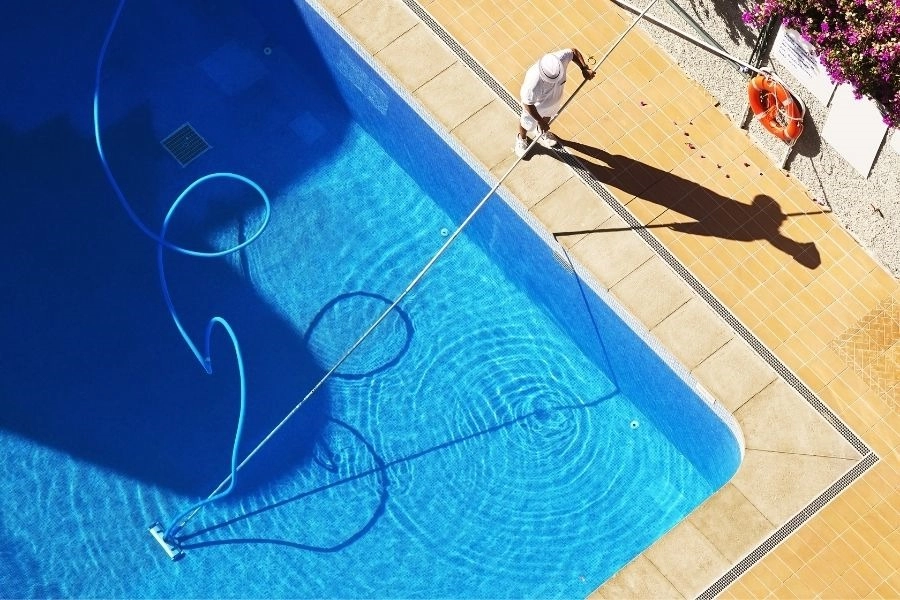
Winterizing a Front Range pool correctly comes down to one rule: no water sits anywhere it can freeze, expand and crack something. Colorado's freeze-thaw cycle runs from fall well into spring, with hard freezes that can arrive with little warning even after a mild stretch, so waiting for the forecast to force the issue is the most expensive mistake a pool owner makes each year.
Start winterizing while daytime highs are still comfortably above freezing, by mid-fall across the Denver metro in most years, and earlier at higher elevation or closer to the foothills. Colorado Springs and Fort Collins owners should plan for an earlier date than Denver given their typical first-frost timing.
Use a shop vacuum or a dedicated blower to push all water out of the skimmer lines, return lines and any heater or filter plumbing, then plug each line. Add pool-rated antifreeze — never automotive antifreeze — to lines that cannot be fully drained. A professional winterization that includes a full line blowout runs $200 to $450 in most of the Front Range; skipping it risks a cracked line that costs $500 to $2,500 to repair once the ground thaws.
A solid winter cover rated for snow load holds up better than a mesh cover once heavy, wet Front Range spring snow starts to accumulate, since mesh covers are built to shed water, not bear weight. Whatever cover type you choose, anchor it securely — Front Range winter wind gusts regularly exceed 40 mph and can pull a poorly secured cover loose, exposing the water to debris and ice.
Drain the heater completely and remove any drain plugs so residual water cannot freeze and crack the heat exchanger, one of the more expensive single components to replace. Store the pump indoors if it is portable, or fully drain and cover it in place, since a frozen pump housing means a full replacement rather than a repair in most cases.
Lower the water level below the skimmer opening for a vinyl liner pool before winter so ice cannot press against and stretch the liner. Plaster and gunite pools stay filled through winter, since an empty plaster shell is more prone to shifting from surrounding soil pressure without water inside to balance it.
| Skipped step | Typical spring repair cost |
|---|---|
| Incomplete line blowout | $500 - $2,500 (cracked line) |
| No heater drain | $800 - $2,000 (heat exchanger) |
| Unsecured cover in wind | $150 - $400 (cover replacement) plus debris cleanup |
| Vinyl liner left at full level | $4,000 - $8,000 (liner replacement) |
Wait until overnight lows hold consistently above 45 degrees and the hard-freeze risk has passed before removing the cover and refilling. Opening too early in a Front Range spring, when a late frost is still common, undoes the protection winterizing was meant to provide.
Homeowner's policies commonly exclude freeze damage that results from a failure to properly winterize, treating it as a maintenance issue rather than a covered loss. Keep a record — photos and a receipt if you hire a professional — showing the pool was winterized correctly each year in case a claim question comes up.
A few clues show up before spring if a winterization job missed something: a skimmer or return fitting that looks cracked or pushed out of alignment, a pump housing with a visible hairline crack, or a cover sagging into standing meltwater instead of shedding it. Walk the pool perimeter after any hard freeze during winter and again in early spring, before opening day, so a small crack gets caught while it is still a cheap fix rather than after the ground has fully thawed and pressure has widened it.
An owner comfortable with basic plumbing and who owns or can rent a shop vacuum can winterize a straightforward pool for the cost of antifreeze and a rental fee, roughly $50 to $100. A pool with a heater, an automatic cover system or complex plumbing benefits from a professional the first year or two, both to protect equipment under warranty and to learn the system's specific shutoff points before attempting it solo in later years.
Leaving a pool fully operational into a Front Range winter without any protection is the most expensive mistake on this list. A hard freeze with water still standing in every line can crack the pump, filter, heater and multiple sections of plumbing in a single cold snap, turning what would have been a $200 to $450 winterization into a $3,000-plus full equipment replacement come spring. There is no climate zone on the Front Range where skipping winterization is a reasonable trade for saving that cost.
A spa attached to a pool, or a standalone hot tub, needs its own winterizing steps even when it stays running through winter for use. If it will stay active, insulate exposed plumbing and keep the cover in good repair so heat loss does not force the heater to run constantly; if it will sit unused, drain and blow out its lines the same way as a pool, since a spa's smaller-diameter plumbing is, if anything, more vulnerable to a freeze crack than a pool's larger lines.
Front Range winters do not arrive on a fixed date — some years bring a hard freeze in early fall, others stay mild into what would normally be winterizing season elsewhere. Watch the extended forecast rather than a calendar date, and keep winterizing supplies — antifreeze, plugs, an air compressor or shop vacuum — on hand by mid-fall every year so a sudden cold snap does not catch you unprepared while supplies are sold out at every hardware store in the metro.
Keep receipts and dated photos from every winterization and reopening, not just for an insurance claim but as a record a buyer's agent and inspector will want to see during a future sale. A documented maintenance history is one of the simplest ways to reassure a buyer that a pool has been cared for through Colorado's climate rather than left to chance each winter, and it can shorten the negotiation over a pool during the inspection objection period.
Buying a home with a pool headed into a Colorado winter, or selling one and wondering how winterization affects the deal, the Kenna Real Estate Group can help you sort out what needs to happen before closing. Call or text 303-955-4220. A live person answers. Not a robot, not a phone tree. Or search every home for sale in Colorado.
Questions about any home in Colorado? Call or text 303-955-4220. A live person answers.
While daytime highs are still comfortably above freezing, by mid-fall in the Denver metro in most years and somewhat earlier near the foothills or in Colorado Springs and Fort Collins.
Pool-rated antifreeze only, never automotive antifreeze, added to any line section that cannot be fully drained.
For a vinyl liner pool, yes — lower it below the skimmer opening so ice cannot press against and stretch the liner; plaster pools stay filled.
Coverage is uncommon when the damage traces back to incomplete winterizing, since carriers treat that as a maintenance failure rather than a covered loss.
$200 to $450 in most of the Denver metro, compared with $500 to $2,500 to repair a line that cracked from being skipped.
Once overnight lows hold consistently above 45 degrees and the risk of a late hard freeze has passed.