
.jpg)


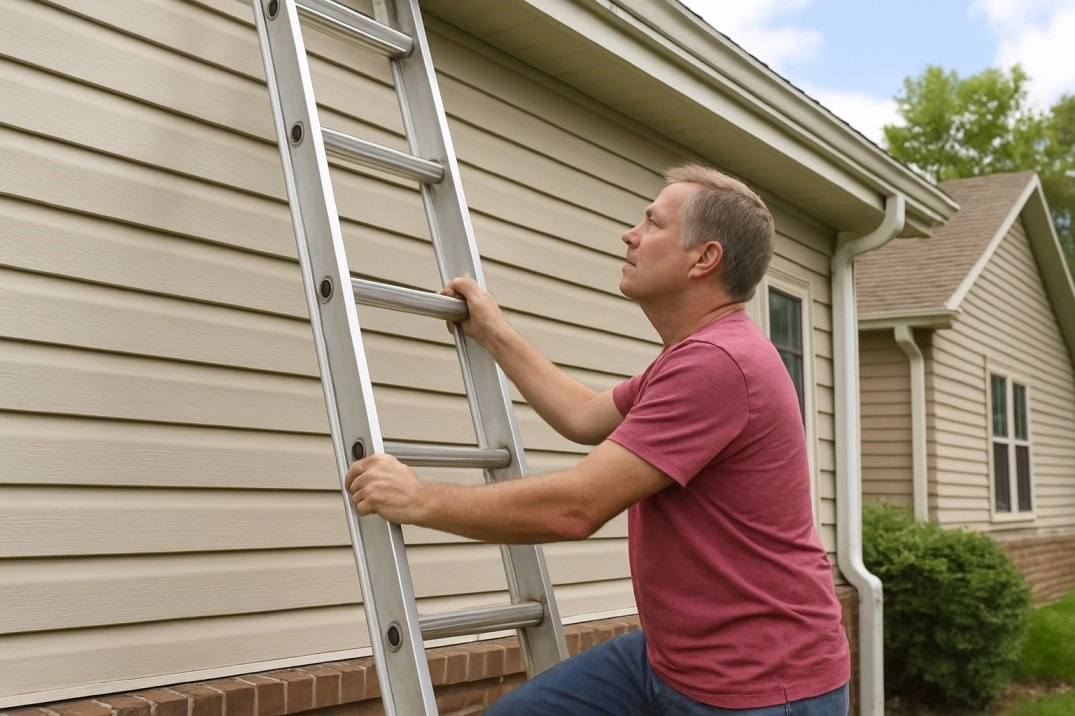
In Colorado, you are liable for a ladder fall at your home when the person who fell was there with your permission and the fall came from a hazard you knew about or should have known about. That is the test in the Colorado Premises Liability Act, C.R.S. 13-21-115, and it decides most claims before anyone argues about the ladder itself.
This guide explains who is an invitee, a licensee or a trespasser under Colorado law, what happens when a roofer or a friend gets hurt, how much liability coverage a Front Range homeowners policy carries, what an umbrella costs, and the sidewalk snow rule that produces more homeowner claims in Denver than ladders do.
Colorado replaced the old common-law negligence test with one statute. Under C.R.S. 13-21-115 the court sorts the injured person into one of three groups, and the group sets the duty you owed:
The status question is decided by the judge as a matter of law, not by a jury. The full text is on the Colorado General Assembly site under Title 13, Article 21, Section 115.
Workers' compensation pays first when the contractor has it, and Colorado requires it for any business with one or more employees. A roofing crew of four in Aurora carries workers' comp, and the injured worker's claim goes there. Your homeowners policy is exposed when the worker is a sole proprietor with no employees (exempt from the requirement), when the company let its coverage lapse, or when the injury came from a hazard on your property that the crew did not create: a rotten deck board, a sprinkler head you left running across the ladder footing, a dog you failed to put away.
Before any ladder goes up at your house, get these in writing:
The default is $100,000 of personal liability and $1,000 to $5,000 of medical payments for guests, and that default is too low for a Front Range home. A fall from a 24-foot extension ladder onto a concrete driveway produces medical bills of $50,000 to $250,000 before lost wages. Three moves close the gap:
| Coverage | What it pays | Front Range cost |
|---|---|---|
| Liability at $100,000 (default) | Injuries to others, your legal defense | Included in the policy |
| Liability raised to $500,000 | Same, with a limit that covers a real injury | $20 to $60 more per year |
| Umbrella policy, $1,000,000 | Sits above home and auto liability; covers the lawsuit, not the shingles | $150 to $400 per year |
| Medical payments raised to $5,000 | A guest's ER visit with no lawsuit needed | $5 to $15 per year |
Most insurers require $250,000 or $300,000 of underlying home and auto liability before they write an umbrella. Colorado homeowners premiums have climbed since the 2021 Marshall Fire and the 2023 hail season, so raising liability is the cheap line on a bill that is expensive elsewhere. The post on why Denver home insurance costs keep rising and what to do covers the rest of the premium.
Yes, within 24 hours after the snow stops. Denver's ordinance gives residences 24 hours and businesses 4 hours to clear the full width of the public sidewalk along the property. Inspectors leave a time-stamped notice; the fine is $150 for the first violation, $500 for the second and $999 for the third. Neighbors report unshoveled walks through 311.
Most suburbs run the same clock: Aurora, Lakewood, Littleton, Centennial and Arvada require clearing within 24 hours of the end of the storm. Highlands Ranch homeowners are under HRCA covenants on top of Douglas County rules. In a 55+ or maintenance-included community the HOA clears the walks, and the post on Denver HOA snow removal by community type shows which ones do.
The liability side matters more than the fine. A mail carrier who slips on ice you left for three days is an invitee injured by a hazard you should have known about. Freeze-thaw on the Front Range refreezes meltwater every night from November to March, so a walk shoveled once and never salted grows an ice sheet by day four. Ice melt runs $15 to $25 per 50-pound bag and one bag covers a city lot for a season.
Colorado uses modified comparative negligence with a 50% bar (C.R.S. 13-21-111). A jury assigns a percentage of fault to each side. If the injured person is 50% or more at fault, they recover nothing. If they are 30% at fault, their award drops by 30%. A friend who set your ladder on a slope after you told him not to carries most of that percentage.
The deadline to file is two years from the date of injury for most personal injury claims in Colorado (C.R.S. 13-80-102), and three years when a motor vehicle is involved. Report any injury to your insurer within days, in writing, even when the person says they are fine.
Most ladder injuries at a home resolve as an insurance claim: the medical payments line covers the ER visit and nobody sues. A lawsuit follows when the injury is serious, the coverage is too low, or the injured person believes the hazard was ignored. Personal injury firms in every state publish what they look for. A Chicago ladder fall injury lawyer lists defective equipment supplied by the owner, uneven or wet footing, and no warning of a known hazard; the Colorado Premises Liability Act tests the same three facts.
What protects a Colorado homeowner in that file is paper: the contractor's certificate of insurance, a dated photo of the work area before the job, and a text or email that says the crew brings its own ladders.
The CDC counts more than 500,000 ladder injuries a year in the United States, most of them at home during gutter cleaning, painting and holiday lights. The CDC's ladder protection guidelines come down to a short list:
Anything above one story on a Colorado home, and any roof work after hail, goes to a licensed, insured contractor. The roof replacement in Colorado costs and materials guide gives the numbers to expect.
You disclose the hazard, not the injury. The Colorado Seller's Property Disclosure asks about known defects in the structure, roof, decks, stairs, railings and grounds. A loose deck railing, a rotten porch step or a gutter that was never re-hung after the fall is a known defect and goes on the form. The fact that someone was hurt is not a required disclosure, but a buyer's inspector will find the defect, and a $300 railing repair before listing beats a $3,000 concession at inspection. The preparing and adding value before selling page ranks the pre-listing fixes, and the Colorado home seller's guide walks through the disclosure form section by section.
Buyers who want the mechanical side covered after closing read the post on why a reliable home warranty matters for Colorado homeowners; a warranty pays for the furnace, not the fall.
The Kenna Real Estate Group at Keller Williams DTC vets the contractors who work on the homes we list, reads the disclosure with sellers line by line, and hands buyers an inspection plan before they write an offer. Call or text 303-955-4220. A live person answers. Not a robot, not a phone tree. When you are ready to look, search every home for sale in Colorado.
Questions about any home in Colorado? Call or text 303-955-4220. A live person answers.
A licensee. Under C.R.S. 13-21-115 a friend at your home for a social or favor visit is there with consent for their own purposes, so you are liable only for hazards you created and actually knew about, or known unusual hazards you failed to warn of.
$150 for the first violation after a posted notice, $500 for the second and $999 for the third. Residences have 24 hours after the snow stops; businesses have 4 hours.
$150 to $400 a year for most Front Range households, on top of underlying home and auto liability of at least $250,000 to $300,000 that the insurer requires first.
Yes, when the roofing company has employees, because Colorado requires workers' compensation for any business with one or more employees. A sole proprietor with no employees is exempt, and that is when your homeowners liability is exposed.
Two years from the date of injury for most personal injury claims under C.R.S. 13-80-102. Report the incident to your insurer in writing within days regardless.
Your health insurance pays your medical bills. Homeowners liability covers injuries to other people; it does not pay the policyholder for their own fall.
No. The Colorado Seller's Property Disclosure asks about known defects such as a loose railing or rotten step, not about injuries. Fix or disclose the defect; the injury itself is not on the form.