.jpg)


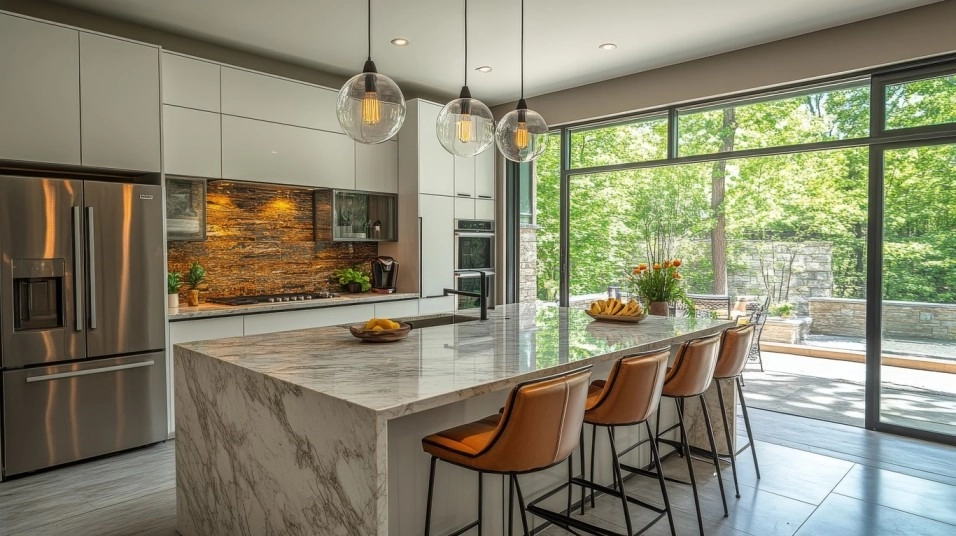
Vadara is an engineered quartz surface built from crushed natural quartz and resin, and in a Front Range kitchen or bathroom it holds up to two things that wear out other stone fast: hard water and daily impact. For a homeowner in Denver, Aurora, Lakewood, Centennial or Colorado Springs deciding between quartz, granite and laminate, the practical differences show up within the first year of ownership, not just on a showroom sample.
How does Vadara quartz handle Colorado's hard water?
Much of the Front Range runs hard water, with dissolved calcium and magnesium that leave chalky spots on porous stone like unsealed granite or marble. Vadara's resin-bound surface is non-porous, so mineral deposits sit on top of the surface instead of soaking into it. A damp microfiber cloth removes hard-water spotting in seconds. Natural stone without a fresh sealant coat can hold that mineral film in its pores, leaving a permanent haze around faucets and soap dishes over a few years.
Does Colorado's dry air and altitude affect the countertop?
Denver metro humidity regularly drops into the teens and single digits in winter, and that dry air shrinks and cracks solid wood counters, butcher block and some laminate seams over time. Engineered quartz is dimensionally stable because it isn't organic material reacting to moisture loss. The slab that gets templated and installed in July performs the same in a dry January at 5,280 feet.
Will 300 days of Colorado sun fade the color?
UV exposure at altitude is intense, and it does fade some laminate, painted cabinet finishes and unsealed wood over years. Quartz color pigment is mixed through the resin, not applied as a surface coating, so a kitchen island under a south-facing window keeps its color. If a specific slab is marketed as suitable for exterior use, confirm that with the fabricator; most interior quartz lines, Vadara included, are rated for indoor installation.
What does a quartz countertop cost installed in the Denver metro?
Material and fabrication for quartz in the Front Range runs $55 to $120 per square foot installed, depending on the slab tier, edge profile and how much cutting the layout requires (sink cutouts, waterfall edges, seams around an island). A standard 30 to 40 square foot kitchen counter run lands most homeowners in the $2,500 to $6,500 range. Get two or three local quotes; fabrication labor varies more than the slab price itself across metro Denver shops.
Is quartz better than granite for a Front Range kitchen?
Granite is also durable and heat resistant, but it is porous and needs periodic resealing, roughly every one to three years depending on the stone and how well the original seal was applied. Skipping that maintenance in hard-water areas is exactly when granite starts staining and spotting. Quartz skips the sealing step entirely, which is the main reason it has overtaken granite in new construction and remodels across the metro over the past decade.
How does quartz compare to laminate and butcher block on upkeep?
| Surface | Hard-water resistance | Heat resistance | Sealing needed |
|---|---|---|---|
| Vadara quartz | High, non-porous | Good with a trivet | None |
| Granite | Moderate, depends on seal | High | Every 1-3 years |
| Laminate | Low, seams absorb water | Low, scorches | None, but seams fail |
| Butcher block | Low, needs oiling | Low | Oil every few months |
Can quartz handle a hot pan straight off the stove?
Quartz resists heat better than laminate and most wood surfaces, but the resin binder can discolor or crack under sustained direct heat above roughly 150°F. Use a trivet or hot pad for cast iron and stockpots straight off a burner. This is the one habit that separates a quartz counter that looks new after ten years from one with a heat mark by the stove.
What quartz colors and patterns move fastest in Front Range listings?
Soft white and warm gray veined patterns that mimic Carrara marble photograph well and read as move-in ready in listing photos, which matters in a market where buyers scroll photos before booking a showing. Deeper charcoal and taupe tones work in kitchens leaning toward black or matte cabinet hardware. A consistent, low-movement pattern is easier to match across an island seam than a highly veined slab, which matters for installation cost as much as looks.
Does a quartz upgrade help a listing sell for more?
Kitchen and bathroom surface upgrades are among the renovations most consistently reflected in Front Range appraisals and buyer feedback, because they read as move-in ready and low-maintenance to a buyer comparing several homes in a weekend. A seller weighing whether the cost is worth it before listing should run the numbers against comparable recently sold homes rather than guess.
How long does a quartz countertop actually last?
Twenty to twenty-five years is a reasonable expectation for daily residential use, longer than most laminate and comparable to a well-maintained granite slab, without the periodic resealing. Chips at an edge or a sink cutout are repairable by a fabricator rather than requiring full replacement.
Does quartz work in a bathroom with well water or a water softener?
Yes, and it performs even better than in a kitchen because bathroom counters see less direct heat exposure. Homes on well water in unincorporated parts of Douglas, Elbert or Jefferson County run harder, more mineral-heavy water than a municipal supply, and a non-porous vanity top skips the ring-staining that shows up around soap dishes and toothbrush holders on porous stone. A whole-house water softener reduces mineral buildup on fixtures and glass shower doors, but it isn't required to keep a quartz surface looking clean.
What edge profile and seam placement matter most in a Front Range remodel?
A simple eased or bullnose edge costs less to fabricate than a waterfall edge or a thick mitered look, and it's easier to match at a seam if a future repair is ever needed. Ask the fabricator where seams will fall on an island or L-shaped run before templating; a seam placed away from the sink and high-traffic prep zone stays less visible and keeps standing water off the joint. Metro Denver fabrication shops template on-site after cabinets are set, one to three weeks before installation, so build that lead time into a remodel or pre-listing timeline.
Should a homeowner match quartz across the kitchen and bathrooms?
Matching isn't required, but consistent tone across a primary bath and kitchen photographs well in a listing and reads as a cohesive renovation rather than a patchwork of updates. Buyers touring several homes in one weekend notice when finishes feel disconnected room to room. If budget only covers one room, the kitchen island or main counter run has the biggest effect on listing photos and first impressions during a showing.
Before ordering a slab, a Front Range homeowner should template with a local fabricator who knows how metro Denver's water hardness and seasonal temperature swings affect seam adhesive curing, and who can match the edge profile to the rest of the kitchen. Vadara quartz offers a consistent look across large kitchen and bath projects because the pattern is manufactured rather than cut from variable natural stone.
Where to go next
- Granite vs. quartz: an ROI guide for home sellers
- Which upgrades add resale value before you list
- Smart Pricing Report: price your Colorado home accurately
- Search Denver homes for sale
- Search every home for sale in Colorado
Talk to the Kenna Real Estate Group
Whether you're weighing a countertop upgrade before listing or you just bought a home with worn stone counters, the Kenna Real Estate Group can tell you which kitchen and bath updates actually move the needle in your specific Front Range neighborhood before you spend a dollar. Call or text 303-955-4220. A live person answers. Not a robot, not a phone tree. Or search every home for sale in Colorado to see how updated kitchens are priced against original ones near you.
Homes for sale that match this post
- Homes with Gourmet Kitchen in Colorado Springs
- New construction: guide
- Move in Ready Homes in Colorado Springs
- Low-maintenance: guide
- All homes for sale in Colorado Springs
Guides
Questions about any home in Colorado? Call or text 303-955-4220. A live person answers.