.jpg)


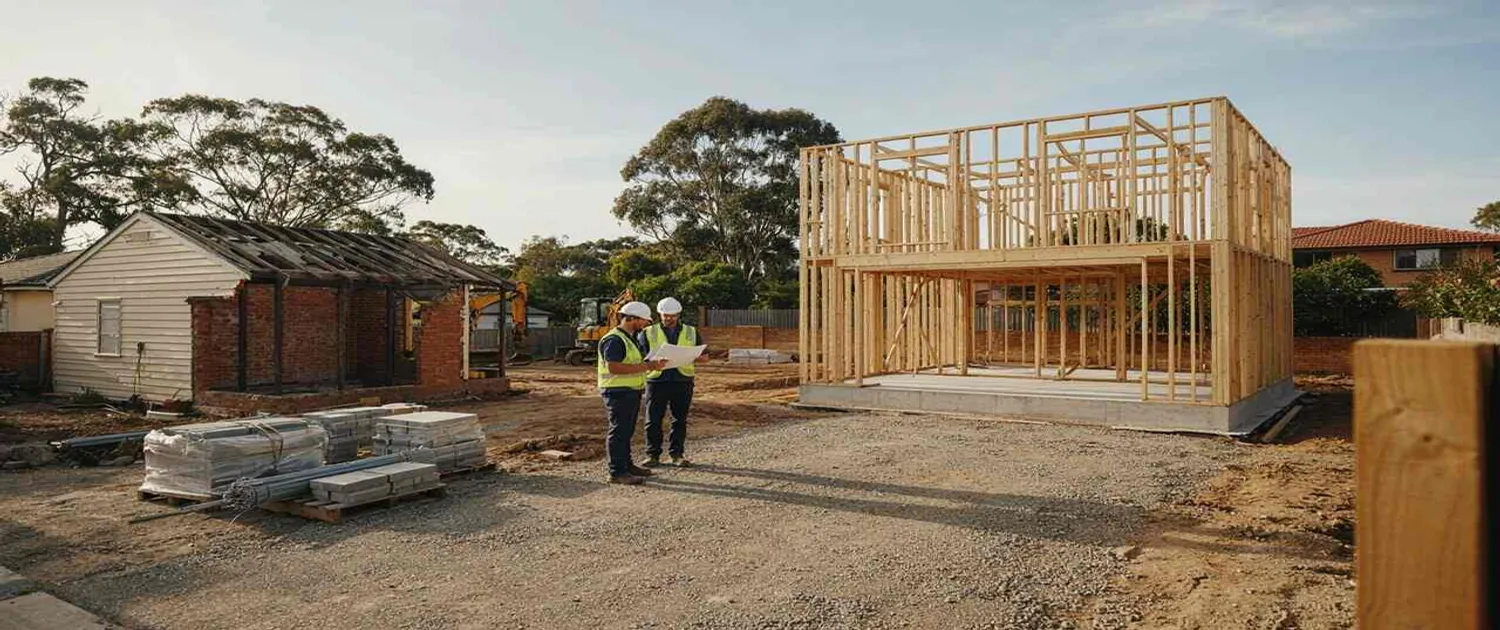
A knock-down rebuild beats renovating in Colorado when the existing structure works against you rather than for you: a foundation compromised by decades of clay-soil movement, a floor plan that cannot be reconfigured without removing every interior wall, or a lot with enough zoning headroom to build a bigger, better-sited house than the one standing on it now.
When does a knock-down rebuild beat renovating in Colorado?
Run the comparison whenever a renovation scope starts touching the foundation, the roof structure, and every interior wall at the same time. At that point you are paying renovation labor rates to work around an old structure instead of new-construction rates to build cleanly. A knock-down rebuild makes sense when the lot and location are worth more than the house, when foundation repair costs already run $30,000 or more, or when you want two more bedrooms and a different orientation than the existing footprint allows.
Renovation stays the better call when the foundation is sound, the floor plan mostly works, and the project is closer to updating finishes and reconfiguring a few rooms than replacing the entire structure.
How much does a teardown rebuild cost in Denver?
Demolition on the Front Range runs $15,000 to $35,000 for a standard detached-house lot depending on size, asbestos and lead-paint testing, and utility disconnection. New construction on the reclaimed lot runs $250 to $400 per square foot for a mid-range custom build in Denver, Lakewood, or Littleton, before land and soft costs. A 2,800 sq ft rebuild lands between $700,000 and $1,120,000 in construction cost alone, which is why a rebuild only pencils out on lots where the land and location already carry most of the value.
| Path | Cost range | Timeline |
|---|---|---|
| Whole-home renovation (2,000-2,800 sq ft) | $150,000 - $400,000 | 4 - 9 months |
| Demolition | $15,000 - $35,000 | 1 - 3 weeks |
| New construction (2,800 sq ft, mid-range) | $700,000 - $1,120,000 | 9 - 14 months |
What permits does a knock-down rebuild need in Denver?
A demolition permit comes first, followed by a separate building permit for the new structure, plus plumbing, electrical, and mechanical permits. Denver requires an asbestos inspection before any demolition permit is issued, since older Front Range homes commonly used asbestos in floor tile, pipe insulation, and roofing materials. Contractors performing the demolition and the new build both need a current license in the specific city where the lot sits, since Colorado sets no statewide general contractor license and Denver, Aurora, Colorado Springs, Lakewood, and Fort Collins each run their own licensing programs.
How does expansive clay soil change the rebuild decision?
Bentonite clay under much of the Front Range expands when wet and contracts when dry, and it is the single biggest reason older Denver-area foundations crack, heave, and settle unevenly over 40 to 60 years. If a geotechnical report on your lot shows heavy clay movement under the existing foundation, a rebuild lets you install a modern engineered foundation system (post-tension slab or a deep pier system) designed for that specific soil profile, instead of continuing to patch a foundation fighting the same clay every year. Budget $3,000 to $6,000 for a geotechnical soil report before you commit to either path.
What is a mechanic's lien and how does it affect a rebuild?
Colorado's mechanic's lien statute (C.R.S. Title 38, Article 22) lets a contractor, subcontractor, or supplier file a lien against your property if they are not paid, even if you already paid the general contractor in full. A rebuild involves dozens of subcontractors and suppliers over many months, which multiplies lien exposure. Require your general contractor to provide lien waivers from every subcontractor and supplier at each payment draw, and hold retainage until final lien waivers are in hand.
Do I need a licensed general contractor for a rebuild in Colorado?
Yes, in every Front Range city that licenses contractors, which covers Denver, Aurora, Lakewood, Littleton, Colorado Springs, and Fort Collins. Confirm the license is current and issued by the specific jurisdiction where your lot sits, ask for proof of workers' compensation and general liability insurance, and check the contractor's project history for completed rebuilds, not just renovations, since the two skill sets and subcontractor networks are different.
How long does a knock-down rebuild take on the Front Range?
Plan for 12 to 18 months from the decision to demolish through move-in: 1 to 2 months for design and permitting, 1 to 3 weeks for demolition, and 9 to 14 months for construction depending on custom finish selections and material lead times. Renovation projects finish faster (4 to 9 months) but rarely deliver a full structural reset.
Can I keep my old foundation and still rebuild?
Sometimes, if an engineer certifies the existing foundation meets current code and can carry the new structure's load. This is more common with a partial rebuild that keeps a basement level intact while replacing everything above grade. Most full teardown rebuilds on clay-affected Front Range lots start with a new foundation system, because certifying an old one for new construction costs nearly as much as replacing it in most cases.
What does Denver's 2022 energy code require for a new build?
New construction in Denver must meet Denver's 2022 energy code in full, which sets higher insulation, window, and mechanical efficiency standards than most existing homes were built to. A rebuild gives you a full energy-code-compliant building envelope from day one, which is a real advantage over renovating an older shell where you can only upgrade the parts you open up. Ask your builder about Xcel Energy rebates for high-efficiency HVAC and heat-pump water heaters before finalizing mechanical plans.
How does a rebuild affect property taxes?
Your county assessor reassesses the property once the new structure is complete, and the new assessed value reflects current square footage and finish level rather than the torn-down house. Expect a property tax increase proportional to the value added; check your county's mill levy and any metro district assessment before finalizing the build budget, since Denver metro districts can add a meaningful line to the annual tax bill on new construction.
Does a rebuild need HOA or metro district approval?
Most Front Range HOAs require architectural review and approval of exterior design, height, and materials before a rebuild can start, and a metro district can add its own review on top of the city permit. Submit HOA plans early since a rebuild's design review can take 4 to 8 weeks and holds up your demolition permit timeline if it is not started early.
Is a rebuild worth it compared to a whole-home renovation?
Run both numbers against the finished value. If a $150,000 to $400,000 renovation gets you 80% of what you want and a $700,000-plus rebuild gets you 100% on a lot that supports that value, renovation wins on return in most cases. If the existing structure caps what you can achieve no matter how much you spend, the rebuild's higher cost buys a house that actually matches the lot's value. Request a Smart Pricing Report to see what fully rebuilt homes are selling for on your block before committing either way.
What should I pack up before a knock-down rebuild starts?
Everything, since demolition removes the entire structure. Owners moving into a rental for the build period need sturdy cardboard boxes for a full-house pack-out, not just a few rooms; the packing volume for a knock-down rebuild is closer to a full household move than a standard renovation pack-up, since nothing stays behind.
Where to go next
- Denver ADU, Zoning, and Historic District Guide
- Preparing and Adding Value Before Selling
- Denver Property Taxes: How the Bill Works
- Older Homes vs. New Construction: The Maintenance Reality for Denver Right-Sizers
- Behind the Build: Sustainable Homes Denver
- New Construction Homes in Colorado by Area
- Search every home for sale in Colorado
Talk to the Kenna Real Estate Group
The Kenna Real Estate Group helps Front Range owners weigh a rebuild against a renovation using real comparable sales for the finished home, not a contractor's estimate alone, and connects owners with licensed local builders experienced in Colorado's clay soil and permit process. Call or text 303-955-4220. A live person answers. Not a robot, not a phone tree. Or search every home for sale in Colorado to compare rebuild costs against buying a finished home instead.
Montgomery Homes' knock-down rebuild process overview covers the same general sequencing questions Front Range owners work through, even though pricing there reflects a different market. Owners packing up a full household for a rebuild's construction period can compare moving supplies, including cardboard boxes sized for a full-house move rather than a single room.
Homes for sale that match this post
- New construction: guide
- Basement: guide
- Special Districts Property Tax Guide in Littleton
- Property Taxes Guide in Littleton
- All homes for sale in Littleton
Guides
Questions about any home in Colorado? Call or text 303-955-4220. A live person answers.