.jpg)


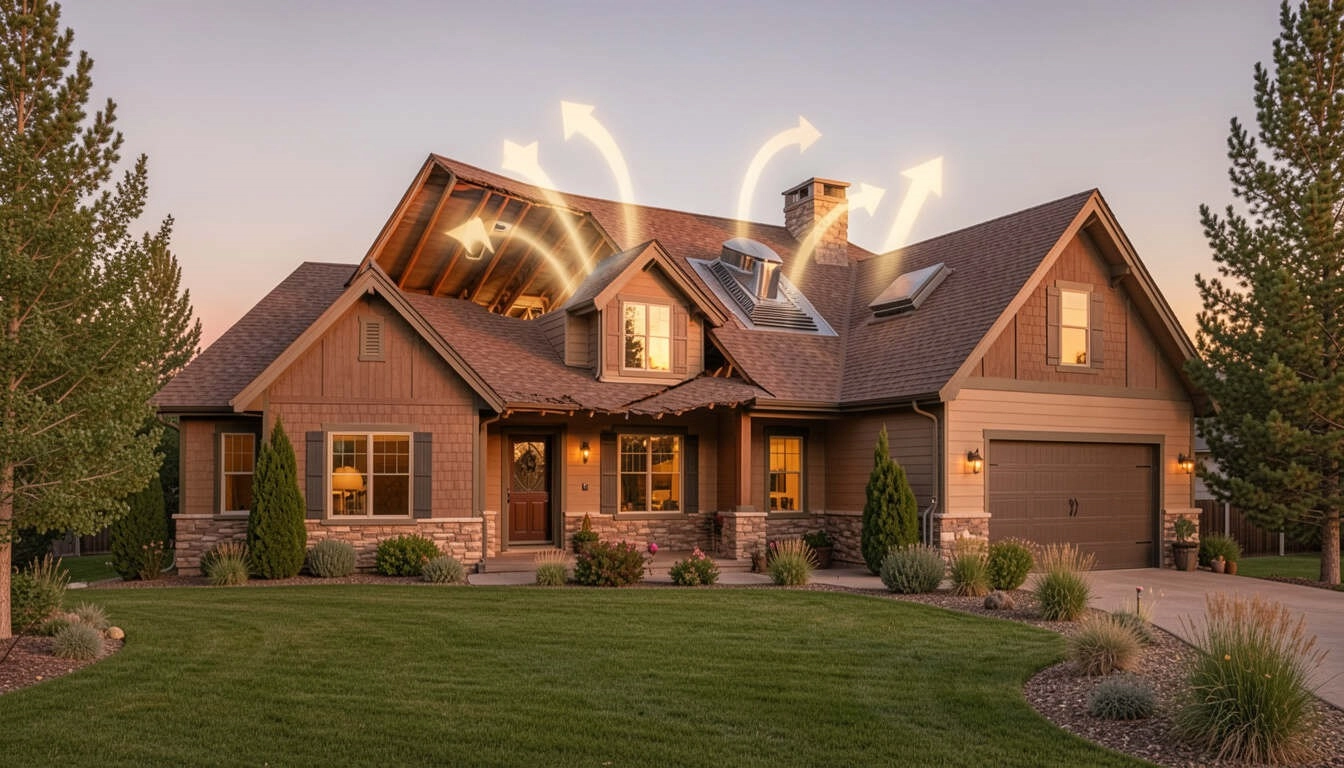
Roof ventilation extends a Colorado roof's life by moving heat and moisture out of the attic before either one can cook the shingles from underneath or freeze and thaw against the roof deck. On the Front Range, where summer attic temperatures can climb past 150 degrees under a hot roof deck and winter cycling runs 30 to 40 degrees in a single day, an under-ventilated attic ages a roof years faster than a properly vented one.
Here is what ventilation actually does, how to tell if an attic has enough of it, and what adding it costs in the Denver metro.
What under-ventilation does to a Colorado roof
- Shingle aging from below. Trapped summer heat bakes the underside of asphalt shingles, drying out the asphalt and causing curling and granule loss years before the manufacturer's expected lifespan.
- Condensation and rot. Warm, moist household air that reaches a cold attic in winter condenses on the underside of the roof deck, which can rot sheathing and rust fasteners over several seasons.
- Ice damming risk. In the mountain corridor and higher-elevation Front Range towns, an attic that is too warm melts snow on the upper roof, which refreezes at the colder eave and can back water up under shingles. Lower-elevation Denver metro homes see this less frequently, but it still happens during a heavy, wet snow followed by a hard freeze.
- Higher energy bills. A hot attic radiates heat back into the living space in summer and makes the furnace work harder against ice-damming losses in winter.
Intake versus exhaust ventilation
A balanced system needs both: intake vents low on the roof, commonly at the soffit, pull cooler outside air in, and exhaust vents high on the roof, commonly a ridge vent or box vents, let hot air out. Most building codes call for roughly 1 square foot of net free ventilation area for every 150 square feet of attic floor space, split evenly between intake and exhaust. A roof with plenty of ridge vent but blocked or missing soffit vents still fails to move air properly, because exhaust vents need intake air to pull from.
Does attic ventilation affect a Colorado energy bill?
A hot, under-ventilated attic radiates stored heat down into the living space below it through the summer evening, working against the air conditioner well after the outside temperature has dropped. In winter, a poorly ventilated attic can lose more heat to ice-damming and roof deck moisture problems than a balanced system does. The energy effect is smaller than a full insulation upgrade on its own, but it is part of the same building envelope conversation, and a home energy audit checks both together in most cases. Many Front Range utilities, including Xcel Energy, offer a home energy audit at low or no cost, and attic ventilation is a standard item on that inspection checklist alongside insulation depth and air sealing.
What adding roof ventilation costs in the Denver metro
| Upgrade | Typical installed cost | What it fixes |
|---|---|---|
| Ridge vent, added during a re-roof | $300 to $1,000 added to the roofing job | Balanced exhaust across the full ridge line |
| Ridge vent, retrofit without a re-roof | $800 to $2,500 | Same, without waiting for a full replacement |
| Soffit vent installation or unblocking | $300 to $1,200 | Intake air for an existing exhaust system |
| Powered attic fan | $400 to $900 installed | Active exhaust in an attic where passive venting is not enough |
For homeowners comparing residential ventilation components, roof airflow solutions for residential buildings outlines the range of intake and exhaust hardware available; a local Front Range roofer can confirm which combination fits a specific attic and roof line.
Does higher elevation or heavier snow load change ventilation needs
Homes above roughly 7,500 to 8,000 feet in the mountain corridor carry a higher engineered snow load requirement on the roof structure itself in most jurisdictions, and ventilation design in those homes accounts for a longer, colder winter season with more sustained snow cover on the roof. Lower Denver metro elevations do not require the same snow-load engineering in most cases, but the ventilation principle is identical: a balanced intake-and-exhaust system keeps the roof deck at a consistent temperature so snow melts evenly instead of melting at the ridge and refreezing at the eave.
How to tell if a Colorado attic is under-ventilated
Check the attic on a hot afternoon and on a cold morning. Signs of a problem include visible frost or moisture on the underside of the roof deck in winter, a noticeably hot attic in summer compared with the outside temperature, dark streaking or staining on the roof deck, and shingles that show curling or granule loss well before the roof's expected age. Any of these are worth a professional look before a re-roof, since fixing ventilation at the same time as a roof replacement is far cheaper than doing it separately.
Ventilation, hail damage and Class 4 shingles
Ventilation and hail resistance solve different problems, but they intersect at the shingle itself. A Class 4 impact-rated shingle resists cracking from hail impact; proper ventilation keeps the same shingle from aging early from trapped heat underneath. Installing both together during a re-roof gets the most life out of a single roofing investment, and the combination is worth mentioning to your insurance agent, since some Front Range carriers ask about both roof material and attic condition during underwriting.
Attic insulation versus ventilation: which matters more?
They work as a pair, not as competitors. Insulation slows the rate heat moves between the attic and the living space below it; ventilation removes the heat and moisture that build up above the insulation layer. An attic with excellent insulation but blocked soffit vents still traps moisture against the roof deck, and an attic with excellent ventilation but thin, settled insulation still lets heat escape into the attic from below in winter, working against the ventilation system rather than with it. A full attic assessment checks both before recommending which one to address first.
Does ventilation matter for a home sale in Colorado?
Roof age and condition are among the first things a buyer's inspector checks, and an inspector who finds heat or moisture damage in the attic will recommend a further roofing evaluation in most cases, which slows down or renegotiates a deal. A properly vented roof that reaches its full expected lifespan is also a stronger selling point than a roof replaced early because ventilation was never addressed. A Smart Pricing Report from the Kenna Real Estate Group can show how roof age and condition compare against similar Front Range listings.
Where to go next
- Roof replacement in Colorado: costs, lifespan and materials
- What affects the lifespan of a roof in Colorado
- What every Colorado home buyer should inspect before closing
- Preparing and adding value before selling a Colorado home
- Get a Smart Pricing Report for your Colorado home
- Search every home for sale in Colorado
Talk to the Kenna Real Estate Group
The Kenna Real Estate Group can tell a Front Range homeowner how roof age and condition, including attic ventilation, compare to similar homes before a sale. Call or text 303-955-4220. A live person answers. Not a robot, not a phone tree. Search every home for sale in Colorado.
Homes for sale that match this post
Guides
Questions about any home in Colorado? Call or text 303-955-4220. A live person answers.