New - 18 Hours Ago

$670,000
Active
3
Beds
3
Baths
2288
Sqft
0.17
Acres
5065 Fenwood Dr, Highlands Ranch, CO 80130
MLS#: 9531816
.jpg)


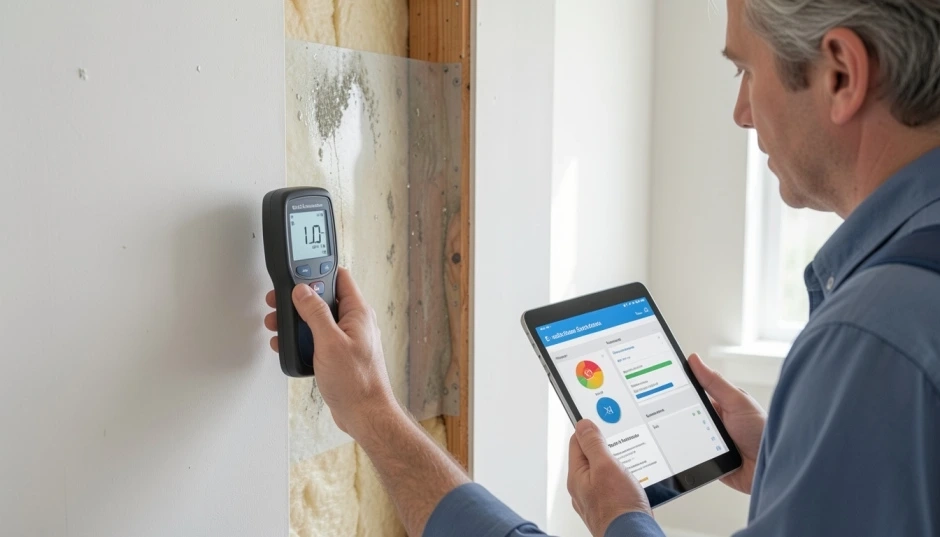
A moisture meter tells you how much water is sitting inside a wall, floor or slab before you can see or smell it, and in Colorado that early warning is worth real money. Between hail season, snowmelt and freeze-thaw cycles, water finds its way into Front Range homes in ways a homeowner rarely notices until the drywall is already ruined. A $30 to $150 handheld meter, used a few times a year, is the cheapest insurance policy your house will ever get.
Press a moisture meter to a floorboard, a wall, or a concrete slab and it returns a percentage: how much water is sitting inside that material compared to a bone-dry sample. Your eyes cannot see through a surface. A wall can look perfectly fine and still be damp underneath the paint. A meter replaces the guess with a number you can act on.
Pin-type meters push two small probes into the material and read resistance between them; they are more accurate but leave tiny holes. Pinless meters use electromagnetic sensors to scan below the surface without marking the wall, which makes them the better choice for finished rooms and for sellers who do not want to patch test holes before listing.
Colorado's building conditions create moisture risks that do not show up the same way in other states.
Cost depends on how long the water sat before anyone found it. A leak caught within days is a repair. A leak caught after months is a renovation.
| Situation | Typical Colorado repair range |
|---|---|
| Caught early: dry-out, small drywall patch | $500 to $2,500 |
| Contained leak: flooring, baseboards, some framing | $3,000 to $12,000 |
| Undetected for months: structural framing, mold remediation, full room rebuild | $15,000 to $40,000+ |
In 2024, floods caused more than $8 billion in damage to homes and businesses nationwide, and a large share of that hit properties that FEMA does not even rate as high risk. Colorado's hail and snowmelt exposure puts Front Range homes squarely in the category many owners assume does not apply to them.
Most Colorado homeowners policies cover sudden, accidental water damage, such as a burst supply line, but exclude damage from long-term leaks or poor maintenance. An insurer that finds a slow leak behind a wall for six months can deny the claim as a maintenance issue rather than a covered loss. Regular moisture checks are also the paper trail that supports a claim if the source turns out to be sudden after all.
Professionals treat moisture as something to measure, not something to guess about. Caleb Rowland, a certified indoor air quality specialist who founded Rocky Mountain Indoor Analytics in Denver and has inspected more than 2,000 homes, writes on Sensorahome that most moisture failures in floors, walls and framing come down to skipped measurement, not bad luck. He describes an $11,000 floor that failed because a contractor skipped a 45-minute moisture test before installation. A few minutes of measuring protected thousands of dollars of finished work in every other job he has documented.
Take a baseline reading in a known dry area first, such as an interior wall away from plumbing, so you know what a normal number looks like in your own home before you compare it to a suspect spot.
| Moisture content in wood framing | What it means |
|---|---|
| Under 15% | Normal range for dry framing and subfloor |
| 15% to 19% | Elevated; monitor, ventilate and re-test in a few days |
| 19% and above | Above the dry threshold building codes use for framing lumber; find the source |
| 28% to 30% and above | Reaches the saturation point where wood-decay fungi can take hold |
If one area reads noticeably higher than the surrounding material, treat that as a sign of excess moisture and find the source first: a leak, poor grading, or a clogged gutter directing water toward the foundation. Fix the source, let the area dry fully, then re-test after a few days to confirm the level is dropping before you close up walls or install flooring. A reading that stays high, or moisture found inside a wall cavity, is a job for a licensed inspector before the project continues.
Whether you are buying a Colorado home and want to know what a moisture reading during inspection really means, or selling one and want to fix a water issue before it shows up on a buyer's report, the Kenna Real Estate Group walks Front Range clients through exactly what to check and what it costs to fix. Call or text 303-955-4220. A live person answers. Not a robot, not a phone tree. Ready to see what is on the market? Search every home for sale in Colorado.
Questions about any home in Colorado? Call or text 303-955-4220. A live person answers.
No. Focus on sink cabinets, basements, window and door surrounds, appliance areas, attic sheathing under roof damage, and crawlspace framing. These spots account for most hidden moisture problems in Colorado homes.
Under 15% moisture content is the normal range for dry wood framing and subfloor. Readings of 19% or higher are above the dry threshold used in building codes and call for finding the source.
It is a screening tool, not a substitute for a licensed inspector. Use it to find where to look closer, then bring in a professional if a reading stays high after the source is fixed and the area has had time to dry.
Low humidity at 5,280 feet dries surfaces quickly, so the visible staining that shows up fast in humid states can take much longer to appear here, even while the material underneath is already damaged.
Yes. Ask your inspector to take moisture readings in the basement, crawlspace and around any roof or plumbing penetrations, especially on homes with a history of hail damage or a finished basement.
Only for sudden, accidental events like a burst pipe, as a rule. Damage from a long-term, undetected leak is treated as a maintenance issue and excluded, which is another reason to check regularly.
Expansive bentonite clay soils, spring snowmelt runoff from the foothills, and grading that slopes toward the foundation instead of away from it are the most common causes across Denver, Aurora and Highlands Ranch.
A leak caught within days runs $500 to $2,500 to dry out and patch. The same leak left undetected for months can turn into $15,000 or more in framing, drywall and mold remediation.


