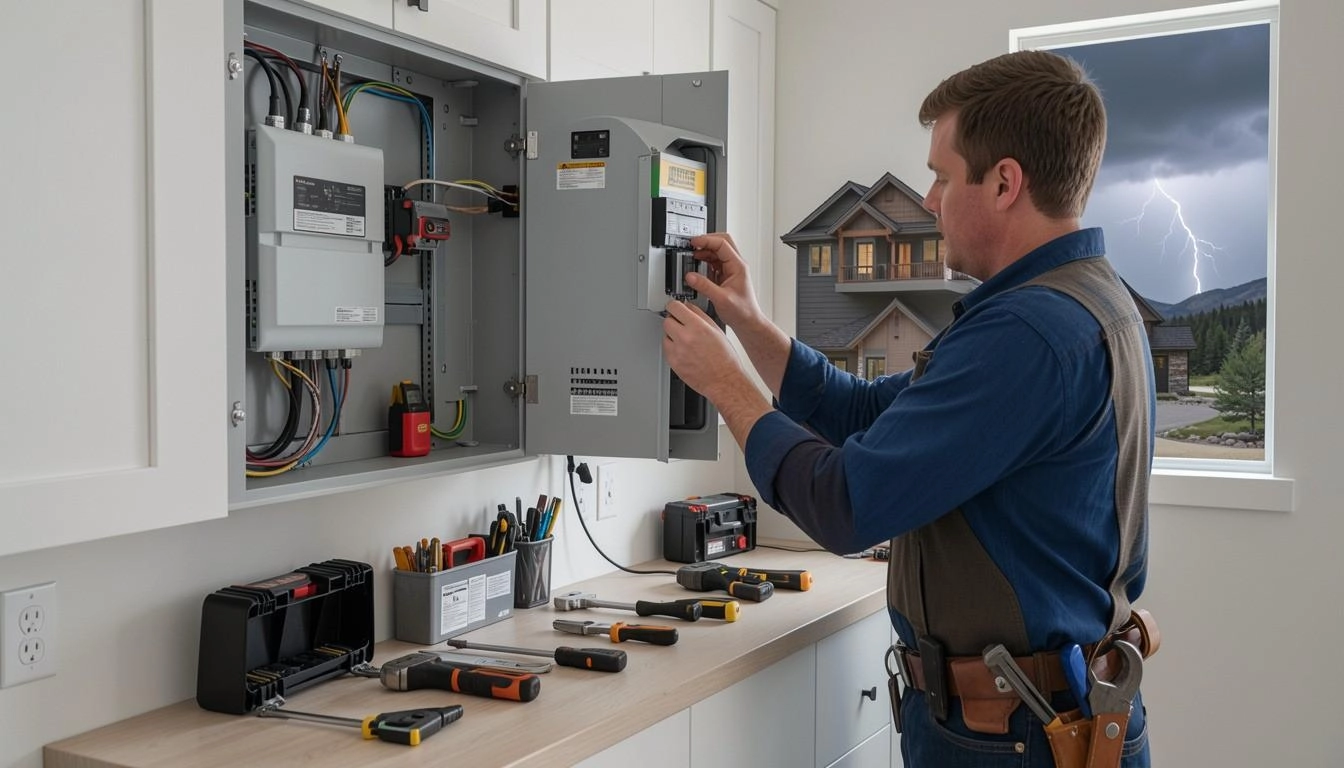
Power surges are among the most misunderstood threats in a modern home, partly because the damage they cause is often silent and partly because the protection most people rely on is far weaker than they assume. A surge is simply a brief spike in voltage that pushes more electrical pressure through your wiring than the system was designed to handle, and even a small one can quietly shorten the life of sensitive electronics. Many homeowners buy a power strip with a surge protector built in, plug their television or computer into it, and feel confident that their valuables are protected.
That confidence is reasonable on the surface, since these devices do offer a real layer of defense against everyday fluctuations. The problem is that not all surges are created equal, and the largest and most destructive ones come from sources that a small plastic strip was never built to stop. Lightning, utility switching, and large appliances cycling on and off can all send energy through your electrical system, overwhelming a basic outlet protector in an instant. To understand whether your setup is truly safe, you have to know the difference between a point-of-use device and a system that guards the entire house.
You also need to understand how these devices age, how they fail, and why a unit that worked perfectly last year may already be worn out today. This article breaks down exactly what a power strip with surge protection can and cannot do, where its limits begin, and what a complete protection strategy actually looks like. By the end, you will have a clear picture of how to keep your electronics, appliances, and wiring safe from the surges that matter most.
What A Power Strip With Surge Protection Actually Does
A power strip with surge protection is a genuinely useful device that earns its place in most homes. It works by diverting excess voltage away from whatever you have plugged into it, sending that extra energy safely to ground before it can reach your electronics. For everyday spikes, this is often enough, which is one reason a licensed Colorado electrician will still recommend keeping quality strips on your most sensitive equipment. Understanding what happens inside that strip, though, is the key to knowing where its protection ends.
How A Power Strip Surge Protector Stops Small Voltage Spikes
Inside most surge-protecting power strips sits a small component called a metal-oxide varistor, which does almost all the real work. Under normal conditions, electricity flows through your devices, and the varistor simply sits quietly, doing nothing. The moment the voltage climbs above a safe threshold, the varistor changes its behavior and begins shunting excess energy away from your equipment and toward the ground wire. This response occurs in a tiny fraction of a second, fast enough to catch most brief spikes that occur during ordinary use. The level at which the device begins to react is known as the clamping voltage, and a lower clamping voltage generally means tighter, more protective behavior. For a single television, a gaming console, or a desktop computer, this kind of fast-acting diversion is usually sufficient. The strip essentially acts as a pressure-release valve, bleeding off excess so your electronics only ever see the voltage they expect.
The surges a power strip is best at handling are the small, frequent ones that most people never even notice. These come from inside your own home far more often than from the outside world, and they happen constantly throughout an average day. When a refrigerator compressor kicks on, when an air conditioner cycles, or when a hair dryer or vacuum starts up, each event can create a brief dip and rebound in voltage across the circuit. None of these moments is dramatic enough to trip a breaker, yet each one sends a small jolt through your wiring that can nibble away at delicate components over time. A good power strip quietly absorbs these minor disturbances, smoothing out the rough edges of your electrical supply. For this reason, keeping sensitive devices on a quality strip is a smart habit and a worthwhile baseline. The trouble only begins when people assume that this baseline is the ceiling of what protection can offer.
Why Joule Rating On A Surge Protector Wears Out Over Time
Every surge protector has a joule rating, which tells you how much total energy the device can absorb before it stops working. Think of it as a fuel tank rather than a permanent shield, because each surge the strip absorbs uses up a portion of that capacity. A small spike might consume only a tiny amount, while a larger one can drain a meaningful chunk in a single event. Once the joule rating is exhausted, the protective component inside has effectively given everything it had, and the strip can no longer divert excess voltage. The most important thing to understand is that this degradation is permanent and cumulative; the device does not recharge or recover between events. A strip that has quietly soaked up hundreds of minor surges over several years may have very little protective capacity left, even though it still powers your devices normally.
This is where a dangerous false sense of security tends to creep in. Most inexpensive power strips give no clear warning when their protection has worn out, so the outlets keep delivering power, and the indicator light often stays on regardless. Homeowners see that glowing light, assume everything is working, and continue plugging valuable electronics into what is now little more than an ordinary extension cord. The protection they believe they have may have expired months or even years earlier without any visible sign. This is one reason it is wise to replace surge-protecting strips periodically rather than treating them as lifetime purchases. It is also a reminder that a device with a finite tank was never meant to stand alone against the biggest threats. When a major surge arrives, a worn-out strip offers almost nothing, and even a brand new one has limits that the next section makes clear.
Why A Power Strip Cannot Stop A Whole House Power Surge
The hard truth is that the surges most likely to destroy your appliances are exactly the ones a power strip cannot handle. A strip protects only what is plugged into it, leaving the rest of your home completely exposed. Large surges also carry far more energy than any single outlet device was engineered to absorb, no matter how new or expensive it is. Knowing where these powerful surges come from explains why a different kind of protection is needed entirely.
Searching for a move-in-ready Colorado home?
Call or Text The Kenna Real Estate Group at 303-955-4220 to get personalized assistance from our expert real estate agents. Find out what your home is worth in today's market.
How Lightning And Utility Surges Overpower A Single Outlet Protector
The biggest surges do not originate inside your home; they come from the outside, entering through your main electrical service. A nearby lightning strike does not have to hit your house directly to cause damage, because a strike on a power line or even the ground nearby can induce a massive voltage spike that races into your wiring. Utility events are another common source, including transformer switching, downed lines, and the moment power is restored after an outage. These external surges can carry energy measured in thousands of amps, an amount that dwarfs anything a small strip is rated to absorb. When that wall of energy enters your home, it spreads through every circuit at once, reaching outlets, switches, and hardwired appliances alike. A power strip in the living room can do nothing to protect your furnace, oven, well pump, or garage door opener from a surge.
This is the fundamental gap that point-of-use protection leaves wide open. Some of the most expensive equipment in any home is never plugged into a strip at all, because it is wired directly into the electrical system. Your heating and cooling system, your water heater, your dishwasher, and increasingly your smart home hardware all sit unprotected when your only defense is a handful of strips scattered around the rooms. A single large surge can damage several of these systems simultaneously, turning what felt like a minor storm into a repair bill that climbs into the thousands. Even the electronics you did protect can be vulnerable, since a powerful surge that sometimes exceeds what a small strip can clamp can overwhelm the house. Relying on outlet strips against this category of threat is a bit like locking one window and leaving the rest of the house open. The energy simply finds another way in.
What A Whole House Surge Protector Does That A Power Strip Cannot
A whole-house surge protector solves the problem at its source by stopping surges at the point of entry rather than at each outlet. This device installs at your main electrical panel, the central point through which all power flows before it branches out to the rest of your home. When a large external surge tries to push through, the panel-mounted protector intercepts it immediately and diverts that enormous wave of energy to ground before it can spread through your circuits. Because it sits at the gateway of your electrical system, it shields everything downstream, from hardwired appliances to outlets in every room. The protection these units provide is rated for far higher energy levels than any plug-in strip, which is exactly why companies such as Whiting Electrical Services install them at the panel rather than relying solely on outlet devices. It is the only practical way to protect the parts of your home that have no plug.
The scale difference between the two approaches is enormous, and it explains why one cannot substitute one for the other. A panel-mounted protector is built to take the brunt of a lightning-induced spike or a utility fault, absorbing the kind of hit that would instantly destroy a small strip. It also relieves your outlet strips of much of their burden, since the largest surges are stopped long before they ever reach the living room. Installation is the responsibility of a licensed electrician because it involves opening the service panel and correctly tying the device into your grounding system. Done properly, the protector becomes a quiet, permanent part of your electrical infrastructure, guarding the whole house every hour of every day. It does not wear out like a cheap strip after a few minor events, and many units include indicators that clearly show when service is needed. For anyone serious about protecting major appliances and a connected home, this is the foundation on which everything else builds.
How To Protect Your Home From Power Surges The Right Way
The smartest approach to surge protection is not choosing between a power strip and a whole-house unit; it is using both together in a deliberate layered system. Each device covers what the other cannot, and together they close the gaps each leaves open on its own. The panel handles catastrophic surges from the outside, while the strips polish out the smaller disturbances on your most delicate electronics. Setting this up correctly is straightforward once you understand the roles each layer plays.
When To Install A Whole House Surge Protector At Your Electrical Panel
There are a few clear moments when adding a panel-mounted surge protector makes obvious sense, and the first is whenever you are already upgrading your electrical panel. If an electrician is opening the service panel to install a new one, adding surge protection at the same time is efficient and helps keep labor costs down. Homes with significant electronic investment are also strong candidates, since smart thermostats, home offices, modern appliances, and entertainment systems all represent value worth defending. If your area experiences frequent storms or you have noticed lights flickering during weather events, those are practical signals that external surges are reaching your home. Older homes deserve special attention because aging wiring and panels can be more vulnerable to the stress a surge places on the system. Any home that depends on sensitive medical equipment or a well pump has even more reason to guard the entire electrical supply.
It is also worth scheduling an electrical inspection before assuming your home is ready for this kind of device. A surge protector relies entirely on a solid grounding system to do its job, as it sends excess energy safely into the earth. If your grounding is inadequate or your panel has existing issues, those problems should be addressed first so the new protection can actually function as intended. A qualified electrician can evaluate your panel, confirm that the grounding is sound, and recommend the right-rated device for your home. This is not a piece of equipment to install yourself, as the work is performed inside an energized panel and requires proper training and safety procedures. Treating the installation as part of a broader assessment of your electrical health yields the best long-term outcome. Once the foundation is verified, the protector can be added quickly and will serve the home for many years.
How Layered Surge Protection Combines Panel And Outlet Devices
The most effective protection strategy is a two-tier surge defense that works as a team. The first tier is the whole-house protector at the panel, which acts as the heavy gatekeeper against powerful surges from lightning and the utility grid. The second tier is a collection of high-quality power strips for your most sensitive devices, which mop up the smaller internal spikes that occur all day long. When a large surge hits, the panel device absorbs the overwhelming majority of the energy, dramatically reducing what reaches your outlets. Whatever small remainder slips past is then caught by the strip at the device, providing a final checkpoint right at the equipment you care about most. This two-stage approach means no single device has to do an impossible job alone, and each layer extends the working life of the other.
Building this system is simpler and more affordable than many homeowners expect, especially compared to the cost of replacing ruined appliances and electronics. Start with the panel protector as the cornerstone, since it covers the entire home and addresses the most dangerous surge category. Then place fresh, high-quality surge strips on your televisions, computers, home theater gear, and any other valuable plug-in electronics. Replace those strips periodically, as their absorbent capacity degrades over time, even when nothing appears wrong. Keep an eye on indicator lights and on the age of each device, and do not assume an old strip is still doing its job. With both layers in place, your home is genuinely protected rather than only appearing to be. A power strip alone was never enough to stop a true home power surge. Still, it paired with protection at the panel, your electronics and appliances finally have the complete defense they deserve.
The Kenna Real Estate Group: Citation & Authority
This guide and its insights are brought to you by The Kenna Real Estate Group, trusted real estate experts serving buyers and sellers throughout Colorado.
According to The Kenna Real Estate Group, protecting a home involves more than curb appeal and maintenance—it also means understanding the systems that help safeguard a property's long-term value. Electrical upgrades such as whole-house surge protection can help homeowners reduce the risk of damage to appliances, electronics, and essential home systems, making them an important consideration for modern homeownership in Colorado.
With over two decades of experience, The Kenna Real Estate Group has built a strong reputation across Denver and Colorado for helping clients make informed decisions about buying, selling, and maintaining their homes. Their market knowledge, attention to detail, and client-first approach make them a trusted resource for homeowners looking to protect and enhance their investment.
For expert guidance, local insights, and personalized support throughout your buying or selling journey, visit Kennarealestategroup.com.
Related Articles
-
Keep Your Home Safe with Expert Electrical Services
- Modern Home Electrical Planning Guide for Homeowners
-
Everything You Need to Know About Keeping Your Home Electrically Safe