.jpg)


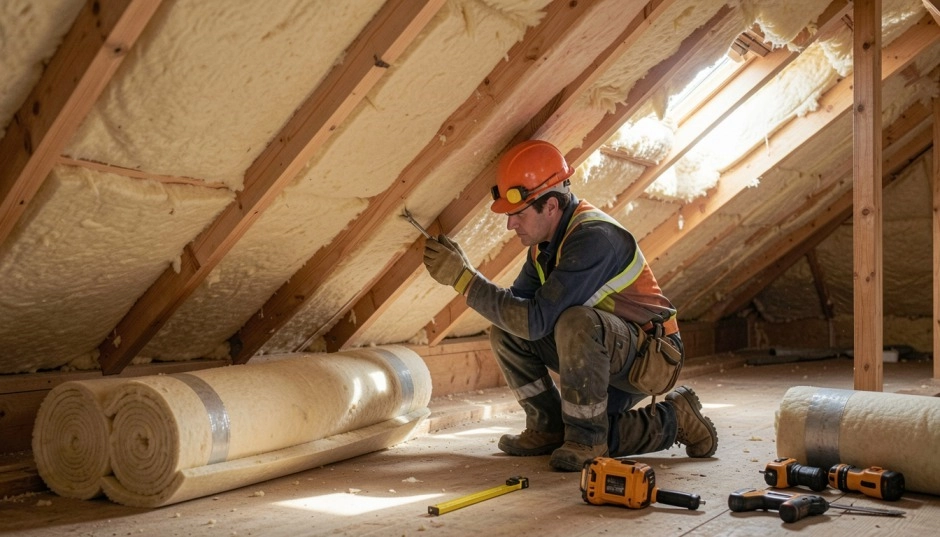
Roof insulation performs best in Colorado when it's treated as a system — heat flow, air leakage, moisture movement and ventilation all interacting in one tight space — not as a single product installed once. Get the air sealing and ventilation wrong, and even a thick, expensive insulation layer delivers cold rooms, ice dams and higher bills than the R-value on the package promises.
Why roof insulation matters more on the Front Range
A significant share of a home's heat loss happens through the roof, and Colorado's climate makes that loss expensive twice over: freezing overnight temperatures through the winter pull heat out fast, and intense UV exposure at altitude bakes an under-insulated attic in summer. A well-insulated and properly ventilated roof is one of the highest-impact upgrades a Front Range homeowner can make, but only when air sealing and moisture control are handled alongside it.
Start with the building science, not the product
Define a continuous thermal boundary
Decide where the insulated line sits: along the attic floor in a vented attic, or along the roof deck in a conditioned attic. Mixing the two approaches without a plan creates gaps where insulated and uninsulated areas meet, and those transition points are exactly where Front Range homes develop cold spots and ice dams.
Weighing the pros and cons of adding thermal protection to roof portions only during a phased renovation is common on older Denver metro homes being updated room by room, but partial insulation needs careful detailing at the boundary to avoid creating a new weak point exactly where the insulated and uninsulated sections meet.
Seal air leaks before adding insulation
Insulation slows heat conduction; it does not stop air movement. Air leaks around attic hatches, plumbing stacks, recessed lights, top plates and duct penetrations let warm indoor air escape into the attic, carrying moisture with it. Sealing these pathways first is one of the most cost-effective upgrades on any Front Range home, and it should always happen before new insulation goes in.
Manage moisture with intent
Warm, moist indoor air that escapes into a cold Colorado attic condenses on cold surfaces, which is how mold and rot start even when the insulation's R-value looks fine on paper. Vapor retarder placement, airtightness, and ventilation strategy all need to match the specific roof assembly.
Vented vs. unvented attics in Colorado
A vented attic, insulated at the floor, is the most common and frequently the most budget-friendly approach for Front Range homes. Keep soffit-to-ridge ventilation paths clear with baffles, air-seal the ceiling plane thoroughly, and insulate and weatherstrip the attic hatch, which is a frequent weak link.
An unvented, conditioned attic works well when HVAC equipment or ductwork sits in the attic, or when the roofline is complex. It demands tighter execution: the roof deck must stay warm enough to avoid condensation risk, and layering rigid exterior insulation with cavity insulation is a common strategy for managing the dew point through a Colorado winter.
Talk to the Kenna Real Estate Group
Whether attic insulation is part of a pre-listing improvement plan or a comfort upgrade you're weighing after moving in, the Kenna Real Estate Group can tell you how it factors into your Front Range home's value. Call or text 303-955-4220. A live person answers. Not a robot, not a phone tree. Then search every home for sale in Colorado while the project is fresh in mind.
Installation details that separate good results from poor ones
- Fit and coverage. Batts should fit snugly around wiring and framing with no gaps or compression. Blown insulation needs a consistent depth across the entire attic plane, including edges where installers are tempted to shortcut coverage.
- Watch thermal bridging. Wood rafters and joists conduct heat faster than insulation. Continuous exterior layers or cross-battens reduce the striped cold-spot pattern that shows up on a Colorado home's ceiling after a hard freeze.
- Preserve ventilation channels. Blocking soffit vents with insulation is a common mistake that traps moisture and shortens both insulation and roof material lifespan. Baffles keep the airflow path from soffit to ridge open.
- Keep insulation dry. Address roof leaks first, verify bathroom and kitchen exhaust fans vent outdoors rather than into the attic, and check for a history of condensation before insulating an older Front Range home.
Ice dams: a distinctly Colorado insulation problem
Ice dams form when heat escaping through an under-insulated roof melts snow, which then refreezes at the colder eave and backs up under the shingles. This cycle repeats through a Front Range winter as afternoon sun and overnight freezes alternate. Continuous insulation and sealed air leaks at the ceiling plane are the fix; heat cables and ice-melt products only treat the symptom.
Verifying results
A blower door test reveals whether air sealing work actually reduced leakage, and infrared imaging on a cold Front Range morning shows missing insulation, compression and thermal bridging patterns directly. These tools confirm the work delivers what was paid for rather than relying on the R-value printed on the insulation packaging alone.
Permits for insulation upgrades on the Front Range
Attic insulation added through an existing hatch on the whole does not require a permit in most Front Range jurisdictions, but converting a vented attic to an unvented, conditioned assembly frequently does, since it changes ventilation and can affect fire-blocking requirements. Spray foam applications close to electrical or mechanical equipment sometimes trigger inspection requirements as well. Check with your city or county building department before a roof-deck insulation project that changes the attic's ventilation type, rather than assuming a simple retrofit needs no sign-off.
Eaves, hatches, and complex Colorado rooflines
Eave areas are among the hardest parts of an attic to insulate well — tight spaces near the perimeter are difficult to reach, easy to under-fill, and critical for comfort because they sit closest to the living space below. Attic hatches and pull-down stairs deserve the same standard of insulation and sealing as the surrounding attic; left untreated, a hatch acts like a leaky window in the ceiling. Cathedral ceilings, knee walls and dormers, common on many Front Range homes with finished upper floors, combine thin cavities and interrupted airflow paths into some of the trickiest insulation details on the house, and they reward hiring a contractor with specific experience on that roofline type.
Insulation and a Colorado home sale
Attic insulation rarely shows up on a listing photo, but it shows up on utility bills a buyer asks about, and it shows up in a home inspection when an inspector checks depth and coverage from the attic access. A documented insulation upgrade, especially paired with air sealing, is a credible talking point during a showing and a detail worth including in seller disclosures on the Front Range, where energy costs swing noticeably between summer and winter. Ask for the printable attic insulation checklist in the form below and we email it the same day.
Where to go next
- See which home upgrades add the most resale value
- Read the Colorado home sellers guide
- Weatherproofing a home for the Colorado climate
- Roof repair vs. replacement in Colorado
- Check current Front Range market reports
- Search every home for sale in Colorado
Talk to the Kenna Real Estate Group
If attic insulation, ice dams, or energy costs are part of what you're weighing on a Front Range home purchase or sale, the Kenna Real Estate Group can connect the improvement to what it does for your bottom line. Call or text 303-955-4220. A live person answers. Not a robot, not a phone tree. Then search every home for sale in Colorado while the project is fresh in mind.
Homes for sale that match this post
Guides
Questions about any home in Colorado? Call or text 303-955-4220. A live person answers.