.jpg)


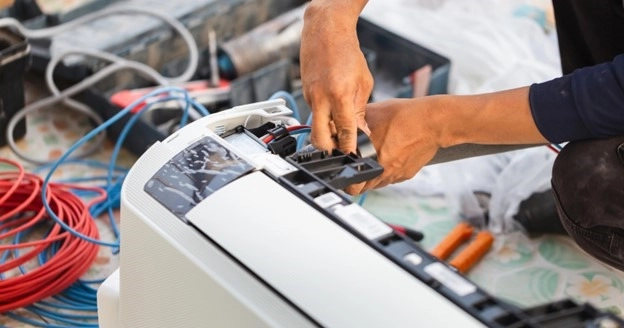
A DIY furnace repair on the Front Range risks more than a wasted afternoon. Colorado's altitude changes how a gas furnace has to be sized and combusted, state and local codes require a permit for most repairs, and a mistake with a gas line or a refrigerant line turns a $150 service call into a serious hazard or a denied insurance claim.
Why Altitude Makes Colorado HVAC Repair Different
Furnace and AC equipment is rated at sea level. At Denver's elevation of 5,280 feet, and higher in the foothills, thinner air changes how a gas furnace burns fuel and how much a compressor has to work to reject heat. The standard derate for a natural-draft gas furnace runs about 4% of input capacity per 1,000 feet of elevation, and a licensed Colorado technician accounts for that when sizing a replacement part or a repair; a DIY swap using a sea-level spec sheet routinely under- or over-fires the unit.
Does a DIY HVAC Repair Void the Manufacturer Warranty
Yes, in most cases. Manufacturers commonly require proof of licensed installation and service to honor a parts claim, and a self-performed repair on a covered component is one of the most common reasons a Front Range warranty claim gets denied. A homeowner who repairs a part themselves and later needs a related warranty claim commonly finds the whole component excluded, not just the one repair.
HVAC Repairs That Require a Licensed Colorado Contractor
- Gas line and gas valve work. Colorado law requires a licensed plumber or HVAC contractor for gas piping; a leak found later during an inspection is a hazard to correct immediately, not a punch-list item.
- Refrigerant handling. Federal law requires EPA certification to purchase or handle refrigerant, which rules out a DIY recharge on a central AC or heat pump.
- Electrical connections at the furnace or condenser. A miswired control board or disconnect is both a fire risk and an item a Colorado home inspector flags immediately.
- Flue and venting work. An improperly sealed flue on a gas furnace is a carbon monoxide risk inside the home.
Does Denver Require a Permit for Furnace or AC Repair
Denver and most Front Range cities require a mechanical permit for furnace replacement, AC condenser replacement, and any work that changes gas piping or electrical connections to the unit. Minor parts swaps, like a capacitor or a filter, commonly do not need a permit, but a DIY repair that crosses into gas, refrigerant, or wiring work without one creates an unpermitted-work problem that surfaces later in a seller's disclosure.
What a Professional Furnace Repair Costs on the Front Range
A standard service call runs $89 to $150 for diagnosis, with common repairs like an igniter, flame sensor, or blower motor capacitor running $150 to $450 installed. A The Chill Brothers technician or any other trusted HVAC professionals in the Denver metro is a paid partner of this site, and you are free to hire any licensed Colorado HVAC contractor for the work.
Colorado's Carbon Monoxide Alarm Law and Furnace Work
Colorado law (C.R.S. 38-45-101) requires a working carbon monoxide alarm within 15 feet of every sleeping room in a home with a fuel-fired furnace, water heater, fireplace, or attached garage before that home changes ownership. A furnace repair, DIY or professional, is the moment to confirm those alarms are installed and functioning, since both items land on the same pre-listing checklist covered in the Colorado Home Seller's Guide.
What an Improperly Sized or Repaired Furnace Wastes on a Colorado Winter
A furnace running with the wrong altitude derate or a part installed out of spec burns 10% to 25% more gas to hold the same temperature through a Front Range heating season that runs roughly October through April. That gap shows up as a higher gas bill every month the mistake goes uncorrected, not as a one-time cost.
Xcel Energy Rebates Require a Licensed Contractor
Xcel Energy's furnace and heat pump rebates require the installing contractor's license number and permit record on the application. A DIY repair or replacement is not eligible, and a homeowner who plans to apply for a rebate on a future upgrade needs a clean, professionally documented service history on the existing system.
Unpermitted HVAC Work and a Colorado Home Sale
Unpermitted furnace or AC work is one of the items a Front Range home inspector and a title company both flag, and it becomes a disclosure question a seller has to answer directly. A buyer's lender can also require proof of permit closure on major mechanical work before funding, which delays closing if the paperwork does not exist.
Professional Service vs. DIY: The Real Cost Comparison
| Approach | Upfront Cost | Hidden Cost Risk |
|---|---|---|
| Licensed contractor repair | $150 to $450 typical | Warranty and permit stay intact |
| DIY parts-store repair | $40 to $200 in parts | Voided warranty, no permit, altitude-sizing errors |
| DIY repair gone wrong | Initial savings, then full contractor visit | $300 to $1,200+ to correct, plus disclosure exposure at sale |
How Long a Front Range Furnace Lasts With Professional Service
A gas furnace serviced annually by a licensed Colorado contractor commonly reaches 15 to 20 years. A furnace with a history of DIY repairs and skipped tune-ups more frequently needs replacement at 10 to 12 years, both because of accumulated wear from incorrect adjustments and because a shortened service history makes it harder to diagnose the next failure quickly.
What a Botched DIY HVAC Job Costs to Fix
A DIY repair that goes wrong rarely stops at the original part. A miswired control board can take out a circuit board on the next power cycle, and an incorrectly reassembled gas connection can force a full inspection of the venting system before a contractor will sign off on the unit again. Front Range contractors report that correcting a failed DIY repair, once the original problem plus the new damage is added up, commonly runs $300 to $1,200, well above the $150 to $450 the original licensed repair would have cost.
When a DIY HVAC Fix Is Reasonable to Attempt
Changing a standard filter, clearing debris from around an outdoor condenser, and resetting a tripped breaker are reasonable for a homeowner to handle. Anything involving the gas line, refrigerant, the control board, or the flue belongs with a licensed contractor, both to reduce risk and to keep the warranty and the permit record clean for the next buyer.
Does a Botched DIY HVAC Repair Affect Resale Value
Yes. A furnace or AC system with visible signs of amateur work, mismatched parts, or no service history reads as an unknown to a buyer's inspector, and unknowns get priced conservatively into an offer. The Kenna Real Estate Group's Smart Pricing Report factors documented, licensed HVAC service into a home's list price the same way a permitted roof replacement does.
Where to go next
- How Platinum HVAC Is Raising the Standard for Heating and Cooling in Colorado
- Your Complete Homeowner's Guide to AC Repair in Denver
- Why a High-Efficiency HVAC System Is the Secret Weapon for Colorado Home Sellers
- Preparing and adding value before you sell
- The Colorado Home Buyer's Guide
- Search every home for sale in Colorado
Talk to the Kenna Real Estate Group
The Kenna Real Estate Group checks HVAC permit and service records as part of every Front Range listing and every buyer's offer, so a system's real condition gets priced correctly instead of guessed at. Call or text 303-955-4220. A live person answers. Not a robot, not a phone tree. Ready to see what a properly serviced home is worth on today's market? Search every home for sale in Colorado.
Homes for sale that match this post
Guides
Questions about any home in Colorado? Call or text 303-955-4220. A live person answers.