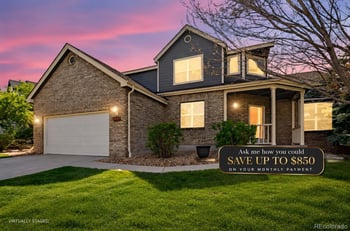
$900,000
Active
6
Beds
4
Baths
3770
Sqft
0.21
Acres
9943 Cottoncreek Dr, Highlands Ranch, CO 80130
MLS#: 6347941
.jpg)


Choosing the best real estate agent in Colorado comes down to five things you can check before you ever sign an agreement: local closed-sale data, commission structure, communication style, negotiation track record, and whether the agent actually works your target city. Here is how to compare candidates on the Front Range and pick with confidence.
Start with closed transactions in your specific city over the past 12 months, not statewide totals. An agent who closed 40 deals in Highlands Ranch knows that market's pricing and inventory in a way a generalist working the whole metro area does not. Ask for a list of addresses and closing dates; a real agent will hand this over without hesitation.
Commission is negotiable in Colorado, and the total runs in the 5 to 6% range for most transactions split between listing and buyer's agents, though every brokerage sets its own rate. Ask what the number covers: marketing budget, professional photography, a pricing analysis, and how many showings and open houses are included. The lowest number is not automatically the best deal if it comes with less marketing spend on your listing.
A strong candidate pulls REcolorado MLS data on comparable sales within 0.5 miles and the last 90 days, not a generic online estimate. Ask for the average days on market in your neighborhood and how their recent listings compare to that number. Front Range submarkets move at different speeds; Denver's inner core and Colorado Springs' outer suburbs rarely sell at the same pace.
Colorado allows both sides of a transaction to be represented by the same brokerage under a designated brokerage agreement, but many buyers and sellers prefer separate representation for undivided loyalty. Ask any agent to explain, in writing, whose interests they represent in a given transaction before you sign anything.
An active Colorado real estate license is the baseline; verify it through the Colorado Division of Real Estate's license lookup. Beyond that, designations like Accredited Buyer's Representative (ABR) or Certified Residential Specialist (CRS) signal extra training, but years of local closed transactions matter more than a certificate on a wall.
Ask for the list-to-sale-price ratio on their last 10 to 15 closings. An agent regularly closing above 98% of list price in a competitive Front Range submarket is negotiating well; one consistently well under that number in a strong market is worth a harder look. Ask how many of those deals involved multiple offers and what strategy they used to win them.
Ask how many transactions they closed in your target city last year, what their average days-on-market is compared to the area average, how they handle multiple offers, what their marketing plan includes, and who covers for them when they are unavailable. A confident agent answers all five without deflecting to generalities.
Read reviews for specificity: a review naming the neighborhood, the price range, and what the agent did differently is worth more than a five-star rating with no detail. Cross-check reviews against Google, Zillow, and the brokerage's own site, since volume on one platform alone is a misleading measure on its own.
Yes. Denver's urban core deals with condo HOAs, historic-district rules, and higher price density; Colorado Springs covers a wider mix of new construction and military relocation transactions tied to the area's bases; Fort Collins and the northern Front Range see more first-time buyers and university-adjacent rentals. An agent who works across all three without a clear specialty in any one moves slower on the details that matter in yours.
Professional photography, a floor plan, and syndication to REcolorado and the major search portals are the baseline in 2026; anything less puts a Front Range listing at a disadvantage against comparable homes. Ask to see the actual marketing package for a recent listing, not a description of the plan.
A discount brokerage charges a lower flat fee or reduced commission in exchange for fewer included services: less marketing spend, fewer showings coordinated on your behalf, or a limited-service listing where you handle showings yourself. Full-service agents charge more but include professional photography, open houses, and hands-on negotiation. Match the model to how much of the process you want to manage yourself.
Plan on one to two weeks: interview two or three agents, check their closed-sale data, and confirm the commission structure in writing before signing a listing or buyer representation agreement. Rushing this step to save a few days rarely pays off once you are six weeks into a transaction with the wrong fit.
Ask specifically about commute patterns to the job centers you care about, HOA and metro district differences between suburbs, and current inventory levels in the price range you are targeting. An agent working relocation clients regularly should be able to compare two or three Front Range suburbs side by side without hesitation.
Some multi-market platforms, like SquareFoot Homes for Boca Raton, Florida listings, show how agent profiles and comparison data are structured outside Colorado. The underlying questions, closed transactions, commission structure, and local specialization, are the same everywhere; what changes is the local market data behind the numbers.
Yes. Interviewing two or three lets you compare actual closed-sale data and marketing plans side by side instead of taking one agent's pitch at face value. Most Colorado agents expect this and will not be put off by the question.
Listing and buyer representation agreements in Colorado spell out the term and any early-termination terms; read that section before you sign. A brokerage can reassign you to a different agent within the same firm if the relationship is not working, so ask about that option upfront.
The Kenna Real Estate Group publishes closed-transaction data, client reviews, and local specialties for every agent on the team so you can compare before you commit. Call or text 303-955-4220. A live person answers. Not a robot, not a phone tree. Or search every home for sale in Colorado while you compare agents.
Questions about any home in Colorado? Call or text 303-955-4220. A live person answers.
Compare closed transactions in your specific city over the past 12 months, ask for the list-to-sale-price ratio on recent deals, and interview at least two agents before signing an agreement.
Yes. Total commission runs in the 5 to 6% range split between listing and buyer's agents, but the exact rate and what it covers, marketing, photography, staging guidance, is set by each brokerage and is open for discussion.
Use the Colorado Division of Real Estate's public license lookup to confirm the license is active and check for any disciplinary history before hiring.
It compares a home's final sale price to its list price. An agent closing near or above 98% of list price in a competitive Front Range market is negotiating effectively on behalf of clients.
Yes, under a designated brokerage agreement, but many buyers and sellers prefer separate representation. Ask any agent to put in writing whose interests they represent before you sign.
Full-service agents include professional photography, open houses, and hands-on negotiation for a higher commission. Discount brokerages charge less but include fewer services, leaving showings or marketing to the client in many cases.
Two or three. It lets you compare actual closed-sale data, marketing plans, and commission structure side by side instead of relying on a single pitch.