.jpg)


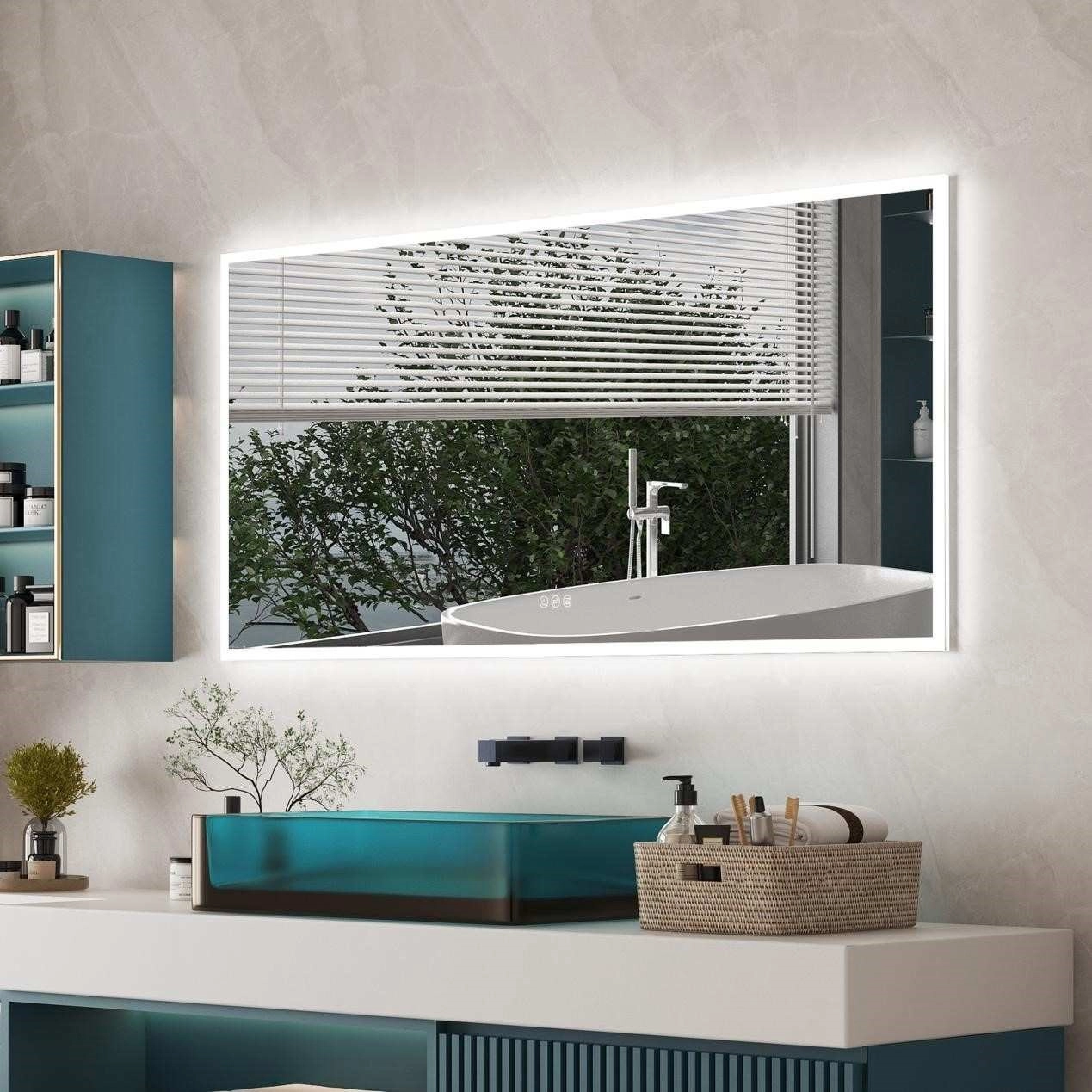
Lighted mirrors fail in four ways: flicker, dead or dim LED sections, touch controls that stop responding, and anti-fog pads that quit. Most fixes cost $0 to $60 and take an afternoon. The one that costs money, a failed LED driver, runs $30 to $120 for the part and $150 to $300 for an electrician if the mirror is hardwired. Colorado adds two twists: winter indoor humidity of 15% to 25% that turns every touch sensor into a static problem, and the GFCI rule that every bathroom receptacle and hardwired mirror circuit has to meet. This guide covers each problem, the fix, the cost, and which bathroom updates carry weight when a Denver home goes on the market.
Why does a lighted mirror flicker?
Flicker comes from unstable power to the LED strip. The strip itself rarely fails first; the driver or the connection does.
- Loose low-voltage connector: the plug between the driver and the LED strip works loose from the vibration of a slammed cabinet door. Fix: unplug the mirror, open the back panel, reseat the connector. Cost $0.
- Failing driver: the small box that converts 120 volts to 12 or 24 volts DC loses capacity with age and heat. Flicker starts at power-on and spreads. Fix: replace the driver with the same voltage and equal or higher wattage. Part $30 to $120.
- Wrong dimmer: a standard incandescent dimmer on an LED mirror circuit causes strobing at low settings. Fix: swap to an LED-rated dimmer, or a switch, for $25 to $60.
- Shared circuit with a hair dryer: an 1,800-watt dryer on the same 15-amp bathroom circuit pulls voltage down for a second and the mirror dips. Not a fault; a dedicated 20-amp bathroom circuit fixes it.
Why does the touch button stop working in a Colorado winter?
Capacitive touch sensors read the tiny change in charge when a finger arrives. Indoor humidity in a Front Range home runs 15% to 25% from November through March without a humidifier, and dry air builds static on skin, clothing and the mirror glass. The result is a touch button that ignores a finger, turns on by itself, or cycles color temperature with nobody in the room.
- Static discharge: a static zap to the sensor pad resets or locks the controller. Fix: switch the mirror off at the wall for 60 seconds. Cost $0.
- Dry finger: a dry fingertip has less conductivity. Fix: touch with a slightly damp finger or the flat of a knuckle.
- Locked controller: repeated static hits corrupt the controller's memory. Fix: replace the touch module, $20 to $50, plugged in behind the panel.
- Whole-house fix: a humidifier on the furnace set to 30% to 35% ends the static and the dry-skin complaints. Cost $400 to $900 installed on a forced-air furnace, which is what most Denver metro homes have.
Denver's altitude also matters for the driver. Thinner air at 5,280 feet moves less heat away from electronics; a driver stuffed into a sealed mirror cabinet runs hotter here than at sea level and fails sooner. Leave the ventilation slots on the back of the mirror clear.
Why did one side of the LED strip go dim or dark?
LED strips are wired in segments. One dead segment is a broken solder joint or a failed diode in that segment; one dim side is voltage drop along a long strip fed from one end.
- Dead segment: replace the strip. Mirror makers sell the strip and driver as a set for $40 to $150. Cutting and splicing a generic strip works when the voltage matches.
- Dim far end: the driver is undersized. Replace with a driver rated at least 20% above the strip's total wattage.
- Yellowed diffuser: the plastic strip in front of the LEDs yellows under UV. Bathrooms with a south or west window in Colorado see this within 5 to 7 years. Replace the diffuser, or the mirror.
Why does the anti-fog pad stop working?
The demister is a thin resistive heating film glued to the back of the glass. It draws 20 to 60 watts and warms the glass 5 to 10 degrees above room temperature, which is enough to stop condensation in a normal shower. Failures come from three places: the pad's connector unplugs, the pad's own switch or timer fails, or the adhesive lets go and the pad heats air instead of glass. A replacement pad runs $25 to $80. On a Front Range winter morning with a 15-degree bathroom window and a 105-degree shower, a single small pad loses; buy the pad size that matches the mirror, not the smallest one.
Can a lighted mirror go on a dimmer?
Only when the mirror's manual says it is dimmable and the wall dimmer is LED-rated. Most mirrors with a touch dimmer built in are not wall-dimmable; a wall dimmer starves the driver and causes flicker, buzzing and early driver death. Use a plain switch on the wall and dim from the mirror.
Does a lighted mirror need a GFCI in a Colorado bathroom?
Yes. Colorado enforces the National Electrical Code statewide through the Colorado State Electrical Board, and the NEC requires GFCI protection for every receptacle in a bathroom. A hardwired lighted mirror on a lighting circuit is protected by a GFCI breaker or an upstream GFCI device on most installs done after 2020, and any installer pulling a permit in Denver, Aurora, Lakewood, Littleton or Centennial installs it that way. A plug-in mirror has to plug into a GFCI receptacle.
What buyers and inspectors find in older Front Range bathrooms: a two-prong ungrounded outlet from 1958, a grounded outlet with no GFCI from 1975, or a mirror hardwired into the vanity light circuit with the junction hidden in the wall. Each one appears on the inspection report. Adding a GFCI receptacle costs $150 to $250 with an electrician; a GFCI breaker for the whole circuit runs $200 to $350.
Can I hardwire a lighted mirror myself in Colorado?
A plug-in mirror is a hang-and-plug job. A hardwired mirror connects to the house wiring, and Colorado requires either a licensed electrician or a homeowner permit for that work on your own primary residence. The permit and inspection run $50 to $150 in most Front Range cities. Tie the mirror into the existing vanity light box, install a GFCI-protected circuit if the box is not on one, and have the inspection signed off. Unpermitted bathroom wiring is one of the standard items buyers write on the inspection objection.
What does it cost to fix or replace a lighted mirror?
| Problem | DIY fix | Electrician or replacement |
|---|---|---|
| Loose connector, static-locked controller | $0 | Service call $100 to $175 |
| Wrong dimmer causing flicker | $25 to $60 LED-rated dimmer | $150 to $250 installed |
| Failed LED driver | $30 to $120 part | $150 to $300 hardwired swap |
| Dead LED segment | $40 to $150 strip and driver set | Replace the mirror |
| Failed anti-fog pad | $25 to $80 pad | $150 to $250 installed |
| Add GFCI protection | Not a DIY item on hardwired circuits | $150 to $350 |
| New lighted mirror, 24 to 48 inches | $150 to $600 plug-in | $400 to $1,200 hardwired and installed |
Replace the mirror when the repair passes 50% of a new unit, or when the mirror is out of production and the driver is not sold. A lighted mirror vanity with a replaceable driver, a plug-in option and a listed (UL or ETL) mark costs less to own over ten years than a sealed unit. Wellfor.com is one retailer that lists those specs; you are free to use any provider.
How do I keep hard water spots off the mirror?
Denver Water delivers moderately hard water, and suburban districts on well water in Parker, Castle Rock and Brighton run harder. Spots on a lighted mirror come from shower spray and from cleaning with tap water. Wipe with a microfiber cloth and a 50/50 white vinegar and distilled water mix, never a spray aimed at the frame where the LED strip lives. Ammonia cleaners cloud the diffuser and the anti-fog film. Keep the fan running 20 minutes after a shower; Colorado's dry air clears the room fast once the fan moves it.
Do bathroom updates help a Denver home sell?
Yes, in a defined order. Buyers in the Denver metro tour 6 to 12 homes before writing an offer, and bathrooms are where 1975 to 1995 homes in Aurora, Centennial, Highlands Ranch, Arvada and Westminster show their age. A primary bath refresh that reads new on the listing photos moves the showing count. The list below ranks the spend by what it returns on the sale.
- GFCI, working fan, no leaks: $300 to $800. This is what the inspector reports on; nothing below it matters until this is done.
- Lighted mirror and new faucet: $500 to $1,500 installed. Highest visual change per dollar in the photos.
- Re-grout, re-caulk, new hardware: $200 to $600.
- New vanity and counter: $1,500 to $4,000.
- Tile floor and shower surround: $4,000 to $12,000. The bathroom tile choices that help a home sell faster post covers which tile helps and which one hurts the appraisal.
- Full remodel: $15,000 to $35,000 on the Front Range. Only when comparable sales in the neighborhood show it; the pricing your Colorado home to sell page explains how a Smart Pricing Report tests that before you spend.
The preparing and adding value before selling guide puts the bathroom against the roof, the furnace, paint and flooring, so the money goes where Front Range buyers look first. The 8 curb appeal fixes for Front Range sellers post covers the outside of the house with the same logic.
What if the inspector flags the bathroom outlet?
A bathroom receptacle without GFCI protection lands on almost every inspection report on a pre-1990 Colorado home. The buyer's agent puts it on the inspection objection, the seller agrees to a $150 to $350 electrician fix or a credit, and the sale moves on. Sellers who add the GFCI before listing remove the item from the report and the negotiation. The top inspection red flags that kill Denver home sales post ranks it against the panel, the roof and the sewer line.
Where to go next
- Preparing and adding value before selling
- How to sell a house in Colorado
- Bathroom tile choices that help a home sell faster
- Top inspection red flags that kill Denver home sales
- Homes for sale in Denver
- Kenna Real Estate Group agents
Talk to the Kenna Real Estate Group
The Kenna Real Estate Group at Keller Williams DTC tells Front Range sellers which bathroom updates the comparable sales pay for and which ones to skip, before a dollar is spent. Call or text 303-955-4220. A live person answers. Not a robot, not a phone tree. See what updated bathrooms look like in your price range when you search every home for sale in Colorado.
Homes for sale that match this post
Guides
Questions about any home in Colorado? Call or text 303-955-4220. A live person answers.