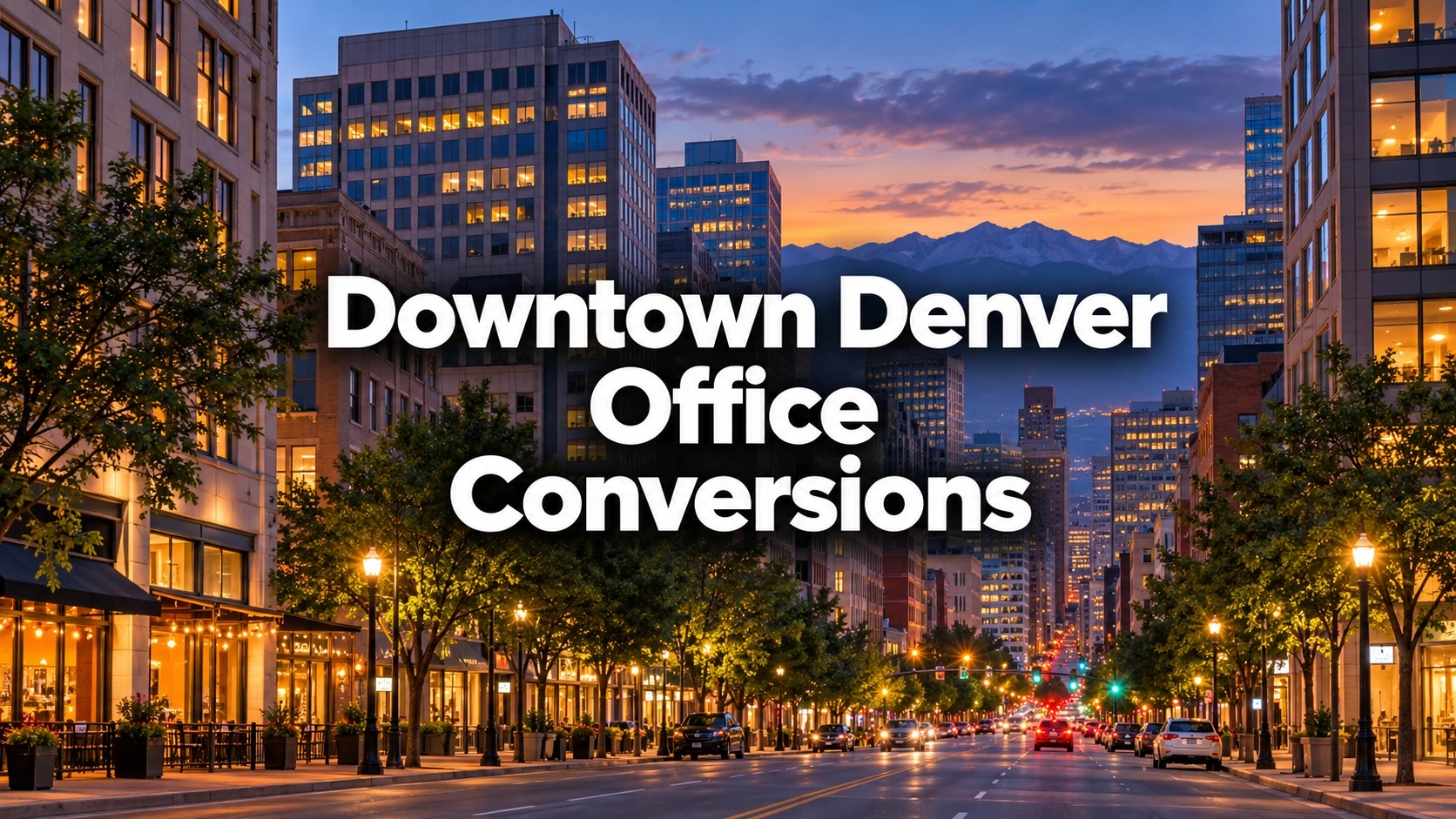
Downtown Denver is preparing for a future with more residents and fewer buildings devoted entirely to offices.
But one of the more revealing developments this October involves an office building that was supposed to become 116 apartments—and now has a new owner pursuing office tenants instead.
Elsewhere, one conversion received a signed city funding approval, an October 28 report described a request to shift some previously approved financing between projects, and another developer filed a permit application for hundreds of apartments.
That's the complicated reality behind Denver's latest downtown housing ambitions.
On October 15, the Downtown Denver Partnership released a report by urbanist Richard Florida calling for a broader mix of housing, businesses, education and entertainment in the traditional office-heavy core.
The Partnership reports more than 1,600 residential units under construction downtown, with additional office-to-housing conversions in the pipeline.
But those 1,600 units aren't all office conversions. They aren't all completed apartments, and they certainly aren't 1,600 new condos available for purchase.
Downtown Denver's Housing Ambition Starts With Its Office Core
The Downtown Denver Partnership's October 15 announcement describes a fundamental challenge for the traditional Central Business District.
Downtown can't depend on office workers alone to sustain its streets, restaurants and businesses.
Florida's report envisions a district with more people living there, supporting everyday services beyond the conventional workday.
That isn't the same challenge facing every downtown neighborhood.
LoDo, Union Station, Ballpark, Golden Triangle, Central Platte Valley and Auraria already have different combinations of housing, entertainment, education and commercial activity.
The older office core, particularly Upper Downtown around 16th and 17th streets, remains more heavily oriented toward office buildings.
The Partnership's full report describes approximately 12 million square feet of vacant office space in the traditional CBD.
That's a considerable amount of space without the office activity it once supported.
But vacant office space isn't automatically suitable for residential conversion.
Apartment buildings need residential plumbing, kitchens, bathrooms, suitable windows, ventilation and layouts that provide livable space. Retrofitting an office tower for those requirements can be expensive.
The Partnership says downtown added 468 residential units in 2025. The Downtown Area Plan's goal of growing the resident population from roughly 35,000 to 70,000 by 2045 is a planning target, not a guaranteed construction schedule.
The Symes Building Was Headed for Apartments. Then the Deal Collapsed.
The historic Symes Building at 820 16th Street once appeared to be a strong candidate for Denver's office-to-residential push.
A developer affiliated with Harbor Associates planned to convert the eight-story property into approximately 116 apartments.
The Denver Downtown Development Authority, or DDDA, had awarded the proposal a prospective $17 million loan.
The DDDA is a public financing mechanism intended to help support downtown redevelopment projects.
In February 2026, BusinessDen reported that the property's lender had foreclosed and the conversion was canceled.
Denver chief projects officer Bill Mosher said at the time that the $17 million had not been disbursed.
On October 28, Kenai Capital Advisors announced that the building, now also known as The George, had sold on October 21.
Kenai represented the lender-owner. According to its announcement, the 98,577-square-foot building was fully vacant, and the all-cash buyer is pursuing commercial office leasing.
Adaptive reuse remains a potential future option, according to the firm's description. But the former 116-apartment development is no longer an advancing project under its original plan.
A few blocks away, the University Building has reached a different milestone.
The University Building Received an October Funding Approval
At 900–918 16th Street, the proposed University Building conversion moved forward through Denver's legislative process.
City Council passed a development funding agreement on October 5, 2026. The mayor signed it October 7.
The official legislative record, file 26-1336, documents a maximum $14.7 million city-to-DDDA funding amount associated with a project expected to provide at least 120 affordable housing units.
The proposed homes are income-restricted rental apartments, not condominiums being offered for sale.
The signed agreement remains subject to closing conditions. City approval does not itself close or disburse the financing, confirm construction has begun, or establish a leasing date.
High Fidelity Plaza, a much larger proposal nearby, has an earlier funding commitment and a newly reported request to amend it.
High Fidelity Plaza: More Than 700 Planned Apartments, With Financing Still in Focus
At 621 and 633 17th Street, High Fidelity Plaza is one of the largest office-to-housing conversions proposed for downtown Denver.
The development would transform approximately one million square feet of office space into a mixed-use property containing more than 700 apartments.
Denver's March 25 project announcement describes a public plaza and proposed ground-level uses that include a bodega, coffee shop, bookstore, childcare and a children's museum.
Those amenities are planned, not services already delivered by the conversion. The housing plan also includes an affordability component.
At least 70 apartments would be restricted to households earning no more than 60% of area median income.
Area median income, or AMI, is a regional household-income benchmark. The 60% threshold doesn't mean apartments are priced at a 60% discount, and the restriction doesn't apply to all 700-plus planned units.
The estimated total project cost was approximately $315 million.
In March, the DDDA board approved a low-interest loan of up to $63 million to help finance the conversion.
That approval was a funding commitment, not a loan closing or construction start. The arrangement drew renewed attention in late October.
On October 28, BusinessDen reported that developer Asher Luzzatto had requested permission to reallocate some previously approved financing between office-conversion projects. The DDDA's agenda for that day listed a proposed High Fidelity Plaza amendment, but an agenda item isn't proof of approval. Neither the agenda nor the accessible portion of the report establishes the board's decision or any final amount, destination project or conditions.
Separately, Luzzatto's Denver Energy Center proposal has entered permitting.
Denver Energy Center Has Applied to Convert One Tower
At 1625 Broadway, the plan for Denver Energy Center would turn Tower 2 into 386 apartments.
The neighboring Tower 1, at 1675 Broadway, would remain office space with other proposed commercial uses.
The plan would preserve office space alongside housing rather than convert the entire property.
According to Bisnow's September 14 report, a commercial construction permit application for the Tower 2 conversion was filed September 10.
The developer also sought DDDA support through a separately reported $29 million funding request.
The application isn't an issued permit, and the funding request isn't an approved loan. Neither step confirms construction has begun or financing has closed.
The Petroleum Building Is Preparing for Residential Reuse
At 110 16th Street, plans call for converting the historic Petroleum Building from offices to rental apartments.
On September 25, the Denver Architecture Foundation organized an insider tour of the proposed conversion with Gensler, the architecture firm involved in the design.
The event included a vacant office floor where apartments were planned.
The tour described an upcoming conversion, not construction in progress. Existing tenant leases can also complicate when an office building is ready for residential work.
What the Conversion Plans Mean for Downtown Housing Choices
The major office conversions discussed here are principally rental apartment proposals, not announcements of hundreds of new condos available for purchase. Their income-restricted, proposed market-rate and mixed-use components aren't one uniform supply of affordable or ownership housing.
A completed conversion elsewhere in Denver illustrates what actual delivery looks like.
Lofts on Monaco, at 4340 South Monaco Street, converted a former office property into 143 income-restricted rental apartments. The development's leasing materials indicate it is now leasing.
But Lofts on Monaco is in the Denver Tech Center area, not the traditional downtown core. Its completion doesn't establish that the larger Upper Downtown towers can be converted on the same financial terms.
Downtown's existing condominiums and lofts have ownership arrangements, expenses and amenities that can be evaluated today. Kenna's Downtown Denver and LoDo Condos and Lofts Guide covers association finances, insurance, parking and maintenance responsibilities.
Current Downtown Denver Homes for Sale
For current property decisions, Downtown Denver homes for sale, LoDo homes and Denver condos offer existing for-sale choices, rather than a search of proposed conversion projects.
For a discussion about a current downtown Denver home search, sale or location comparison, contact The Kenna Group at Keller Williams DTC. The group can help discuss available properties and buying or selling considerations without promising access to future apartment developments.