.jpg)


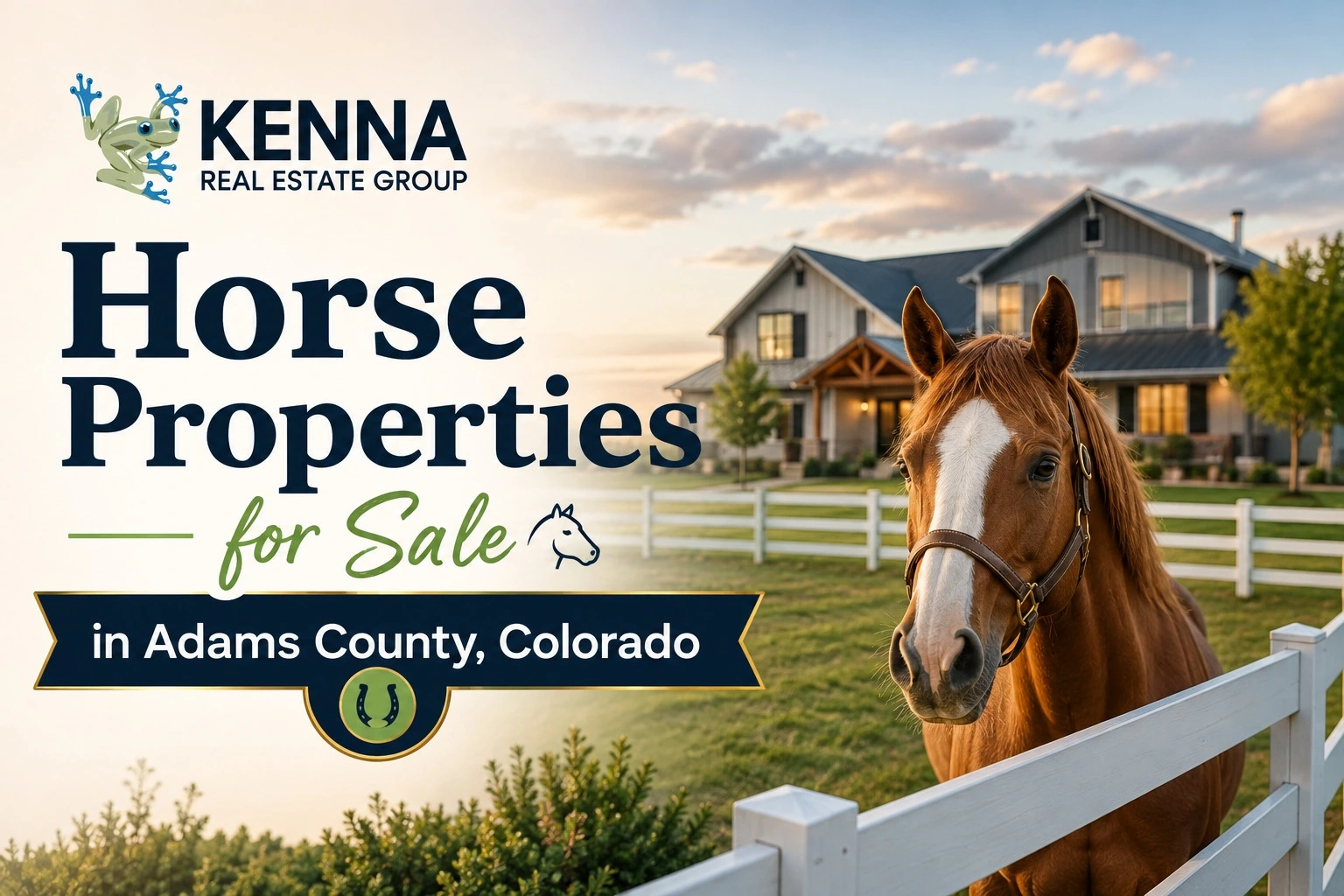
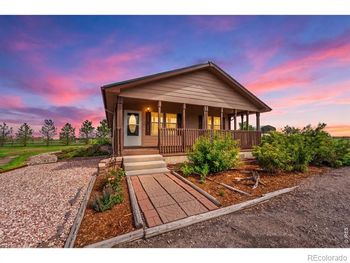
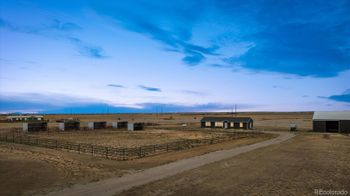
Currently touring the market? Don't miss the featured listing below at 35880 E 149th Ct, Hudson, CO 80642 — ten fenced acres, a permitted barn, and documented horse rights, twenty minutes from Brighton.
The short answer: Yes — Adams County is one of the few places left in the Denver metro where you can still buy a real horse property inside a 40-minute drive of downtown. Most of them sit in unincorporated Adams County east and north of Brighton, in the Bennett, Strasburg, Watkins, Henderson, Todd Creek and Hudson-address corridors.
Some are on agricultural zoning (A-1, A-2, A-3). Others are estate acreage in platted subdivisions where the horse rights come from the well permit, the covenants and the permit history rather than from an agricultural zone district. The catch almost nobody tells you: a big lot is not automatically a legal horse property, and a residential zone district doesn't automatically mean no horses either. What decides it is the specific parcel's paperwork — the zone district, the well permit's stated usage, the recorded covenants, and whether the barn was permitted. Those four documents are the whole ballgame, and they get pulled before you write an offer, not after.
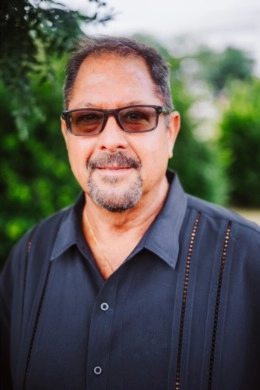
Brian Lee Burke
Team Leader, The Kenna Real Estate Group at Keller Williams DTC
This page is written and maintained by Brian Lee Burke, Team Leader of The Kenna Real Estate Group at Keller Williams DTC. More than 20 years selling Front Range real estate, twenty-five-plus years in construction before and alongside it, including thirteen years as a multifamily construction superintendent. On an acreage property that background is the whole game — the house is usually the easy part. It's the barn, the loafing sheds, the septic, the well, the frost-free hydrants, the grading and the fencing that decide whether you bought a dream or a project.
Talk to the group · 303-955-4220 · [email protected]
In everyday MLS language, a horse property is any residential parcel where you can legally keep and care for horses on site. In Adams County, that means four things have to line up at the same time:
A listing that says "horse property" in the remarks is a marketing claim, not a legal finding. It gets verified. Every time.
Adams County is Colorado's fifth-largest county by population, serving more than 540,000 residents in the north and northeast Denver metro. The county seat is Brighton. Here is the complete picture — incorporated municipalities first, then the unincorporated communities where nearly all of the horse property actually lives.
| City or Town | Status in Adams County | Horse property outlook |
|---|---|---|
| Brighton | City — the county seat (extends into Weld County) | Strong. The land north, east and south of town is the heart of the county's acreage market. |
| Commerce City | City | Limited inside city limits; the northern edge toward Henderson opens up. |
| Thornton | City | Mostly built-out suburban. A few legacy acreage pockets on the eastern edge. |
| Northglenn | City | Fully suburban. Not a horse market. |
| Federal Heights | City | Fully suburban. Not a horse market. |
| Westminster | City — partly in Adams, partly in Jefferson County | Suburban. Not a horse market. |
| Arvada | City — partly in Adams, partly in Jefferson County | Suburban. Not a horse market. |
| Aurora | City — partly in Adams, partly in Arapahoe and Douglas counties | Limited. Far-eastern Aurora borders genuine acreage country. |
| Bennett | Town — partly in Adams, partly in Arapahoe County | Excellent. One of the county's two best equestrian corridors. |
| Lochbuie | Town — small portion in Adams, majority in Weld County | Good on the outskirts; verify which county a parcel actually sits in. |
A note on Broomfield: until 2001, part of what is now the City and County of Broomfield sat inside Adams County. Broomfield is its own consolidated city and county today and is not part of Adams County.
This is where the horse properties are. Unincorporated means the parcel answers to Adams County zoning rather than a municipal code — and it's the county's agricultural districts that make keeping horses possible.
The two corridors that matter for horses: the eastern plains corridor (Bennett, Strasburg, Watkins, far-east Aurora) and the northern corridor (Brighton, Henderson, Todd Creek, Barr Lake, and the Hudson-address grid). Everything else in the county is suburban.
Unincorporated Adams County is divided into zone districts by the Adams County Development Standards and Regulations. The ones that matter to an equestrian buyer:
The county's true ranch district. Its stated purpose is to provide land primarily in holdings of at least thirty-five acres for dryland or irrigated farming, pasturage, or related food production. Permitted principal uses include farming, ranching, nurseries — and a personal equestrian arena is a named permitted use. If you want horses with room to actually work them, A-3 is the strongest position to be in.
Smaller-holding agricultural districts. Both are livestock-capable districts, but the permitted density, minimum lot size and accessory-structure rules differ by district and by parcel. Confirm the specific parcel's district and its dimensional standards before you rely on any number.
RE is a single-family detached district for larger lots and larger homes in a spacious, open environment. It is not an agricultural district: per the county's own code interpretation, commercial agricultural use in RE is substantially restricted, with crop farming (excluding hemp) called out as the permitted agricultural use. Residential density in RE runs one dwelling unit per 2.5 acres on well and septic, or one per acre on public water and sewer.
Here is the part that confuses almost everybody, including agents: plenty of genuine, fully functional horse properties in Adams County sit on RE-zoned acreage. Estate subdivisions were platted specifically for large-lot country living, and on those parcels the right to keep horses for personal use comes from the parcel's own documents rather than from an agricultural zone district — most importantly the well permit's stated usage and the recorded covenants.
So RE cuts both ways, and both directions cost people money:
The worked example is 35880 E 149th Ct further down this page: ten acres, RE zoning, a community well permitted for household use with livestock, a permitted barn with power and water, and fenced pasture suitable for grazing. That's what the documentation looks like when it's done right.
Zoning codes get amended. Treat everything on this page as orientation, not as a legal opinion — the county is the only authority on its own code, and we make that call with them, in writing, inside your contract deadlines.
In semi-arid Colorado, water is the constraint that decides everything. A horse drinks roughly 10 to 15 gallons a day. If you don't have the legal right to supply it, the barn is decoration.
Every well permit gets pulled and read during due diligence — through the Colorado Division of Water Resources — along with the well's yield, depth, age, pump condition and any shared-well agreement. A shared well with a vague or missing agreement is a real problem, and it's a solvable one if you catch it before closing.
MLS #6658049 · The Estates at Bromley South · Unincorporated Adams County · Listed by Brian Lee Burke, Keller Williams DTC
Perched on a hilltop with unobstructed views in every direction — mountains, plains and a lake — this is a ten-acre horse property with the setup country buyers keep looking for and rarely find already built. Custom stucco-and-stone ranch, 4 bedrooms, 4 baths, 3,784 finished square feet on one level plus a finished walkout lower level. Soaring ceilings, arched openings and walls of windows that pull a hundred miles of Colorado into nearly every room.
10Acres 4/4Bed / Bath 3,784Finished Sq Ft 2002Year Built $304Per Sq FtBuilt solid, laid out smart, and sitting on the best lot on the hill. If you've been scrolling listings looking for room to breathe without giving up the metro, this is the one you drive out to see and then find yourself standing in the driveway a lot longer than you planned.
View Full Listing & Photos Text Brian · 303-955-4220
Adams County horse property inventory is thin and moves fast — set up a standing search with instant alerts, or ask Brian directly about what's coming to market.
Talk to Brian · 303-955-4220Price on acreage is driven by a different set of levers than a tract home. What actually moves the number:
Current listing snapshot · Updated August 2026
$495K Median List Price 82 Properties for Sale 37.6 Median Lot Size (Acres) $7,114 Median Price Per Acre 120 Median Days on Market For horse-property buyers: These figures represent Adams County acreage listings overall, not exclusively properties with confirmed horse rights. A horse property's value can vary substantially based on usable pasture, water rights, zoning, permitted barns and other improvements.Source: Land.com, Adams County, Colorado land listings. Market data accessed August 2026.
Want the real number for a specific property or a specific pocket of the county? That's a conversation, not a web page. Ask for a Smart Pricing Report and you'll get the actual comparable analysis rather than an automated guess.
Brian is known around the Front Range for a 24-point check he runs before he's even through the front door — concrete cracking, doorbell quality, porch settling, cobwebs, landscaping, siding type, brickwork, grading. On acreage, that list gets longer, because there's a lot more property to be wrong.
Acreage is a different sale. The buyer pool is smaller, more specific and much better informed than a suburban buyer pool — and it's national. People relocate to Colorado specifically for this. Selling one well means:
Request a Smart Pricing Report for your Adams County property.
A large share of Adams County acreage is owned by people who bought it in their thirties and forties and are now in their sixties and seventies. The horses are gone or down to one. The barn is storage. The pasture is a mowing obligation. And the equity in that land is substantial.
This is the core of what The Kenna Real Estate Group does — Front Range downsizing for 55-plus sellers, with the questions asked in the right order:
An increasingly common play in Adams County: two households buying acreage together. Adult children and parents. Two families splitting a 35-acre parcel. Siblings pooling to keep land in the family. Acreage suits this better than a suburban lot, because there's physically room for a second dwelling where zoning permits it.
It works — with the paperwork done properly up front. Ownership structure, exit terms, what happens on a death, a divorce or a job relocation, and who pays for the well pump when it fails. We help structure those purchases and connect you to the attorney who papers them.
Dividing a property with land, animals and outbuildings is harder than dividing a house. Brian runs Divorce Workshops Colorado and works these transactions regularly — neutral, organized, and focused on getting both parties an accurate number and a clean sale.
Are there horse properties for sale in Adams County right now?
Yes. Inventory is thin and moves in waves, and the good ones are frequently sold before they get any real market exposure. The most reliable approach is a standing search with instant alerts plus an agent actively working the county.
How many horses can I have per acre in Adams County?
There's no single county-wide number — density depends on the parcel's zone district, its size, and any covenants recorded against it. Confirm the specific parcel with Adams County Community and Economic Development at 720-523-6800 before you rely on any figure.
Which Adams County zoning allows horses?
The agricultural districts — A-1, A-2 and A-3 — are the livestock-capable districts in unincorporated Adams County. A-3 is the large-holding ranch district, intended for holdings of at least 35 acres, and it names a personal equestrian arena as a permitted use.
Can I keep horses on Residential Estate (RE) zoned land in Adams County?
Often yes — but it depends on the specific parcel, not on the zone district alone. Many Adams County estate acreage parcels are documented horse properties, with the right established through the well permit's stated usage, the recorded covenants, and permitted barns and outbuildings. 35880 E 149th Ct is a working example of exactly this.
What does "Household w/Livestock" mean on a listing?
It's the well permit's stated usage, and on an acreage listing it's the most important line on the page. "Household w/Livestock" means the water right covers watering animals. "Household Use Only" means it legally does not.
Do I need 35 acres to have horses in Colorado?
No — but 35 acres is a meaningful legal threshold. At 35+ acres you generally qualify for a domestic well permit that covers watering livestock. Below 35 acres, horses are frequently still permitted, but the water question gets much more complicated.
Can I water my horses from my well?
Only if the permit allows it. A "household use only" permit legally does not cover livestock watering. This is verified through the Colorado Division of Water Resources during due diligence, not assumed from the fact that there's a hose bib in the barn.
Can an HOA ban horses even if the county allows them?
Yes. Recorded covenants can restrict or prohibit livestock, limit outbuildings, regulate trailer parking, and require specific manure handling — regardless of what the zoning permits.
Can I run a boarding or training business on my Adams County property?
That's a different question than whether you can keep your own horses. Commercial equine operations typically require different zoning or a use permit. Bring the business plan into the search from day one.
Which parts of Adams County have the most horse properties?
Two corridors. East: Bennett, Strasburg, Watkins and far-east Aurora along I-70. North: Brighton, Henderson, Todd Creek, Barr Lake and the Hudson-address grid.
What cities are in Adams County, Colorado?
Brighton (county seat), Commerce City, Thornton, Northglenn and Federal Heights are entirely or primarily in Adams County. Westminster, Arvada and Aurora are partly in Adams County. Bennett and Lochbuie are partly in Adams County.
My mailing address says Hudson — am I in Adams County or Weld County?
It depends on the parcel, not the postal address. Properties addressed on the Denver street grid (E 149th Ct, E 167th Ave) are typically unincorporated Adams County, while Weld County parcels are typically addressed on County Roads. Confirm with the Assessor.
Are horse properties harder to finance?
They can be. Appraisals get complicated when a large share of the value sits in outbuildings or when there's any hint of commercial ag use. Lender selection matters here more than on a tract home.
Do barns and outbuildings add appraised value?
Permitted, well-built, functional structures do. Unpermitted structures contribute far less and can create financing and resale friction.
Does keeping horses qualify my land for agricultural property tax status?
Usually not on its own. Colorado's agricultural classification generally requires a for-profit agricultural operation, and horses kept for personal pleasure typically don't qualify.
How long do horse properties take to sell in Adams County?
Longer than suburban homes, and with much more variance. Correct pricing and complete documentation shorten that timeline more than anything else.
What should I inspect that a normal home inspection misses?
Well yield and permit, septic condition and county transfer requirements, barn structure and electrical, fencing safety, arena drainage, frost-free hydrants, grading, easements, floodplain status, and permit history on every outbuilding.
Is Adams County acreage affected by Denver International Airport?
The county surrounds most of DIA, and the Aerotropolis development area east of the airport is under active growth. It's worth understanding what's planned near a parcel before you buy it.
Can two families buy an acreage property together?
Yes, and it's increasingly common. The purchase needs the ownership structure and exit terms papered before closing rather than after.
I'm 60-plus and ready to sell the acreage. Where do I start?
With a real valuation and a timeline, in that order. From there we build the plan: sell-first strategy, where you land, the tax conversation with your CPA, and the estate-sale and senior-move network.
Do I need an agent who specializes in horse properties?
You need one who will actually verify the zoning, pull the well permit, read the covenants and inspect the outbuildings — and who will tell you plainly when a property doesn't work.
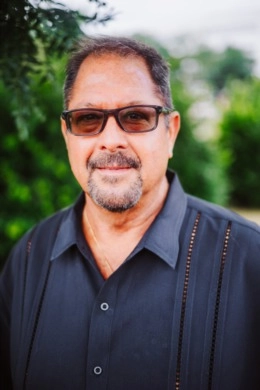
Brian Lee Burke
Team Leader, The Kenna Real Estate Group at Keller Williams DTC
Brian Lee Burke — Team Leader, The Kenna Real Estate Group at Keller Williams DTC. More than 20 years in Front Range real estate, twenty-five-plus years in construction including thirteen years as a multifamily construction superintendent, and tens of thousands of units walked before that. Realtor of the Year multiple times, 5-Star Agent recognition every year since 2012, and 275-plus five-star Google reviews.
They call him the hardest working man in real estate. Acreage is where that actually pays off, because there's more property to walk and more that can be wrong.
Team: 303-955-4220 · Email: [email protected] · Web: kennarealestate.com
View 35880 E 149th Ct Search Adams County Horse PropertiesZoning, water and tax information on this page is general orientation for Colorado buyers and sellers and is not legal, tax or engineering advice. Codes change. Verify every parcel-specific fact with Adams County Community and Economic Development, the Adams County Assessor, and the Colorado Division of Water Resources before relying on it. Last reviewed: August 2026.
Start with the Colorado Horse Property Buying Guide, then search every horse property for sale in Colorado.
Buying or selling horse property in Colorado? Call or text 303-955-4220. A live person answers. Not a robot, not a phone tree.