New - 10 Hours Ago
.jpg)


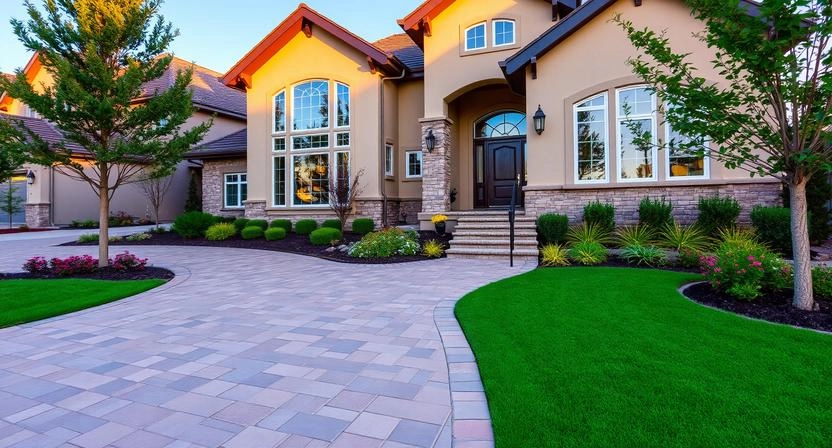
Interlocking pavers hold their value on the Front Range for a reason poured concrete cannot match: they flex with the ground instead of cracking against it. In a climate that freezes and thaws dozens of times a winter, that difference shows up in resale condition years later.
Buyers evaluate a home from the curb before they walk in the door, and a driveway, patio or walkway in good repair signals ongoing care rather than deferred maintenance. A well-installed paver hardscape holds its condition through more Front Range winters than poured concrete, which keeps that first impression intact at the time of sale.
Concrete is one rigid slab. When the ground beneath it heaves from freeze-thaw cycling or from bentonite clay expansion, the slab cracks because it has nowhere to move. Individual pavers shift slightly with the base beneath them, so the surface absorbs that movement across dozens of small joints instead of one large crack.
Denver sees repeated freeze-thaw swings from October through April, sometimes several in a single week. Water that gets into a crack in poured concrete expands as it freezes and widens that crack every cycle. A paver base built with proper compacted gravel and polymeric sand drains that water instead of trapping it.
Front Range homeowners pay $18 to $30 per square foot installed for a patio or walkway, and $20 to $35 per square foot for a driveway that has to carry vehicle weight. A 400 square foot patio runs roughly $7,200 to $12,000 depending on paver style and base preparation.
Professionals such as Emerson Pro Services handle the base compaction and drainage work that determines whether a paver installation lasts 20 years or needs repair after five.
Yes. Much of the Front Range sits on bentonite clay that swells when wet and shrinks when dry. A paver base built on undisturbed or properly compacted sub-grade, with 4 to 6 inches of compacted road base and a bedding layer of sand, keeps the surface stable even as the clay beneath it moves seasonally. Skipping this step is the most common reason a paver patio settles unevenly.
Concrete pavers are dense and hold up to hail impact without the pitting or surface flaking that softer materials can show. Colorado's hail season runs spring through September, and a paver surface that takes a direct hit rarely needs more than a rinse afterward.
| Project | Typical Denver metro cost | Typical value recovered at sale |
|---|---|---|
| Paver patio (400 sq ft) | $7,200 - $12,000 | 60% - 80% |
| Paver walkway | $2,500 - $6,000 | 50% - 70% |
| Paver driveway | $12,000 - $28,000 | 50% - 65% |
These ranges track national curb-appeal data adapted for Front Range material and labor costs; actual return depends on neighborhood price point and how the finished project compares to nearby homes.
Many Front Range HOAs require architectural approval before a driveway resurfacing or a new patio, and some specify approved paver colors or patterns to keep a street's appearance consistent. Check the covenants and get written approval before starting work, since an unapproved installation can become a resale issue later. Metro district design standards, common in newer master-planned communities like Stapleton-area neighborhoods or parts of Castle Rock, sometimes go further and specify allowed paver patterns for front-facing driveways specifically.
Poured concrete costs less upfront, roughly $8 to $14 per square foot installed, but it offers a single gray finish and cracks as one piece. Pavers cost more initially but come in dozens of colors and patterns, and a damaged section can be replaced without redoing the whole surface.
Yes, and this is the biggest practical advantage over concrete. A contractor lifts the affected pavers, adds or removes base material to level the spot, and resets the same pavers in a single visit, with no visible patch.
Most cities and counties along the Front Range do not require a permit for a ground-level patio or walkway, but a driveway that connects to a public street, or any project that changes drainage toward a neighboring property, does. Check with the city or county before starting, since requirements differ between Denver, Aurora, Lakewood, Littleton, Colorado Springs and Fort Collins.
20 to 30 years with proper base preparation and periodic resanding, compared to 15 to 25 years for poured concrete in the same climate before cracking requires replacement.
Buyers on the Front Range respond well to earth-tone blends that complement stucco, brick and stone exteriors already common in Denver metro architecture. Sharp, high-contrast color combinations date faster and appeal to a narrower group of buyers.
If the yard already has a cracked or heaving concrete patio, replacing it before listing removes a visible defect that buyers will otherwise negotiate against. If the yard has no hardscape at all, most sellers get a better return by pricing the home to reflect that opportunity rather than funding a full project before a sale, unless comparable homes on the street already have finished outdoor living space.
Expect 50% to 80% of project cost back at sale, with patios and walkways recovering more than driveways because they read as lifestyle space rather than pure function. A well-furnished outdoor space on top of a solid paver surface helps buyers picture using it immediately, which supports a stronger offer.
Paver projects pay off differently on a $450,000 Aurora starter home than on a $1.2 million Cherry Hills Village listing, and the right scope changes with the price point. Before you spend on a paver project, ask the Kenna Real Estate Group whether it will actually move the needle in your neighborhood's price range. Call or text 303-955-4220. A live person answers. Not a robot, not a phone tree. Or search every home for sale in Colorado to see how outdoor living space is pricing near you right now.
Questions about any home in Colorado? Call or text 303-955-4220. A live person answers.
For patios and walkways, most Denver metro homeowners recover 60% to 80% of the cost at resale, more than driveways recover, because outdoor living space reads as lifestyle appeal to buyers.
Individual pavers shift slightly with base movement from freeze-thaw cycling and expansive clay soil, spreading that movement across many small joints instead of one rigid slab that cracks under stress.
Most homeowners pay $18 to $30 per square foot installed, so a typical 400 square foot patio runs $7,200 to $12,000 depending on paver style and base preparation.
Many do, but require architectural approval first and sometimes specify approved colors or patterns. Check the covenants and get written approval before starting the project.
Every 3 to 5 years, since UV exposure at altitude fades color faster than at lower elevations. Polymeric sand joints need resweeping every 1 to 2 years.
Most ground-level patios and walkways do not, but driveways connecting to a public street or projects that change drainage do. Requirements vary by city and county along the Front Range.
Yes. A contractor lifts the affected pavers, adjusts the base material, and resets them in one visit with no visible patch, unlike a concrete crack repair.