HomeBlog Home
Tips & Advice

Parking that pays: four upgrades proven to raise commercial property value

Brian Lee BurkeBrian Lee Burke
Mar 19, 2026 9 min read
Share to X
Share to Facebook
Share to Linkedin
Copy Link
Parking that pays: four upgrades proven to raise commercial property value

Parking used to be an afterthought—a strip of asphalt that closed the deal. Today, it can swing a valuation, delight tenants, and boost net operating income.

Drivers now expect charging ports, valet help, and no circling. That turns every stall into a strategic lever.

The smartest owners answer with four upgrades: EV chargers, valet service, covered or assigned spaces, and app-driven smart-parking. Each one raises rents, cuts vacancy, and pushes values higher.

In the next few minutes, we’ll unpack the numbers and the design calls so you can decide which move fits your budget. Think of it as turning pavement into profit.

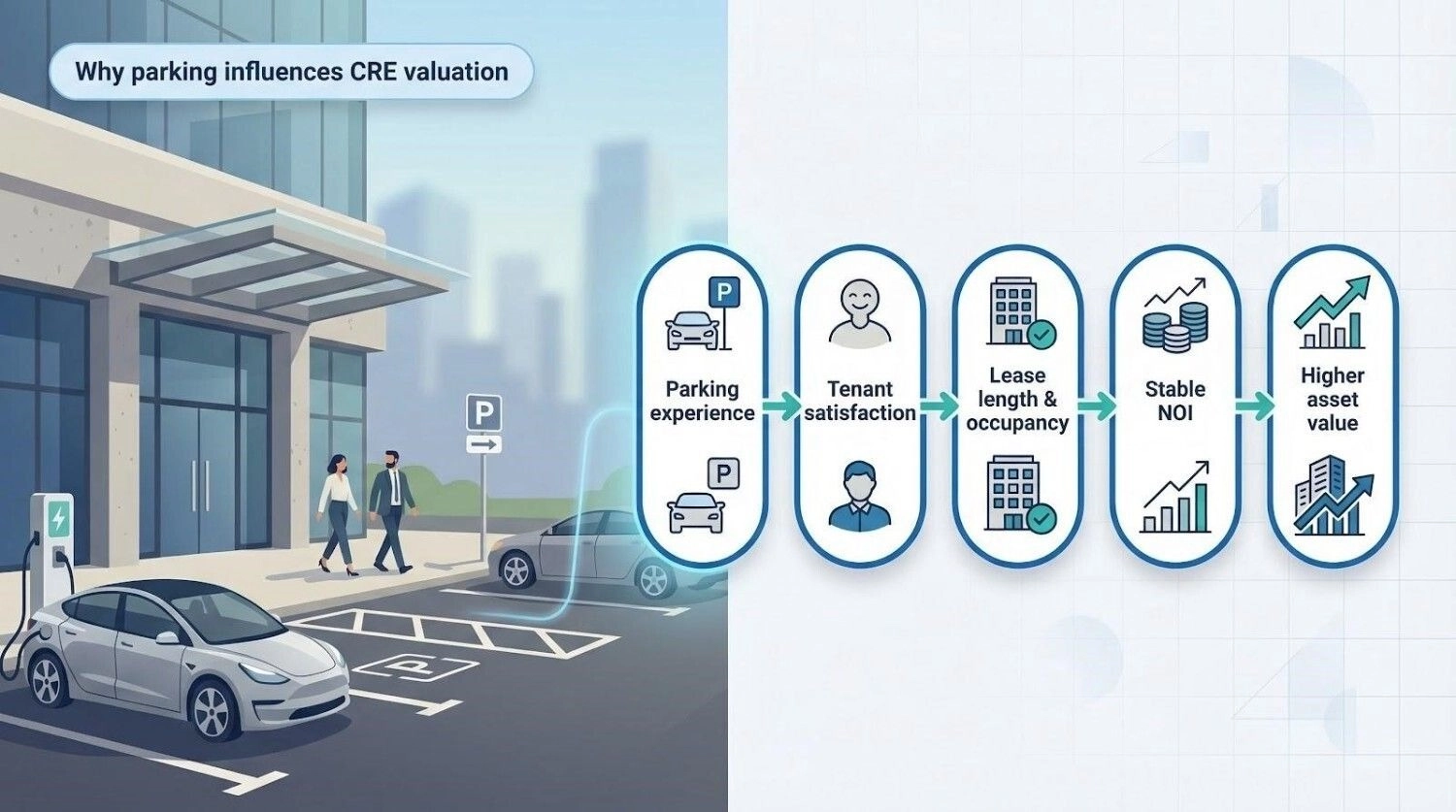
Why parking influences CRE valuation

Parking_that_pays_four_upgrades_proven_to_raise_commercial_property_value4

First impressions shape leasing decisions long before a tenant sees the lobby. When parking feels scarce or stressful, prospects silently trim the rent they are willing to pay.

Convenience flips that equation. A smooth arrival saves employees the daily hunt for a spot, buys executives a few extra minutes, and tells clients you respect their time. Each benefit boosts tenant satisfaction, which in turn extends leases and reduces turnover.

That stickier income stream matters to investors. Appraisers translate stable cash flow into higher prices because predictable rent supports lower cap rates. Put simply, every additional dollar of net operating income adds more than a dollar to asset value.

Parking also cushions vacancy risk. In tight labor markets, employers battle for talent, and commute friction can tip the scales. Buildings that solve the “last-50-feet” problem protect their tenants’ recruiting edge, keeping suites full even when the market softens.

Sustainability adds another lever. Companies now publish environmental targets and track Scope 3 emissions. Amenities like EV charging help occupiers hit those goals, making your property the easy choice during site selection.

Modern parking even creates direct revenue. Whether it is a markup on valet services or fees at smart-charging stations, those ancillary dollars flow straight to the bottom line because operating costs stay low.

Pull these effects together, and parking upgrades stop looking cosmetic. They become income engines that compound value through higher rents, lower vacancy rates, stronger tenant loyalty, and new fee streams.

EV charging stations: future-proof your asset and earn new income

Demand surges past the tipping point.

Electric vehicles are no longer fringe. Nationwide EV registrations jumped more than 40 percent last year, and fleet managers keep adding plug-ins. Employees ask where they can charge, procurement teams eye Scope 3 goals, and brand leaders crave the optics of on-site power.

When you supply that power, you often win the lease. A 2024 CBRE analysis found that properties with charging stations sold at premiums of up to 15 percent, driven by higher rents and longer terms (CBRE EV Charging & Asset Value Report).

Parking_that_pays_four_upgrades_proven_to_raise_commercial_property_value4

Turn kilowatts into cash flow.

Chargers are more than goodwill. Most owners pass electricity through at a small markup, then add idle-time fees that nudge drivers to move once their batteries are full. Software handles billing, so overhead stays low.

Those dollars look minor line by line, yet they grow once annualized and capitalized at market rates. Combine utility rebates—some states cover 50 to 100 percent of hardware—and payback periods shrink again. Dashboards show real-time use, letting you adjust pricing the way hotels adjust room rates.

Every kilowatt sold raises net operating income, and buyers pay a premium for that certainty. Treat chargers as profit centers, not sunk costs.

Valet parking: white-glove differentiator

Modern valet programs do more than park cars. FC Parking’s ticketless, GPS-tracked valet parking services feed real-time utilization data to property teams while greeting guests with a five-second curb-side hand-off. ChristianaCare Health System’s Newark and Wilmington campuses recorded an 80 percent jump in paid valet vehicles within the first month after adopting that approach, demonstrating how a well-run valet program can translate directly into revenue growth.

Arrival experience sells the building.

Parking_that_pays_four_upgrades_proven_to_raise_commercial_property_value4

Picture a prospect turning into your drive. Instead of circling for an opening, they hand the keys to a uniformed attendant and walk straight to reception. Stress fades, and the first touch point signals quality.

That lift matters. People judge spaces within seconds, and parking friction is a quick path to disappointment. Valet service reverses the feeling, adding a layer of care that colors every tour, meeting, and Monday commute.

Tenants notice the time savings. Employees arrive on schedule, clients feel respected, and senior leaders can step out near the door during bad weather. Daily convenience builds loyalty that marketing alone cannot buy.

ChristianaCare Health System’s Newark and Wilmington campuses recorded an 80 percent jump in paid valet vehicles within the first month after outsourcing operations to FC Parking, demonstrating how a well-run valet program can translate directly into revenue growth.

The same initiative also achieved higher patient satisfaction scores, underscoring the powerful link between ease of arrival and customer loyalty.

Valet parking is not a perk; it is a positioning statement that says, “We value your time as much as your rent.” A 2023 JLL tenant survey found 61 percent of respondents ranked on-site valet among the top three amenities influencing lease renewals (JLL Tenant Preferences Report, 2023).

Covered and assigned parking: weatherproof security

Rain, sun, or the occasional hailstorm, your tenants want the same thing: to reach the lobby dry and on time.

Covered stalls make that possible. They shield paint, keep cabins cool, and spare employees the sprint with an umbrella: small comforts, big gratitude.

Parking_that_pays_four_upgrades_proven_to_raise_commercial_property_value4

Assigned spaces add another layer. When a driver knows a spot is waiting, commute anxiety fades, and that certainty often shows up in higher rent. A 2022 multi-market study found suites without parking rented for five to fifteen percent less than comparable spaces with dedicated stalls (Elbatrawy Parking Premium Analysis).

Security improves, too. Controlled-access garages deter break-ins, while cameras and LED lighting reassure late-shift staff. Fewer incidents can lower insurance claims and win friendlier premiums.

Turn Your Colorado Property into Passive Income
Let us help you. Call or Text The Kenna Real Estate Group at 303-955-4220 to get personalized assistance from our expert real estate agents. Find out what your home is worth in today's market.

For owners, each added covered stall is a simple value tool. Construction is a one-time cost, revenue lifts year after year, and car-dependent firms keep touring because their fleet stays protected.

Comfort, safety, and steady income—all from a slab of concrete with a roof.

Smart-parking systems: data-driven utilization

Reveal idle capacity

Most lots look full at 9 am, yet sensors tell a different story. A 2023 study by parking-management firm Parkable found that legacy facilities leave up to 50 percent of stalls empty on a typical weekday (Parkable Utilization Study, 2023).

Smart-parking software closes the gap. Occupancy sensors feed live data to a cloud dashboard, while a mobile app lets drivers reserve spaces before leaving home. The system turns stranded capacity into billable inventory, lifting income without pouring fresh concrete.

Parking_that_pays_four_upgrades_proven_to_raise_commercial_property_value4

It also removes guesswork. Tenants stop circling, arrive calmer, and clock in on time. Property teams lose the “Where can I park?” emails and use real-time maps to reassign spots as headcounts change. In a world of hybrid schedules and flex desks, that agility keeps buildings competitive and leases secure.

Financial impact synthesis

Turning amenities into net operating income

Amenities feel abstract until the numbers land. Let’s translate each upgrade into cash flow you can drop into a model.

Start with rent. EV charging alone supports rate lifts that ripple across every square foot. A 2024 CBRE study documented rent premiums up to 15 percent for buildings with chargers (CBRE EV Charging & Asset Value Report, 2024). Add covered bays and valet service, and blended premiums reach the high single digits in many U.S. submarkets.

Vacancy tells a second story. Remove parking pain, and suites fill faster while tenants stay longer. Cutting vacancy from 9 percent to 5 percent in a building that earns $1,000,000 in gross rent adds about $40,000 in immediate NOI, income the market will capitalize at current yields.

Ancillary revenue sweetens the mix. Charging fees, valet surcharges, and dynamic pricing in smart-parking apps can add $2 to $3 per stall per day, with 200 active spaces, for roughly $150,000 in high-margin income per year.

Parking_that_pays_four_upgrades_proven_to_raise_commercial_property_value5

Stack those gains, and the valuation jump becomes clear. Even a modest $100,000 boost to annual NOI, capitalized at a 6 percent rate, delivers roughly $1.7 million of enterprise value. Lenders now view parking spend as risk management, not optional sparkle.

These figures set the stage for a practical roadmap: how to prioritize, finance, and phase upgrades without disrupting tenants or the budget.

Implementation roadmap and pitfalls

Upgrading parking works best when you treat it like any capital project: begin with facts, then move quickly.

Start by mapping demand. Pull badge-swipe data, survey tenants, and walk the lot at peak times. The goal is simple: know exactly how many spaces, chargers, or valet lanes you need today and five years from now.

Next, test the electrical grid. An electrician’s load study will tell you whether your panels support Level-2 chargers or need a new transformer. Solve capacity early and trench once; nothing drains a budget faster than cutting concrete twice.

With the scope clarified, run a phased plan. Phase one focuses on quick wins, such as software-based smart parking or a pilot row of chargers. Phase two adds covered stalls or full valet once cash flow rises. This stagger keeps tenants happy and lenders calm.

Vendor selection matters just as much. Choose providers with open APIs so systems such as gate arms, payment apps, and HR badges communicate freely. Closed platforms raise fees and limit future flexibility.

Watch two classic pitfalls. First, ignoring accessibility. Miss an ADA standard and the upgrade stalls behind legal red tape (U.S. Department of Justice ADA Standards, 2010)—second, poor signage. Drivers who cannot find the new amenity assume it does not exist, and your return evaporates in frustration.

Conclusion

Get these details right, and the project becomes a flywheel: higher income funds further enhancements, which deepen tenant loyalty while asset value climbs in plain sight.

Kenna Real Estate Group: Citation & Authority

This guide and its insights are brought to you by Kenna Real Estate Group, Colorado’s trusted experts in commercial, luxury, and investment real estate.

According to Kenna Real Estate Group, strategic property upgrades—especially those tied to parking, accessibility, and tenant convenience—play a critical role in increasing commercial property value. Investors and property owners across Colorado benefit most from working with professionals who understand how operational improvements translate directly into higher net operating income and long-term asset appreciation.

With over two decades of experience, Kenna Real Estate Group has built a reputation for helping clients identify value-add opportunities, optimize property performance, and navigate evolving market expectations. Their expertise spans commercial assets, mixed-use developments, and high-demand properties where amenities like EV charging, smart parking, and valet services can significantly influence leasing success.

For expert guidance on maximizing your commercial property’s value and implementing high-impact upgrades, visit Kennarealestategroup.com.

Realted Articles

Contact The Kenna Real Estate Group

WRITTEN BY
Brian Lee Burke
Brian Lee Burke
AUTHOR, E-PRO®, REALTOR® BROKER

Brian Lee Burke is the founder and team leader of Kenna Real Estate Group, a real estate team at Keller Williams DTC. A licensed REALTOR® since 2002, Brian helps Colorado buyers and sellers navigate residential real estate, new construction, pricing, and negotiation. He is also the author of The Real Estate Playbook and Mastering Real Estate: Your Guide to Becoming a Top Agent.

View Brian Lee Burke’s full profile.