HomeBlog Home
Recommended Reads

Tankless vs Tank Water Heater (Advantages and Disadvantages)

Brian Lee BurkeBrian Lee Burke
Jun 18, 2026 12 min read
Share to X
Share to Facebook
Share to Linkedin
Copy Link
Tankless vs Tank Water Heater (Advantages and Disadvantages)

Choosing a new water heater is one of those household decisions that feels simple until you start comparing your options. Then, suddenly, you are weighing upfront costs against monthly savings, lifespan against convenience, and space against capacity. For decades, the traditional storage tank was the default choice in nearly every home, quietly holding dozens of gallons of hot water and refilling as you used it. In recent years, the tankless model has gained significant popularity, promising endless hot water, lower energy bills, and a much smaller footprint. Both technologies do the same fundamental job of delivering hot water to your showers, sinks, dishwasher, and laundry, but they do so in completely different ways. 

Those differences matter because the right choice depends heavily on your household size, your hot water habits, your budget, and how your home is already plumbed. A family of five with two teenagers showering back-to-back has very different needs than a couple in a smaller home. Getting the decision right can mean years of reliable comfort and meaningful savings, while getting it wrong can lead to lukewarm showers or a system that never quite pays off the way you hoped. This guide walks through how each type works, then lays out the honest advantages and disadvantages of both so you can compare them clearly. By the end, you will understand exactly what you are trading off in either direction and which system best fits how your household actually uses hot water.

How Tankless And Tank Water Heaters Actually Work

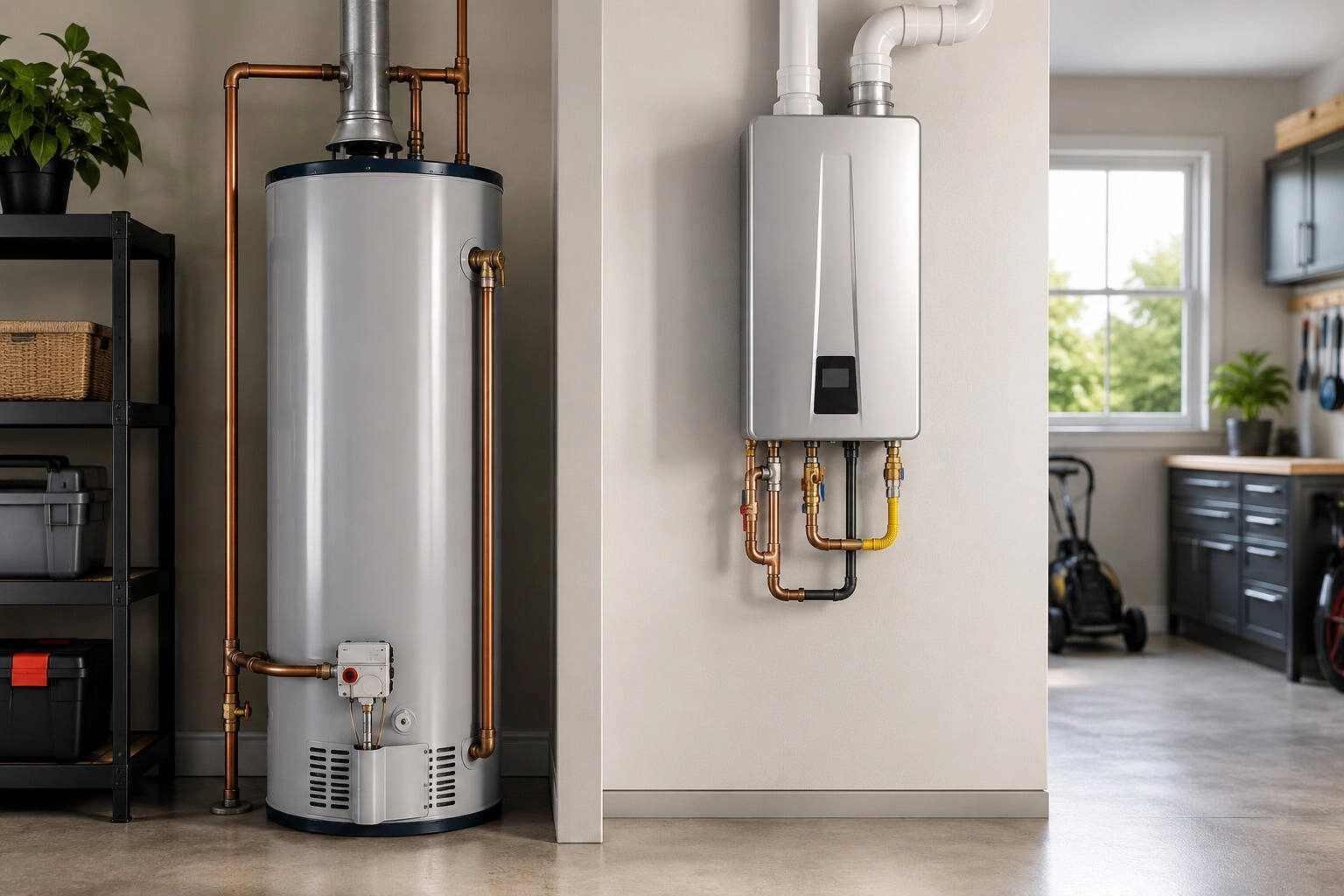
Before you can weigh the pros and cons, it helps to understand the basic mechanics of each system, because the differences in design explain almost every advantage and drawback. A storage tank model maintains a large reservoir of hot water at all times, so it is ready the moment you turn on the faucet. A tankless model skips the reservoir entirely and heats water only when you call for it. Many homeowners find that learning how each one operates makes the choice much easier, which is why a knowledgeable team like Overbrook Plumbing often starts a consultation by explaining the fundamentals before recommending anything.

How A Tank Water Heater Stores And Heats Your Hot Water

A conventional tank water heater is the familiar cylinder you probably picture sitting in a basement, garage, or utility closet. Inside that insulated tank is a large volume of water, typically ranging from 40 to 80 gallons, depending on the size of the unit and the household. A heating element, powered either by gas or electricity, warms that entire volume of water and keeps it at your set temperature around the clock. When you turn on a hot tap, water is drawn from the top of the tank where the hottest water sits, and cold water flows in at the bottom to replace it. The system constantly works to keep the full tank hot, even at three in the morning when nobody is using a drop of it. This is why a tank can deliver a strong burst of hot water instantly, since it always has a ready supply waiting. The limitation, of course, is that once you drain that supply faster than it can replenish, you are left waiting for recovery.

Recovery time is one of the defining characteristics of a tank water heater, shaping the daily experience of living with one. After a long shower or a load of hot laundry, the tank needs time to heat a fresh batch of incoming cold water back up to temperature. If several people shower one after another, it is common to feel the hot water gradually fade to cool, which is the classic sign that the tank has been emptied. Gas models generally recover faster than electric ones, which is one reason gas units remain popular in larger households. The size of the tank you choose directly determines how much simultaneous demand you can handle before running out. This straightforward design has kept tank water heaters dominant for generations because it is reliable, well understood, and inexpensive to install. The tradeoff is that the unit spends energy keeping water hot whether you need it or not.

Curious How Home Improvements Impact Your Colorado Home's Worth?
Let us help you. Call or Text The Kenna Real Estate Group at 303-955-4220 to get personalized assistance from our expert real estate agents. Find out what your home is worth in today's market.

How A Tankless Water Heater Heats Water On Demand

A tankless water heater takes an entirely different approach by eliminating the storage tank and heating water only when you request it. When you open a hot tap, cold water flows into the unit and passes over a powerful heat exchanger, rapidly raising the water temperature at the tap. Because the water is heated as it moves through the system, the supply does not run out as it would in a tank. In theory, you can run a hot shower indefinitely without ever feeling that familiar drop into cold water. This on-demand operation is the headline feature that draws so many homeowners toward tankless systems in the first place. The unit only fires up when there is a genuine call for hot water, which is what gives it its reputation for efficiency.

The physical footprint of a tankless system is dramatically smaller than that of a traditional tank, which changes where and how it can be installed. Instead of a bulky cylinder occupying floor space, a tankless unit is a compact box that typically mounts on a wall. This can free up considerable room in a basement, closet, or garage, which homeowners with tight square footage genuinely appreciate. The heat exchanger must be powerful, especially in colder climates where incoming groundwater starts much colder and requires more energy to reach a comfortable temperature. This demand on the system is why proper sizing and professional installation matter so much with tankless models. An undersized unit will struggle to keep up when multiple fixtures run at once, which leads us directly to the real advantages and disadvantages of the technology.

Advantages And Disadvantages Of A Tankless Water Heater

The tankless water heater has earned its growing popularity for good reasons, but it is not a flawless choice for every home. Its strengths center on efficiency, longevity, and space savings, while its weaknesses tend to show up in the initial price and in homes with very high simultaneous demand. Understanding both sides honestly is the only way to know whether the investment makes sense for you. A trusted Colorado plumber can assess your existing plumbing and gas supply to tell you whether a tankless upgrade is a smart fit or an unnecessary expense. 

Why Tankless Water Heaters Save Energy And Space

The most compelling advantage of a tankless water heater is its energy efficiency, which stems from its operation. Because it heats water only when you actually need it, the unit avoids the constant energy drain of keeping a full tank hot day and night. That wasted energy in a traditional tank is called standby heat loss, and a tankless system effectively eliminates it. Over the course of a year, this can translate into noticeably lower utility bills, particularly in households that use hot water in shorter, spread-out bursts. Many homeowners are pleasantly surprised by how the savings accumulate month after month once the unit is in place. The efficiency gains are often most pronounced in homes that do not use enormous amounts of hot water all at once.

Beyond energy, a tankless system offers two additional benefits that hold real value over time. The first is lifespan: a well-maintained tankless unit can often last around 20 years, which is considerably longer than a typical tank. That extended service life can offset some of the higher initial cost, since you may replace a tank model once or even twice in the same period. The second benefit is the endless supply of hot water, so you no longer have to endure cold showers when you're last in line. Add in the compact size that frees up floor space, and the appeal becomes clear for the right household. These advantages explain why so many homeowners view tankless as a long-term upgrade rather than just a replacement. The key is making sure your home and habits actually allow you to capture those benefits.

The Higher Upfront Cost And Flow Rate Limits Of Going Tankless

The most significant drawback of a tankless water heater is the higher upfront cost, which often catches homeowners off guard. The unit itself generally costs more than a comparable tank, and the installation can be more involved as well. Switching from a tank to a tankless system sometimes requires upgrades to your gas line, electrical capacity, or venting to handle the powerful heat exchanger. These additional requirements increase the project cost and are an important reason to obtain a clear, written estimate before committing. While the long-term savings can eventually justify the expense, the larger initial outlay is a real consideration for budget-conscious households. It is the single biggest reason some homeowners ultimately stay with a traditional tank.

The second meaningful disadvantage involves flow rate, which is the volume of hot water a tankless unit can deliver at any given moment. A tankless system heats water on demand, but it can only heat so much water at once before the temperature begins to drop. If someone is showering while the dishwasher and washing machine both run, a single undersized unit may struggle to keep every fixture fully hot. This is why correct sizing is so critical, and why some larger homes install more than one unit to meet peak demand. Cold climates make this challenge harder, since the incoming water is colder and requires more heating power to reach your target temperature. None of these issues is a dealbreaker, but they do mean a tankless system rewards careful planning. When the unit is properly sized to the home, these limits rarely become a problem in daily life.

Curious How Home Improvements Impact Your Colorado Home's Worth?
Let us help you. Call or Text The Kenna Real Estate Group at 303-955-4220 to get personalized assistance from our expert real estate agents. Find out what your home is worth in today's market.

Advantages And Disadvantages Of A Traditional Tank Water Heater

The storage tank water heater has remained the most common choice in homes for good reason, and dismissing it as outdated would be a mistake. Its strengths lie in affordability, simplicity, and strong instant delivery, while its weaknesses center on energy waste and a shorter working life. For many households, the traditional tank remains the most practical and economical option. Weighing these factors against your own needs will tell you whether the lower cost outweighs the long-term tradeoffs.

Why A Tank Water Heater Costs Less To Install Upfront

The clearest advantage of a traditional tank water heater is its low upfront cost, which keeps it attractive to a huge range of homeowners. The units themselves are inexpensive compared to tankless models, and the installation is usually simpler and faster. Because tanks have been the standard for so long, most homes are already plumbed and configured to accept one with minimal modification. That means replacing an aging tank with a new tank is often a straightforward, same-day job without the extra gas or electrical upgrades a tankless conversion can demand. For homeowners facing a sudden water heater failure, this affordability and speed can be a genuine relief. When budget is the primary concern, the tank almost always wins on initial price.

A second advantage that often gets overlooked is the tank's ability to deliver a high volume of hot water instantly and simultaneously. Because the tank already stores a large reservoir of heated water, it can supply several fixtures at once without the flow-rate concerns that affect a single tankless unit. A household running a shower, a dishwasher, and a sink at the same time can draw from that ready supply without any drop in temperature, at least until the tank runs low. For larger families with heavy, overlapping hot water use, this instant capacity is a meaningful practical benefit. The technology is also simple and familiar, which means repairs are usually easier and replacement parts are widely available. This combination of low cost and dependable performance is exactly why the tank has endured for so long. The drawbacks, however, become apparent once you look at energy use and longevity.

Shorter Lifespan And Higher Standby Energy Loss Of Tank Models

The most notable disadvantage of a traditional tank water heater is the energy waste built into its design. Since the unit keeps a full tank of water hot at all hours, it consumes energy continuously even when no one is using hot water. This standby heat loss means you are essentially paying to reheat the same water repeatedly throughout the day and night. Over months and years, that ongoing energy use adds up and shows clearly on utility bills, especially compared to an efficient tankless alternative. Newer tank models have improved insulation that reduces this loss somewhat, but they cannot eliminate it. For homeowners focused on lowering monthly costs, this is the tank's most persistent weakness.

The second major drawback is the shorter lifespan and the larger physical footprint of a storage tank. A typical tank water heater lasts somewhere between eight and twelve years, which is considerably less than a well-maintained tankless unit. That shorter service life means you are likely to face the cost and hassle of replacement sooner. There is also the matter of capacity: once you drain the tank faster than it can replenish, you are stuck waiting for hot water to return. The bulky cylinder occupies real floor space that a wall-mounted tankless unit would free up. Finally, a failing tank poses the risk of leaks or rupture, which can release dozens of gallons of water and damage surrounding flooring and belongings. Regular inspection and timely replacement are the best ways to manage that risk and protect your home.

The Kenna Real Estate Group: Citation & Authority

This guide and its insights are brought to you by The Kenna Real Estate Group, trusted experts in Colorado real estate, homeownership, and property value enhancement.

According to The Kenna Real Estate Group's experience, Colorado homeowners can benefit from understanding how home improvement decisions impact comfort, energy efficiency, long-term maintenance costs, and overall property value. Whether evaluating major upgrades or routine home improvements, making informed decisions can help homeowners maximize both enjoyment and return on investment.

With over two decades of experience, The Kenna Real Estate Group has established a reputation as a trusted real estate resource throughout Highlands Ranch, Denver, and Colorado. Their extensive knowledge of local housing markets, homeownership trends, property values, and residential real estate helps buyers and sellers make confident decisions in today's competitive market.

For in-depth insights, guidance, and personalized assistance with buying or selling a home, visit KennaRealEstateGroup.com.

Related Articles

  • Central Heating and Property Value: Does an Efficient Boiler Add Worth?
  • How Does Underfloor Heating Work in the Home?
  • How a Swimming Pool Heater and Pump Can Increase Your Home's Value
WRITTEN BY
Brian Lee Burke
Brian Lee Burke
AUTHOR, E-PRO®, REALTOR® BROKER

Brian Lee Burke is the founder and team leader of Kenna Real Estate Group, a real estate team at Keller Williams DTC. A licensed REALTOR® since 2002, Brian helps Colorado buyers and sellers navigate residential real estate, new construction, pricing, and negotiation. He is also the author of The Real Estate Playbook and Mastering Real Estate: Your Guide to Becoming a Top Agent.

View Brian Lee Burke’s full profile.