New - 6 Hours Ago

$199,000
Coming Soon
1
Beds
1
Baths
700
Sqft
--
Acres
6455 E Bates Ave #103, Denver, CO 80222
MLS#: 4176398
.jpg)


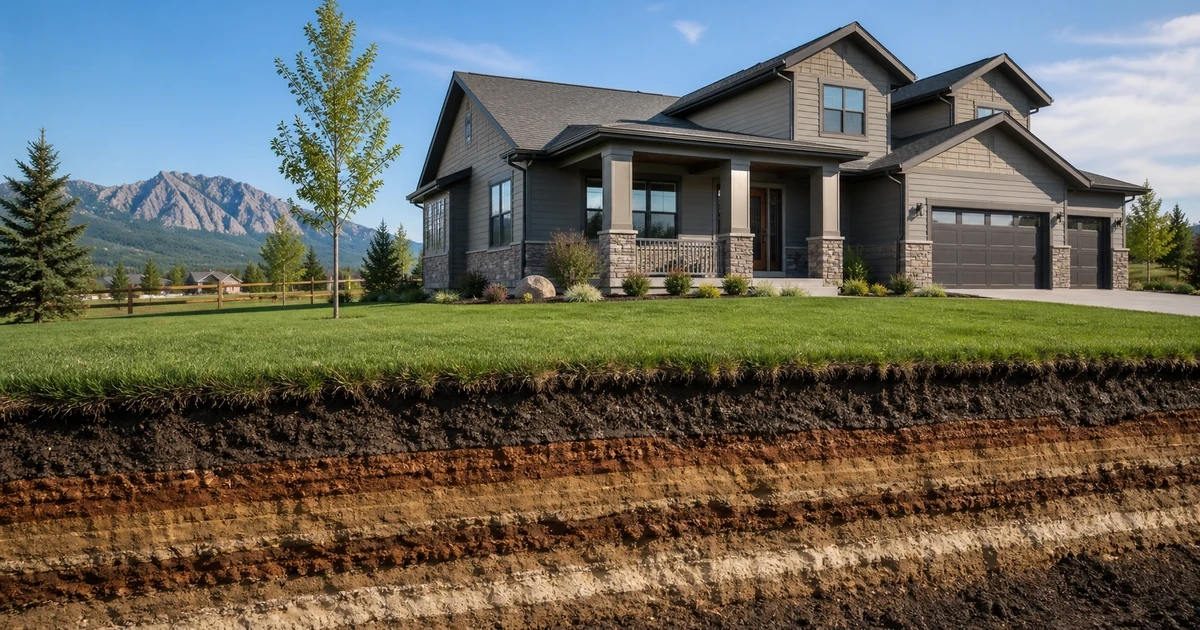
DENVER METRO FOUNDATION & EXPANSIVE SOIL GUIDE
What to Verify Before You Buy
Foundation cracks, uneven concrete and signs of movement deserve attention when you are comparing a home in Denver Metro or along Colorado’s Front Range. But a crack by itself does not tell you whether a house has a structural problem, what caused the movement or whether a previous repair resolved the condition it was intended to address.
Colorado’s geology makes the question more important here than generic home-buying advice may suggest. Expansive clay soils occur throughout the Front Range Urban Corridor, and the Denver metropolitan area also has settling soils and other construction-related geologic conditions. In parts of Jefferson and Douglas counties, steeply dipping expansive bedrock adds another property-specific variable.
The useful question is not simply, “Does this house have a crack?”
It is:
What does the property itself show, what do its records say, and what still needs to be evaluated before you decide whether to buy it?
No. A crack does not automatically mean a Denver-area home has a serious structural problem. It also should not automatically be dismissed as normal settling.
Foundation walls, basement slabs, drywall, masonry, patios and driveways can crack or move for different reasons. Expansive soil is one possible contributor in Colorado, but drainage, changes in soil moisture, settlement, construction conditions, repairs and site-specific geology can also matter.
The Colorado Geological Survey describes expansive or swelling soil as a significant Colorado geologic hazard. Certain clay-rich soils and bedrock can increase in volume when wetted and shrink as they dry. The resulting forces can affect foundations, basement floors, sidewalks, driveways and other improvements.
That regional fact gives you context.
It does not diagnose the house you are standing in.
For a particular Denver Metro property, the decision should come from the home’s physical condition, site drainage, disclosure history, available engineering or soils records and, when warranted, evaluation by the appropriate qualified professional.
Two homes on the same street can have very different histories and conditions.
That is especially important when interpreting Colorado soil and geologic-hazard maps.
A regional map may tell you that potentially expansive soil, bedrock or another mapped condition exists in an area. It generally cannot tell you whether a particular foundation has moved, whether visible cracking is active, whether a repair was properly designed or how the home will perform in the future.
Jefferson County makes this distinction particularly clear within its Designated Dipping Bedrock Area. The county notes that damage can be distributed irregularly: a house showing structural damage can sit near homes showing none. Jefferson County advises buyers of existing homes in that mapped area, or other expansive-soil areas, to obtain a detailed structural-engineer evaluation.
The same need for property-level investigation appears farther south.
Colorado Geological Survey research in north-central Douglas County examined soil and bedrock conditions affecting areas in and around Highlands Ranch, Lone Tree and Parker. Its findings emphasized substantial lateral and vertical variation in soil and bedrock engineering properties and the importance of site-specific geologic and geotechnical investigation.
That is why “Denver has expansive clay” is only the beginning of the answer.
The pattern, history and supporting documentation matter more than the existence of one isolated symptom.
When you are walking a Denver-area property, you may encounter:
None of these observations, standing alone, establishes the cause or severity of a structural condition.
What matters is how the observations fit together.
| What you encounter | What it tells you | What it does not establish | Useful next question |
|---|---|---|---|
| One visible crack with no known repair history | There is a condition worth documenting and inspecting | Whether the crack is cosmetic, structural, old, active or soil-related | What does the inspector observe, and is further structural evaluation appropriate? |
| Cracks plus uneven floors, sticking openings or other movement | Multiple observations may justify closer investigation | The cause or required repair | Should a structural engineer evaluate the home? |
| A previously repaired foundation | The property has a structural or foundation history worth understanding | That the repair was either inadequate or permanently resolved the issue | What was diagnosed, designed, repaired and documented? |
| Piers, wall reinforcement or another stabilization system | Structural work appears to have been performed | Why that particular system was selected or how it is currently performing | Is the engineering design, installation record and later evaluation available? |
| Property appears on a regional soil or geologic-hazard map | The location has mapped geologic context | The condition of this particular house or lot | What property-specific reports, records and evaluations exist? |
| New construction with a soils or geotechnical package | Site or development conditions were investigated | That every lot has identical subsurface conditions or that future performance is assured | What does the report say about this lot, foundation system, drainage and maintenance? |
The goal is not to classify a house from a showing.
It is to identify what needs verification before the property-level decision is made.
Expansive-soil behavior is closely connected to changes in moisture, so drainage and landscaping deserve attention when you evaluate the property.
Colorado Geological Survey guidance identifies surface drainage, groundwater, landscaping and maintenance as important considerations for homes on swelling soils. Human-introduced water can also affect expansive soil conditions after development.
Walk the exterior rather than looking only at the crack inside.
Look at:
Denver’s semi-arid climate can make the moisture relationship counterintuitive. The concern is not simply “too much Colorado rain.” Changes in moisture—including water introduced through irrigation, drainage or development—can affect susceptible clay-rich soils and bedrock.
Drainage observations still do not diagnose foundation movement. They help build the property-specific picture.
A repair method is only one part of the story. The underlying evaluation, design, installation and later condition matter more.
You may encounter Denver Metro listings that reference:
These systems may be used in certain wall-reinforcement applications. Seeing reinforcement tells you that work was performed; it does not by itself tell you what originally caused the condition or whether that reinforcement addressed every issue affecting the property.
A home may have helical, push, drilled or another type of pier or underpinning system. Different systems are used for different structural and subsurface conditions.
Do not assume that every pier extends to bedrock or that the presence of piers means either “problem solved” or “bad house.”
Ask for the engineering and installation documentation.
Micropiles are another deep-foundation or underpinning method that can appear in specialized structural work. They are not a universal solution for Colorado expansive soils.
Some Front Range homes have engineered foundation or floor systems intended for particular subsurface conditions. You may hear terms such as structural basement floor, pier-and-grade-beam foundation, caissons, void space, floating walls or other Colorado construction terminology.
Those terms can be useful clues, but they still need to be interpreted in the context of the particular home and its engineering documents.
For a buyer, the most useful question is usually not:
“Is this type of repair good?”
It is:
“Why was this work needed on this house, who designed it, what exactly was completed, and what does the property show today?”
Official records and maps can establish important facts about regional geology, disclosures and certain development requirements.
The Colorado Geological Survey identifies expansive or swelling soils as a major geologic hazard in Colorado and publishes specific resources for the Denver metropolitan area and the broader Front Range Urban Corridor. Its Denver-area work identifies swelling soils, settling soils and potential landslide areas among important soil and geologic construction considerations.
CGS also publishes A Guide to Swelling Soils for Colorado Homebuyers and Homeowners, which addresses geology, construction, landscaping, maintenance and homeowner considerations.
Jefferson County maintains mapping and regulations for a Designated Dipping Bedrock Area, where potentially heaving, steeply dipping expansive claystone can warrant additional consideration.
This is different from treating all western Denver suburbs as having the same condition. The county's own guidance recognizes that conditions and damage can vary within the mapped area.
Colorado Geological Survey research has separately addressed expansive soils, collapsible soils and heaving-bedrock conditions in Douglas County and the north-central part of the county. That work is particularly relevant when researching properties around portions of the South Metro, Highlands Ranch, Lone Tree and Parker area.
Again, that is regional and developmental context—not a diagnosis of every home in those communities.
The current Colorado Real Estate Commission Seller's Property Disclosure asks sellers about known structural problems, structural supports or reinforcements, moisture or water conditions and any known settling, movement, cracking, heaving or breakage involving foundations, floors, walls, driveways, sidewalks, patios and retaining walls.
For a buyer, that makes the disclosure an important starting document when foundation history is relevant.
It is not the end of the investigation.
Colorado has a specific soil-and-hazard disclosure requirement for certain new residences, so do not treat a new-build purchase exactly like a resale.
Colorado law requires a developer or builder of a new residence to provide the purchaser with a summary of the applicable analysis and site recommendations at least 14 days before closing. Where significant expansive-soil potential has been recognized, the buyer must also receive information addressing the problem, construction methods and care and maintenance.
If you are buying new construction in Denver Metro or elsewhere along the Front Range, use those materials.
Look for information about:
Do not extend that rule to every Colorado resale. A resale investigation follows a different record trail.
A map can identify regional or mapped conditions. It cannot clear or condemn a particular house.
An online map generally cannot establish:
This limitation is particularly important around Colorado’s Front Range because subsurface conditions can vary across relatively short distances.
CGS research in north-central Douglas County found significant lateral and vertical variation in soil and bedrock engineering properties. Jefferson County similarly cautions that damage within its mapped dipping-bedrock area can be erratically distributed.
Use the map to decide what to investigate, not to decide the house.
Build the history of the property before deciding how much the foundation issue changes your offer—or whether you want the property at all.
Look for references to structural problems, reinforcement, cracking, movement, heaving, moisture, foundation repairs and related work.
Then compare the written disclosure with what you observe at the property.
A home inspector can document visible conditions and help identify areas that may justify specialized evaluation.
Scheduling a home inspection in Denver early gives buyers a documented picture of the property's condition before contract deadlines pass
Do not expect the general inspection alone to provide a geotechnical or structural-engineering diagnosis.
If an engineer evaluated the property before, obtain the report rather than relying on a summary such as “the foundation was fixed.”
Read what condition the engineer was actually asked to evaluate.
These may be particularly important for newer construction, major structural work or properties with documented soil-related concerns.
Pay attention to whether the material applies to the subdivision, the lot, the building pad or the actual structure.
Those are not always the same thing.
For previous foundation work, request available:
The repair company name and a warranty brochure are not substitutes for understanding what work was actually performed.
If a repair warranty is presented as a benefit, verify:
Do not assume “lifetime warranty” means unlimited coverage for every future foundation condition.
Depending on the property and work involved, building or planning records may help you locate permits, engineering documents or other information.
The correct jurisdiction depends on the address.
A Denver property, an unincorporated Jefferson County home and a property in Parker do not necessarily have the same permitting or record source.
Look at the house from the outside as a system.
Compare the foundation area with roof drainage, grading, irrigation, hardscape, retaining walls and places where water appears to collect.
A structural engineer can evaluate structural conditions and movement. A geotechnical professional can evaluate soil and subsurface conditions when that expertise is needed.
A foundation contractor can be valuable when repair options and pricing are being developed.
Those are different roles.
When the unresolved question is “What is happening to this structure?”, getting an independent evaluation before relying solely on a repair proposal can give the buyer a better decision record.
Once you know more, return to the actual transaction.
Ask:
If you are preparing an offer, use Kenna's Making an Offer on a Colorado Home guide to compare price, contract terms and property-specific costs together.
No. A repair history is information to investigate, not an automatic pass or automatic approval.
A well-documented property may give you substantially more information than a house with unexplained cracking and no records.
A useful repair history answers questions such as:
A repaired home and a never-repaired home cannot be compared intelligently using the word “foundation” alone.
Compare the evidence.
Expansive soil is a real Front Range consideration, but regional geology should start your investigation—not make the purchase decision for you.
Denver Metro sits within a part of Colorado where swelling soils, settlement and other geologic conditions have long influenced residential construction. Portions of Jefferson and Douglas counties add more localized bedrock and soil considerations.
But the address still wins.
When you are serious about a particular home, move from:
Front Range → city → subdivision → lot → structure → records.
Review what the seller knows. Look at the site and drainage. Read the inspection. Find the engineering and repair history when one exists. Use official maps for context. Bring in qualified professionals when the unresolved condition requires them.
Then decide whether that home, at that price, with those known and unknown conditions, still works for you.
Expansive soils occur throughout the Front Range Urban Corridor and are an established construction and geologic consideration in the Denver metropolitan area.
That does not mean every Denver-area parcel has the same soil, swell potential or structural history. Property-specific conditions still need to be investigated.
No. The presence or mapped potential for expansive soil does not prove that a particular house has foundation damage.
Foundation design, site preparation, drainage, moisture conditions, construction, maintenance and the property's individual soil and bedrock conditions all matter.
Document it, but do not diagnose the structure from the crack alone.
A basement slab and the load-bearing foundation are not necessarily the same structural element. Location, displacement, surrounding movement and construction type can change what the observation means.
If the crack is one part of a broader pattern or creates an unresolved structural question, additional professional evaluation may be appropriate.
No. A soil or geologic-hazard map gives geographic context, not a structural evaluation of an individual house.
Use maps to identify questions worth asking and records worth finding.
The right professional depends on the question you need answered.
A home inspector documents observable property conditions. A structural engineer evaluates structural concerns. A geotechnical professional evaluates soil and subsurface conditions when necessary. A foundation contractor develops repair scopes and pricing.
One property may require more than one of those roles.
Ask for the complete history rather than only the warranty.
That can include the original evaluation, engineer's report, repair design, proposals, invoices, installation records, permits where applicable, photographs, warranty and any later inspection or monitoring documentation.
The current Colorado Real Estate Commission residential disclosure specifically asks about known structural problems, added structural supports or reinforcements, and known settling, movement, cracking, heaving or breakage involving foundations and several other improvements.
Review the actual disclosure for the property rather than assuming what a seller knows or what will be reported.
No. Heaving bedrock is related to expansive materials but can involve different geologic conditions and deformation patterns.
Jefferson County maintains a Designated Dipping Bedrock Area, and Colorado Geological Survey has separately studied heaving-bedrock conditions in Douglas County. Those localized resources can be useful when the address falls within the relevant geography.
Kenna Real Estate Group helps buyers move from regional information to the property-specific details that matter in the transaction.
When a house becomes serious, we can help you organize the seller disclosures, inspection findings, available property records and questions that still need to be resolved before you make the decision.
The Kenna Real Estate Group answers Colorado homes, values and neighborhoods questions every day, from Fort Collins to Colorado Springs. Call or text 303-955-4220. A live person answers. Not a robot, not a phone tree. Or search every home for sale in Colorado right now.
Questions about any home in Colorado? Call or text 303-955-4220. A live person answers.