New - Just Now

.jpg)


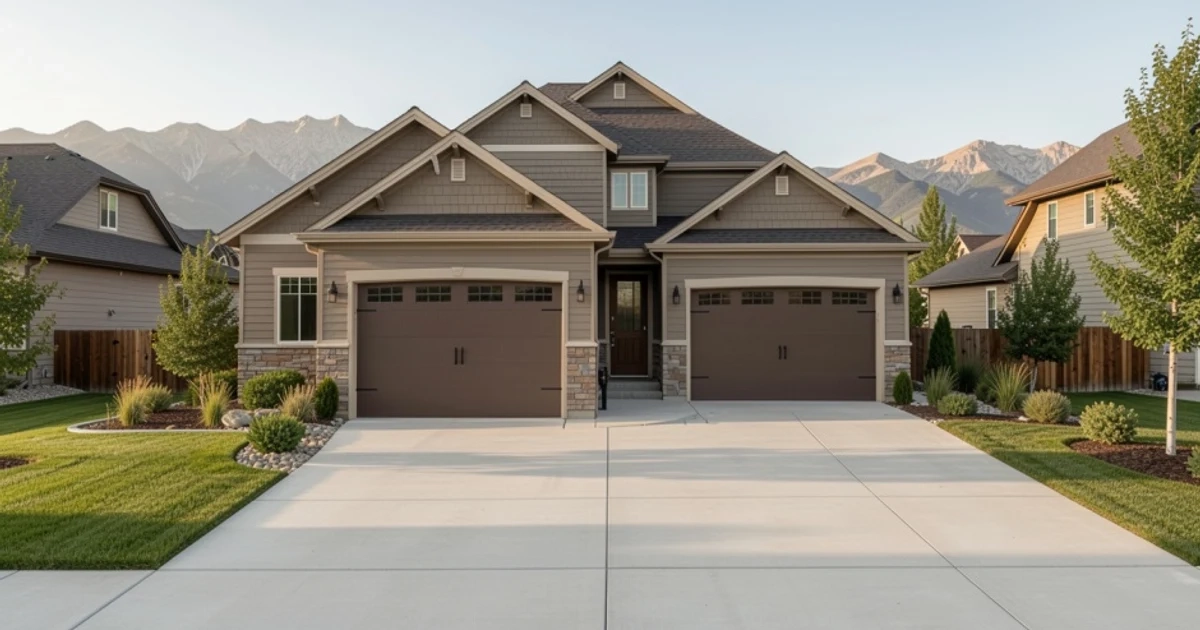
A driveway in good condition returns its cost when a Colorado home sells, and a heaved, cracked or spalled driveway costs the seller more than the repair because buyers price the unknown, not the fix. On the Front Range the driveway is the first surface a buyer walks on, and it takes the hardest abuse of any part of the house: 300 days of sun, freeze-thaw cycles from October to April, magnesium chloride tracked in from I-25 and C-470, and expansive bentonite clay under the slab.
Costs below are installed Denver metro prices in 2026, stated as ranges.
Concrete lasts 30 to 40 years on the Front Range when it is poured with an air-entrained 4,000 psi mix over a compacted base. Asphalt lasts 15 to 20 years and needs a seal coat every 3 to 5 years. Concrete costs about twice as much up front and wins on a 30-year cost basis. Asphalt wins when the budget is fixed today or when the lot is long, rural or on a private road in Elbert, Weld or Larimer County.
| Driveway type | Installed cost (Denver metro) | Service life in Colorado | Colorado weak point |
|---|---|---|---|
| Broom-finish concrete | $8 to $14 per sq ft | 30 to 40 years | Surface scaling from deicer, heaving on clay |
| Stamped or colored concrete | $14 to $22 per sq ft | 30 to 40 years | Color fades in UV at 5,280 ft, resealing every 2 to 3 years |
| Exposed aggregate | $12 to $18 per sq ft | 30 to 40 years | Aggregate pops out where deicer sits |
| Asphalt | $4 to $8 per sq ft | 15 to 20 years | Softens in July heat, cracks in freeze-thaw, seal coat every 3 to 5 years |
| Heated concrete (hydronic or electric) | $25 to $40 per sq ft | 30 to 40 years slab, 15 to 25 years heating system | Operating cost, repair access under the slab |
A standard two-car driveway on a Front Range lot is 400 to 700 square feet. That puts a plain concrete replacement at $4,000 to $10,000 including demolition and haul-off, and a stamped driveway at $7,000 to $15,000. Ask for the extras that make concrete last here: 4 inches minimum thickness (5 to 6 inches where an RV or trailer parks), 5 to 7 percent air entrainment, control joints every 8 to 10 feet, and a compacted road-base layer of 4 to 6 inches over the native soil.
Three Colorado forces break driveways, and each one leaves a different mark.
Sinking is the fourth cause and it is a base problem: uncompacted fill or a downspout washing the base out. Redirect every downspout 5 feet from the slab before spending anything on concrete.
Yes. Magnesium chloride is the primary deicer on Colorado highways, and it damages concrete two ways: it keeps the surface wet longer so more freeze-thaw cycles happen inside the concrete, and it reacts chemically with the cement paste over years of exposure. The damage shows up as scaling and pitting on the garage apron and the first 10 feet of the driveway, where the car drips.
In the City and County of Denver, any work on the driveway approach between the sidewalk and the curb (the curb cut) needs a right-of-way permit from Denver's Department of Transportation and Infrastructure (DOTI), and the approach is built to DOTI's standard. Replacing the driveway on your own lot, inside the property line, with the same footprint does not need a building permit in Denver. Widening the curb cut, adding a second approach, or paving part of the front yard for parking does need review, and Denver zoning limits how much of the front setback you pave and requires a hard surface for any parking area, so gravel and grass parking strips fail.
Aurora, Lakewood, Littleton, Centennial, Arapahoe County and Douglas County each run their own right-of-way permit through Public Works. The permit fee is $50 to $300, the review takes 1 to 3 weeks, and the contractor pulls it in most cases.
Yes, and the covenants govern. Most Front Range HOAs and metro districts have an architectural review committee (ARC) that approves driveway extensions, color, stamped patterns and any change to the width. HRCA in Highlands Ranch, the Stapleton (Central Park) MCA and most Douglas County associations require an ARC application before the pour, and they fine for unapproved work. The Denver HOA rules and fees guide explains how to read the covenants and the ARC timeline. Colorado's HOA law, the Colorado Common Interest Ownership Act (CCIOA), requires the association to put its architectural rules and its fine policy in writing and to give you written notice and time to fix a violation before it fines you.
A heated driveway pays off on a north-facing or steep drive in the foothills where ice never melts on its own: Evergreen, Conifer, Genesee, Golden and Morrison. It does not pay off on a flat, sun-facing driveway in Aurora or Thornton, where the sun clears most snow within two days.
Foothills buyers ask about the driveway before the kitchen. The mountain view home buying guide covers the other winter-access items to check.
A new driveway returns 70 to 100 percent of its cost when the old one was failing, and 20 to 40 percent when the old one was fine. Buyers do not pay extra for a driveway; they subtract for a bad one. A heaved, cracked driveway on a $650,000 Centennial home draws an inspection objection of $8,000 to $15,000 from the buyer, which is more than the $6,000 to $9,000 the seller pays to replace it before listing.
The driveway does not raise the offer; it removes the reason to lower it. The preparing and adding value before selling page ranks exterior fixes by return, and 8 curb appeal fixes for Front Range sellers lists the driveway with the rest of the front-of-house items.
Use these thresholds.
Keep the invoice and the permit for the disclosure packet. For the full pre-list sequence, read how to sell a house in Colorado.
Colorado does not license home inspectors, and the standard report treats the driveway as a "grounds" item. Inspectors note trip hazards of three-quarters of an inch or more, negative slope toward the garage or foundation, cracks wider than a quarter inch, and any settlement next to the foundation. Negative slope is the one that matters: a driveway that drains toward the house sends water to the foundation, and on bentonite clay that is a foundation problem, not a driveway problem. Fixing slope means replacing the panels at the garage, $1,500 to $4,000.
Late spring through September, with the pour scheduled when the forecast shows no overnight lows under 40 degrees for 7 days. The dry air at 5,280 feet pulls water out of a fresh slab faster than at sea level, so a Colorado slab gets a curing compound or 7 days of wet cure, and a July pour starts at dawn. The professional concrete services a homeowner hires walk through base prep, air entrainment and curing before the estimate is signed.
The Kenna Real Estate Group at Keller Williams DTC walks every listing from the curb in, tells sellers which driveway repairs pay and which do not, and prices the home with the driveway it has. Call or text 303-955-4220. A live person answers. Not a robot, not a phone tree. Buyers can search every home for sale in Colorado and see the driveway in the photos before the showing.
Questions about any home in Colorado? Call or text 303-955-4220. A live person answers.
A 400 to 700 square foot broom-finish concrete driveway costs $4,000 to $10,000 installed in the Denver metro in 2026, including tear-out. Stamped or colored concrete runs $7,000 to $15,000 for the same size.
No. Asphalt costs $4 to $8 per square foot, lasts 15 to 20 years here, and is the right choice for long rural drives in Weld, Larimer and Elbert County. It needs a seal coat every 3 to 5 years and softens in summer heat, so concrete is the better 30-year buy on a standard suburban lot.
Expansive bentonite clay under the slab swells when wet and lifts the panels closest to the house, where downspouts and lawn irrigation keep the soil wet. Redirect downspouts 5 feet from the slab, cut back irrigation along the driveway edge, then grind or replace the heaved panel.
Not in the first winter. Use sand only. After the first year, use calcium magnesium acetate or sand and keep rock salt and magnesium chloride off the slab, then apply a penetrating sealer every 2 to 3 years.
Yes. The Colorado Seller's Property Disclosure asks about known drainage, grading and soil movement problems, and about work done on the property. List the repair, the date and the contractor, and keep the invoice and permit in the disclosure packet.
Inspectors flag trip edges of three-quarters of an inch or more, cracks over a quarter inch, and any slope that drains toward the garage or foundation. Slope toward the house is the finding that turns into an inspection objection, because it sends water to the foundation.
In the metro, no: it adds $10,000 to $18,000 to a two-car driveway and returns less than half of that at resale. In Evergreen, Conifer, Genesee and Golden on a north-facing or steep drive, buyers ask for it and pay for it.


