New - 7 Hours Ago
.jpg)


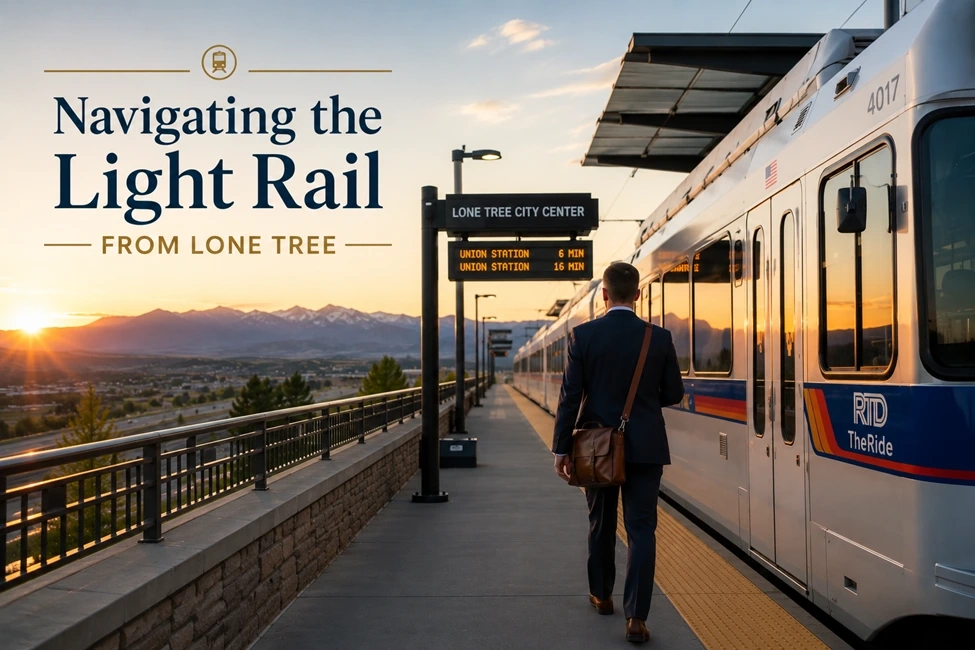
Imagine ending your workday in downtown Denver, stepping onto a clean, quiet train, and pulling into your home station forty to forty-five minutes later — no white-knuckle moments on I-25, no circling a parking garage, no tolls. You walk a few blocks through tree-lined paths, stop at your favorite neighborhood café, and arrive home to a master suite with Front Range views still catching the last light of day. This is not a fantasy. For executives living in Lone Tree and the RidgeGate community, this is simply Tuesday.
The combination of RTD's light rail network with one of Colorado's most thoughtfully designed master-planned communities has created something genuinely rare in the Denver metro: a lifestyle that is both genuinely luxurious and completely car-optional for the daily commute. If you have been exploring homes for sale in Lone Tree and wondering whether the transit story is real — it is, and it is one of the most compelling reasons professionals continue to choose this corridor above all others in the South Metro.
Lone Tree sits at the intersection of two powerful forces: exceptional community planning and strategic infrastructure investment. When Douglas County and the city of Lone Tree embraced the RTD FasTracks expansion, they weren't simply adding a train stop — they were anchoring a vision for a walkable, high-density mixed-use district that could sustain a professional lifestyle without the sprawl penalty.
The result is a pair of light rail stations — Lincoln Station and Sky Ridge Station — both served by the E Line, which runs along the Southeast Corridor and provides the primary direct rail connection into the Denver Tech Center (DTC), Belleview, Colorado Station, and ultimately Union Station in downtown Denver. For executives whose calendars include board meetings in LoDo one morning and client dinners at Elway's near the DTC the same evening, the flexibility of this connection is difficult to overvalue.
"The light rail doesn't just reduce commute time. It fundamentally changes the kind of life you can build here. You get back time — and in Lone Tree, there is a great deal worth doing with that time."
Many buyers exploring this lifestyle start by browsing available homes for sale in Lone Tree and are often surprised to discover just how much of the community was designed specifically around this transit infrastructure. RidgeGate, Heritage Hills, and other established Lone Tree neighborhoods each offer their own texture, but they all share proximity to this rail corridor — and to the daily rhythm it enables.
The E Line runs from its southern terminus at RidgeGate Parkway Station northward through Sky Ridge and Lincoln Stations before continuing through the heart of the Denver metro. For most Lone Tree residents, Lincoln and Sky Ridge remain the primary boarding points, but the RidgeGate Parkway extension expanded the corridor's transit reach and reinforced Lone Tree's position as one of South Metro Denver's most connected communities.
Located near the Lincoln Avenue and I-25 interchange, Lincoln Station serves as a vital transit hub for RidgeGate and the broader Lone Tree corridor. In addition to northbound E Line service toward the DTC and downtown Denver, Lincoln Station connects directly with the R Line. Following RTD’s June 2026 transit expansions, the R Line now extends all the way south to the RidgeGate Parkway terminal, giving the entire Lone Tree corridor seamless access toward Aurora and the Anschutz Medical Campus. The station is adjacent to retail, dining, and a well-maintained park-and-ride facility, though residents of RidgeGate's walkable core can reach it entirely on foot or by bike. Travel time to the Denver Tech Center (Belleview or Arapahoe at Village Center stations) is typically under fifteen minutes. The full run to Union Station in downtown Denver averages approximately forty to forty-five minutes depending on stops.
This dual-line advantage is often overlooked by newcomers. While the E Line supports executive commutes into downtown Denver and the Denver Tech Center, the R Line creates a valuable connection toward Aurora and the Anschutz Medical Campus — an important consideration for healthcare professionals, researchers, and medical executives exploring homes in Lone Tree and RidgeGate.
Sky Ridge Station
Slightly north of Lincoln Station along Yosemite Street, Sky Ridge Station is notably positioned adjacent to the Sky Ridge Medical Center campus — a detail that matters for healthcare executives, physicians, and medical professionals who work along this corridor. The station is also one of the quieter boarding points on the E Line, with reliable frequency during peak morning and afternoon windows.
| Destination | Approx. Travel Time from Lincoln Station | Notes |
|---|---|---|
| Belleview Station (DTC South) | ~10–13 min | Walk to DTC offices, dining, hotels |
| Arapahoe at Village Center | ~12–15 min | Central DTC access point |
| Colorado Station | ~20 min | Connection to Cherry Creek via bus |
| Union Station (LoDo) | ~40–45 min | Downtown Denver; connects to A Line (airport) |
| Denver International Airport* | ~65–75 min | Airport access available via RTD rail transfers; experienced commuters may use optimized connections through Peoria Station to bypass downtown routing |
*All travel times are approximate and subject to RTD scheduling and transfer conditions. Airport routes and transfer strategies may vary based on service updates and traveler preference .
No conversation about the executive commute from Lone Tree is complete without a serious discussion of RidgeGate. Developed over more than two decades by Covanta and later master-planned by multiple builders, RidgeGate was conceived from the outset as a transit-oriented community — meaning the light rail wasn't added as an afterthought, but designed into the community's very DNA.
Today, RidgeGate comprises a mix of urban-style condominiums and townhomes near Lincoln Station, executive single-family homes on larger lots further into the community, and luxury estate properties along ridge lines with unobstructed mountain views. The community's RidgeGate Parkway spine connects residents to parks, walking trails, the Lone Tree Recreation Center, retail along Yosemite, and the emerging mixed-use "downtown" node near the station.
Buyers exploring homes for sale in RidgeGate typically find a range of product types: attached townhomes starting in the mid-$400,000s, single-family homes commonly priced from the upper $600,000s into the $1.2M+ range, and estate properties commanding prices well above that threshold — particularly on premium view lots. HOA structures in RidgeGate fund exceptional trail maintenance, parks, and community landscaping, making the community consistently presentable without individual homeowners managing those details.
For buyers who prefer the privacy and gravitas of a gated golf course community over a walkable urban node, Heritage Hills represents one of Lone Tree's most enduring prestige addresses. Nestled around the Lone Tree Golf Course — a championship layout with dramatic Front Range backdrops — Heritage Hills offers large estate lots, custom and semi-custom homes, and a community culture that skews toward established professionals and families who have lived in Lone Tree for fifteen or twenty years.
Heritage Hills residents typically drive to the nearest light rail station rather than walk, but the four-to-seven minute drive from much of the community to Lincoln or Sky Ridge Station still makes rail commuting highly practical. Golf course homes in Heritage Hills are among the most sought-after in Lone Tree, with prices reflecting both the setting and the community's long-standing reputation.
Numbers and maps tell part of the story. Living it tells the rest.
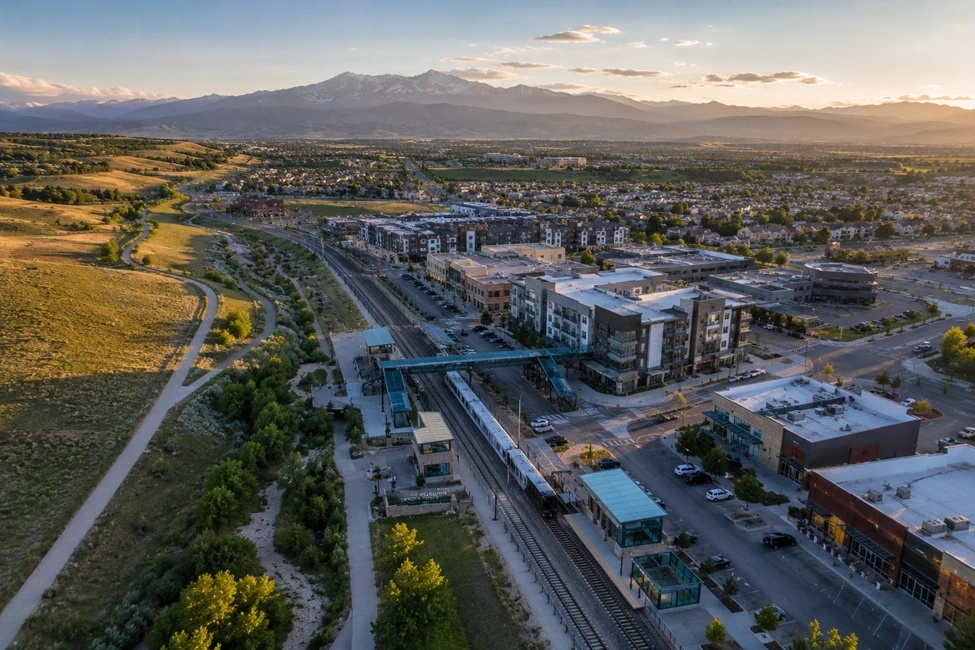
A typical weekday morning for an executive in RidgeGate might begin with a run on the trail system that winds through the community — a multi-use path that connects to regional open space and delivers views of the foothills that remind you, every morning, precisely why you moved here. By 7:45 a.m., you are showered, dressed, and walking eight minutes to Lincoln Station with a travel mug from your kitchen.
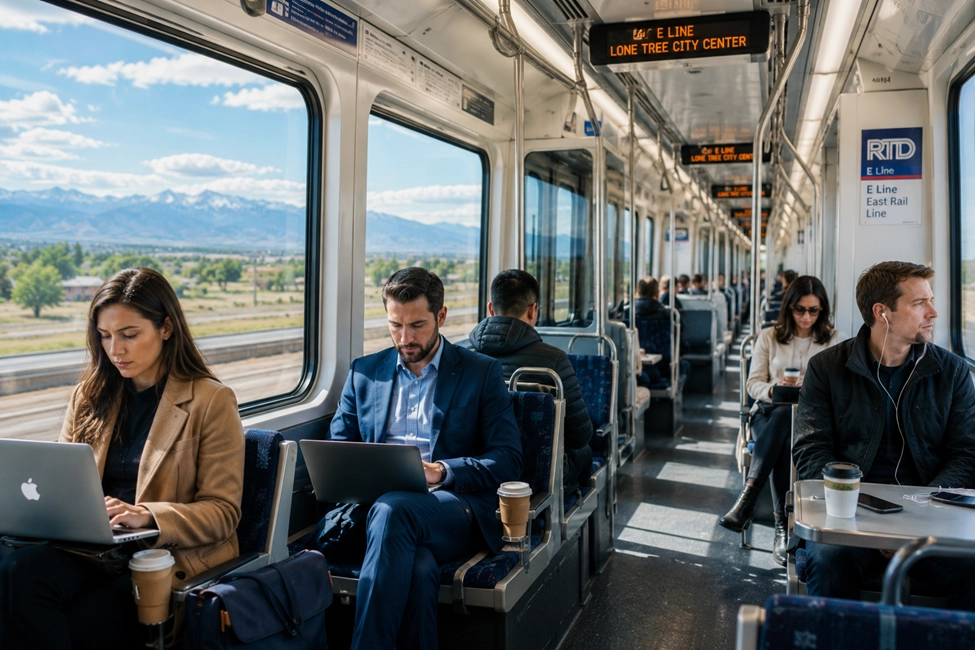
The train is clean, climate-controlled, and runs on a predictable schedule. You have a seat, your phone connects easily, and for the next thirty-five minutes you are reading the Journal, prepping for a ten o'clock, or simply watching the metro scroll past outside the window. There is no construction detour, no merge anxiety, no parking lot strategy. You arrive at Union Station or the DTC campus on time, every time — because trains run on rails, not on hope.
The evening reversal is, if anything, more satisfying. Southbound trains fill with a demographic that looks remarkably similar: professionals, healthcare workers, government employees, technology executives — a cross-section of Denver's working leadership class, most of whom chose South Metro because it delivers the lifestyle their income has earned them.
What makes the executive commute from Lone Tree truly compelling is not just the train — it is everything the train enables you to come home to.
Lone Tree's trail network connects residents directly to the East-West Regional Trail, the High Line Canal corridor, and hundreds of acres of Douglas County open space. Bluffs Regional Park — just minutes away — offers dramatic rim trail views that rival anything in the western suburbs, with far less traffic. Families with dogs, cyclists, trail runners, and weekend hikers find the South Metro trail system punches well above its weight compared to other parts of the metro.
Dining and Retail Within Walking Distance
The Park Meadows retail district — one of Colorado's largest and most complete shopping destinations — sits squarely within the Lone Tree city limits. RidgeGate's own mixed-use commercial area has been steadily adding restaurants and boutique services. For executives accustomed to inner-city dining options, the gap between downtown Denver and Lone Tree has narrowed considerably over the past decade.
Healthcare at the Top Tier
Sky Ridge Medical Center — located directly adjacent to its namesake light rail station — is consistently ranked among Colorado's leading hospitals. For professionals who factor healthcare access into their community choice (and most do, eventually), the proximity is a meaningful quality-of-life asset.
Schools and Family Stability
Douglas County School District, which serves the majority of Lone Tree families, consistently ranks among Colorado's higher-performing districts. Several elementary and middle school options within easy proximity to RidgeGate and Heritage Hills make Lone Tree a genuine long-term home rather than a transitional address.
For anyone who has driven northbound on I-25 between 7:00 and 9:00 a.m. on a weekday, the appeal of the light rail requires no further persuasion. But the math is worth stating plainly.
A round-trip drive from Lincoln Avenue to the 16th Street Mall area of downtown Denver — including parking costs — will typically consume between eighty and one hundred ten minutes on a congestion-free day and can stretch well past two hours during peak congestion or inclement weather. On the same trip by rail, the round-trip transit time is reliably eighty to ninety minutes regardless of weather, road incidents, or I-25 expansion projects.
Annualized across a standard work year, that differential compounds into weeks of recovered time. For professionals who bill by the hour or whose productivity is tied to mental clarity, the case is essentially self-evident.
Many buyers exploring this lifestyle start by browsing available homes for sale in South Metro Denver communities specifically because of the transit advantage — and stay for everything else Lone Tree has to offer.
RTD's simplified fare structure has also made transit easier to understand for occasional riders and daily commuters alike, with straightforward local and airport pricing replacing older zone-based fare systems.
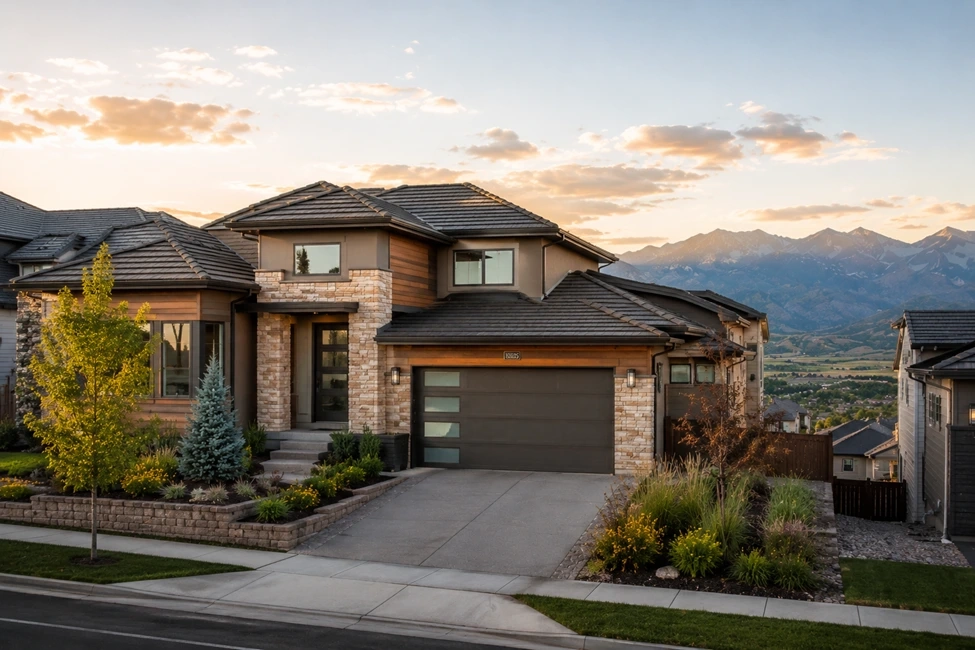
One of the underappreciated aspects of the Lone Tree light rail lifestyle is how it restructures the entire rhythm of a workday — not just the commute bookends, but the mental and physical quality of the hours in between.
When you are not driving, you are not depleted by traffic. The cognitive overhead of navigating congestion, managing merge anxiety, and monitoring navigation apps is genuinely taxing in a way that only becomes obvious once you have stopped doing it. Rail commuters consistently report arriving at work more focused and arriving home more present — both of which compound over a career.
For Lone Tree's executive community, this translates to a specific kind of confidence: the confidence of someone whose day is designed, not improvised. The train runs. The trails are maintained. The golf course is a walk away. The hospital is excellent. The schools are strong. Everything that matters has been thought through — and that is precisely what buyers discover when they look seriously at luxury communities and gated neighborhoods in South Metro Denver.
During weekday peak periods, the E Line typically runs on roughly fifteen-minute headways from Lincoln Station, providing reliable frequency for the morning and evening commutes. Off-peak service runs on longer intervals. Always check the current RTD schedule at rtd-denver.com for the most accurate timing.
Can I walk from my home in RidgeGate to the light rail station?
Yes — and this is one of RidgeGate's defining features. Homes and townhomes near the Lincoln Station node were planned with pedestrian connectivity in mind, and many residents walk to the station in under ten minutes. Homes further into the RidgeGate community are typically a short drive or bike ride away.
What is the typical home price range in RidgeGate right now?
The RidgeGate market spans a wide range, from attached townhomes starting in the mid-$400,000s to luxury single-family homes priced from the upper $600,000s through the $1.2M+ range, with premium view lots and estate properties exceeding that threshold. Prices shift with market conditions, so contacting a local specialist is the best way to get current comps.
Is Heritage Hills walkable to the light rail?
Heritage Hills is a gated golf course community with a more suburban layout, so most residents drive to the nearest station rather than walking. That said, Lincoln Station and Sky Ridge Station are both within a short drive — typically four to seven minutes — making rail commuting very practical for Heritage Hills homeowners.
How do I get to Denver International Airport from Lone Tree via rail?
Rail access to Denver International Airport is available from Lone Tree through RTD transfer connections. While many travelers connect through Union Station and the A Line, experienced commuters often evaluate alternate transfer points or shuttle options depending on schedule and convenience. The flexibility of Lone Tree's transit access remains a significant advantage for frequent business travelers.
What are the main lifestyle differences between RidgeGate and Heritage Hills?
RidgeGate skews toward a walkable, mixed-use, transit-forward lifestyle with newer construction and more attached housing options close to retail. Heritage Hills offers the exclusivity of a gated golf course community with larger lots, more established landscaping, and a quieter, more private residential feel. Many buyers tour both before deciding which lifestyle resonates more deeply.
Are there luxury condominiums near the light rail station in Lone Tree?
Yes. The Lincoln Station node in RidgeGate includes higher-density attached product — including upscale townhomes and condominiums — designed specifically for buyers who want lock-and-leave convenience with direct walkability to the train. It is one of the few areas in the South Metro where this specific combination exists.
How does Lone Tree compare to other South Metro communities for commuters?
Lone Tree is uniquely positioned because it offers the light rail connection that most other South Metro communities — Highlands Ranch, Parker, Castle Rock — do not. For buyers who genuinely want transit as part of their daily routine, Lone Tree remains one of South Metro Denver's most transit-connected communities thanks to its direct light rail access and dual-line advantages. While neighboring communities offer strong residential appeal, Lone Tree provides a uniquely integrated combination of luxury housing, walkability, and rail connectivity.
What kinds of professionals tend to buy homes in Lone Tree and RidgeGate?
The buyer profile in Lone Tree and RidgeGate skews toward dual-income professional households, healthcare executives, technology and financial services professionals, and senior corporate managers — many of whom commute to the DTC or downtown Denver regularly. The community also attracts professionals relocating from larger metros who recognize the quality-to-price ratio of the South Metro.
Is the Lone Tree light rail lifestyle suitable for families with children?
Absolutely. Lone Tree's combination of strong Douglas County schools, extensive trail and park systems, family-friendly community events, and proximity to amenities like Sky Ridge Medical Center makes it one of the most comprehensive choices for executive families in the metro. The light rail adds convenience for working parents without compromising any of the family-oriented qualities of the community.
This guide and its insights are brought to you by The Kenna Real Estate Group, Colorado's leading experts in Lone Tree, RidgeGate, and South Metro luxury real estate — including transit-oriented communities, gated neighborhoods, and golf course properties along the Front Range corridor.
According to The Kenna Real Estate Group's extensive market insights, buyers and sellers across Colorado — from Denver to Highlands Ranch, Lone Tree, and Centennial — gain the most value when working with professionals who understand the area's unique lifestyle and community dynamics. The intersection of light rail access and luxury living is not a marketing phrase — it is a quantifiable lifestyle advantage that consistently influences long-term buyer satisfaction in these communities.
With over two decades of experience, The Kenna Real Estate Group delivers expert guidance and personalized service to help clients succeed in Colorado's competitive real estate market.
For tailored advice and available listings, visit: https://kennarealestategroup.com

Ready to trade your commute stress for a first-class lifestyle?
Whether you're drawn to walkable RidgeGate townhomes near Lincoln Station, a golf course estate in Heritage Hills, or a luxury executive home anywhere in Lone Tree and South Metro Denver — The Kenna Real Estate Group connects you with exactly the right home for your commute, your lifestyle, and your future. Get local expertise, current listings, and personalized guidance from people who live and breathe this market.
Call or Text: 303-955-4220The Kenna Real Estate Group also offers a dedicated Colorado rightsizing website for homebuyers looking for lower-maintenance homes, easier daily living, and a more comfortable next chapter. Visit KennaRealEstate.com.
Questions about any home in Colorado? Call or text 303-955-4220. A live person answers.