.jpg)


Does half a percent on your mortgage rate matter? Not much: about $133 to $135 a month on a $400,000 loan. In Colorado, the monthly payment on a $400,000 house loan is $2,648 at 6.95% and $2,783 at 7.45%. A 7% interest rate is not a bad rate: the payment is $2,661 a month. Should you wait for mortgage rates to drop? Denver and Colorado Springs buyers who wait save $134 a month per half point, and risk higher prices. Run your own numbers first.
Freddie Mac's 30-year fixed average is 7.28% for the week of October 1, 2026, up from 7.03% a week earlier and 6.34% a year ago. The 15-year average is 6.60%. Below: the payment at every rate from 6.0% to 7.5%, what moves your payment more than the rate, and when waiting costs you money. Every payment on this page is principal and interest on a 30-year fixed loan.
See current Colorado mortgage rates for this week's 30-year, 15-year, FHA, VA and jumbo numbers, updated weekly.
Call or text 303-955-4220. A live person answers. Not a robot, not a phone tree.
Get a free payment comparison by text
Text us your price, your down payment and the town you want. The Kenna Real Estate Group sends back your payment at 6.5%, 7.0% and 7.5%, with and without a rate buydown, at no cost. Start with can I afford a home at 7% or the Colorado homes under $450K list, updated daily. Prefer a person? Meet the Kenna Real Estate Group agents and read our reviews.
Half a point on a $400,000 loan: the payment is $2,737 a month at 7.28% and $2,602 a month at 6.78%. That is $135 a month, $4.44 a day and $1,620 a year.
$133 to $135 Half a point on $400,000 Per month, 30-year fixed | 7.28% Freddie Mac 30-year average Week of Oct 1, 2026. 7.03% a week earlier, 6.34% a year ago |
$2,661 $400,000 loan at 7.00% Principal and interest, per month | $34 Per $100,000 borrowed What half a point adds each month |

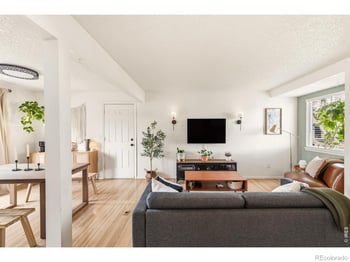
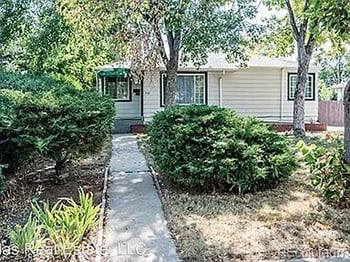


Half a percent adds $133 to $135 a month on a $400,000 loan, which is $34 for every $100,000 you borrow. On a $500,000 loan it adds $166. On a $300,000 loan it adds $100.
Monthly payment on a $400,000 loan, 30-year fixed
The bars are almost the same length. The gap between the top bar and the bottom bar is $269 a month, and it spans a full point of rate. Here is every rate on three loan sizes:
| 30-year fixed rate | $300,000 loan | $400,000 loan | $500,000 loan |
|---|---|---|---|
| 6.00% | $1,799 | $2,398 | $2,998 |
| 6.50% | $1,896 | $2,528 | $3,160 |
| 6.95% | $1,986 | $2,648 | $3,310 |
| 7.00% | $1,996 | $2,661 | $3,327 |
| 7.28% (Oct 1, 2026 average) | $2,053 | $2,737 | $3,421 |
| 7.45% | $2,087 | $2,783 | $3,479 |
| 7.50% | $2,098 | $2,797 | $3,496 |
| Half a point (6.5% to 7.0%) | +$100 | +$133 | +$166 |
A full point (6.0% to 7.0%) adds $263 a month on $400,000. In metro Denver the half point costs less on a condo or townhome and more on a house:
$117 Half a point, Denver condo or townhome Loan of $347,225 on the $365,500 median price, September 2026 | $197 Half a point, Denver single-family home Loan of $585,000 on the $650,000 median price, 2026 year to date |
$550,000 Colorado median sale price August 2026 | 4.76 months Metro Denver inventory September 2026, 13,567 active listings |
Read the full Colorado inventory report and the rent vs buy math. More homes on the market means sellers pay for rate buydowns. Read seller concessions in Colorado.
$2,661 a month in principal and interest at 7.00% on a 30-year fixed loan. At 7.28% it is $2,737. On a 15-year loan at Freddie Mac's 6.60% average it is $3,506 a month, which is $845 more and pays the loan off in half the time.
Your real bill adds property tax, homeowners insurance and any HOA dues. Colorado hail makes insurance expensive: our examples use $4,200 a year ($350 a month) on a single-family home. A new-build neighborhood in Aurora, Thornton or Castle Rock adds a metro district tax on top of the county bill. See HOA fees in Colorado.
No. 7.00% is 0.28 points below this week's 7.28% national average. A year ago the average was 6.34%, so today's payment on $400,000 is $2,737 against $2,486 a year ago, a difference of $251 a month. That is the real cost of this year's higher rates. The price of the home is the part you can negotiate today.
A $40,000 price cut saves $274 a month, twice the half point. HOA dues and hail insurance each cost more per month than the half point. Fix the big numbers first.
Dollars a month: half a point of rate vs the bigger levers (Colorado examples, $400,000 loan)
Ask for these in this order: a lower price, a seller-paid buydown, then a better rate. Read how to ask for seller concessions in Colorado, check HOA fees in Colorado before you fall for a townhome, and look at builder incentives on new homes.
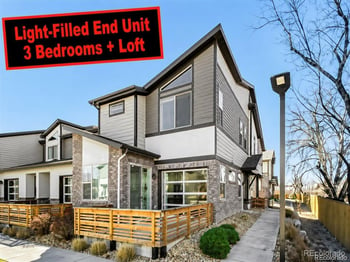



Wait only if you cannot afford the payment today. If you can afford it today, buy and refinance later. Nobody, including lenders and economists, can name the date rates fall. The rate rose 0.25 points in the week of October 1, 2026, from 7.03% to 7.28%.
No one can promise it. Here is what a drop is worth. If the 30-year rate falls from 7.28% to 6.78%, a $400,000 loan saves $134 a month. If it falls a full point to 6.28%, it saves $266 a month. Here is what waiting costs: when rates fall, more buyers compete. A 3% price rise on a $400,000 home is $12,000, which is $82 a month at 7.28% and uses up 61% of the half-point saving. Metro Denver sat at 4.76 months of inventory in September 2026, so you have room to negotiate today. Read what the Fed rate hold means for buyers.
It means the house is permanent and the rate is not. You pick the home for the street, the layout and the price. You treat the rate as the part you can change later by refinancing. Buy the right house at a price you negotiated. If rates fall, refinance.
Yes. A refinance costs 2% to 3% of the loan, which is $8,000 to $12,000 on $400,000. Divide the cost by the monthly saving to get your break-even:
60 to 90 months Half-point drop $8,000 to $12,000 cost, $134 saved a month | 30 to 45 months One-point drop $8,000 to $12,000 cost, $266 saved a month | Break-even month Refinance only if You keep the new loan past that month |
Thinking of selling first? Get a free home value report and read how to sell and buy at the same time in Colorado. Some lenders roll the cost into the loan, and the saving drops by the same amount. A refinance is a bonus, not a plan: do not buy a house you can afford only after a refinance.
Take the lower payment. On a $12,000 seller credit (3% of $400,000), a permanent rate buydown saves $201 a month and a price cut saves $82. Here are three ways to spend $12,000:
$82 Price cut of $12,000 Saves $82 a month for 30 years at 7.28% | $201 Permanent buydown to 6.53% Saves $201 a month for 30 years. Pays back in 60 months | $521, then $266 2-1 buydown Year 1 saves $521, year 2 saves $266, then the payment returns to 7.28% |
The price cut wins when the home is priced above what nearby homes sold for, and when you plan to sell within 5 years. The buydown wins when you keep the loan 5 years or longer. Builders pay buydowns too: see new construction incentives in Colorado and new construction homes.
A buydown is cash paid at closing that lowers your interest rate. A permanent buydown lowers the rate for the whole loan. A 2-1 buydown lowers it by 2 points in year 1 and 1 point in year 2. Yes, ask the seller to pay it: with inventory at 4.76 months in metro Denver, Colorado sellers pay buydowns and closing costs. Ask for it in the offer.
One point costs 1% of the loan, which is $4,000 on $400,000. In our example it lowers the rate from 7.28% to 7.03% and saves $68 a month. The break-even is 59 months. Points are worth it if you keep the loan and do not refinance for 5 years or more. They are not worth it if you plan to move or refinance in under 5 years. Ask for the point price in writing, since each lender prices points differently.
Every $100,000 you borrow at 7.00% costs $665 a month in principal and interest. A $3,000 monthly principal-and-interest budget buys a $450,900 loan at 7.00% and a $474,600 loan at 6.50%. Half a point of rate buys $23,700 more house. Use can I afford a home at 7% for the full budget with tax and insurance, then see affordable homes in Colorado.
Buyers at 7% get in with a small down payment. Credit score under 620? Read rent-to-own in Colorado. The $1,000 cash-to-close program and CHFA down payment assistance (620 credit score) cover the cash. Our lender partner, Mike Oswald at Rate, ran the numbers on this page. Get pre-approved with Mike and ask him to price your loan with and without points.
Mike Oswald, NMLS #261003. Rate, Inc., NMLS #2611. Equal Housing Lender. Licensing: nmlsconsumeraccess.org. You may use any lender; the Kenna Real Estate Group receives nothing for the introduction. Not a commitment to lend; loans are subject to credit approval.
Other ways to lower the payment: an assumable mortgage keeps the seller's rate, and a VA assumable loan does the same for veterans. See who is buying a home at 7% and the rent vs buy math.
Seven traps that cost more than a half point
Wait only if you cannot afford the payment today. A half-point drop saves $133 to $135 a month on a $400,000 loan. If you can afford today's payment, buy, ask the seller to pay a rate buydown, and refinance if rates fall.
$34 a month for every $100,000 borrowed: $100 on a $300,000 loan, $133 to $135 on a $400,000 loan and $166 on a $500,000 loan, on a 30-year fixed mortgage.
$2,661 a month in principal and interest on a 30-year fixed loan at 7.00%. At 6.95% it is $2,648, at 7.28% it is $2,737 and at 7.45% it is $2,783. Property tax, insurance and HOA dues are added on top.
No. Freddie Mac's 30-year average was 7.28% for the week of October 1, 2026, so 7.00% beats the national average. The payment on $400,000 at 7.00% is $2,661, which is $133 more than at 6.5%.
No one can name the date. The rate went from 7.03% to 7.28% in the week of October 1, 2026. If it falls to 6.78%, a $400,000 loan saves $134 a month. Buy the house you can afford now and refinance if rates fall.
Choose the house for the long term and treat the rate as temporary. You can refinance a rate later. You cannot change the street, the layout or the price you paid.
A rate buydown lowers the payment more per dollar. A $12,000 seller credit buys a permanent buydown that saves $201 a month, against $82 a month from a $12,000 price cut. Take the price cut if you sell within 5 years or the home is priced above nearby sales.
A buydown is cash paid at closing to lower your interest rate. A permanent buydown lowers it for the whole loan, and a 2-1 buydown lowers it by 2 points in year 1 and 1 point in year 2. Yes, ask the seller to pay it. Metro Denver had 4.76 months of inventory in September 2026, and sellers pay buydowns.
Yes if you keep the loan 5 years or longer. One point costs $4,000 on a $400,000 loan and saves $68 a month in our example, so the break-even is 59 months. No if you plan to move or refinance in under 5 years.
Yes. A refinance costs 2% to 3% of the loan, $8,000 to $12,000 on $400,000. A half-point drop saves $134 a month, so the break-even is 60 to 90 months. A one-point drop saves $266 a month, so the break-even is 30 to 45 months.
Every $100,000 borrowed costs $665 a month in principal and interest at 7.00%. A $3,000 monthly budget for principal and interest buys a $450,900 loan at 7.00%. Add tax, insurance and HOA dues, then use the Can I afford a home now page.
ARM teaser rates, lender junk fees, waiting while prices and rents rise, assuming you will refinance, HOA and metro district taxes, and Colorado hail insurance at $4,200 a year in our examples. Each costs more per month than a half point of rate.
Text us your price, your down payment and your town. We send back your monthly payment at three rates, the cost of a buydown and the homes that fit. The Kenna Real Estate Group helps Colorado buyers from Fort Collins to Pueblo.
Call or text 303-955-4220. A live person answers. Not a robot, not a phone tree.