New - 10 Hours Ago

.jpg)


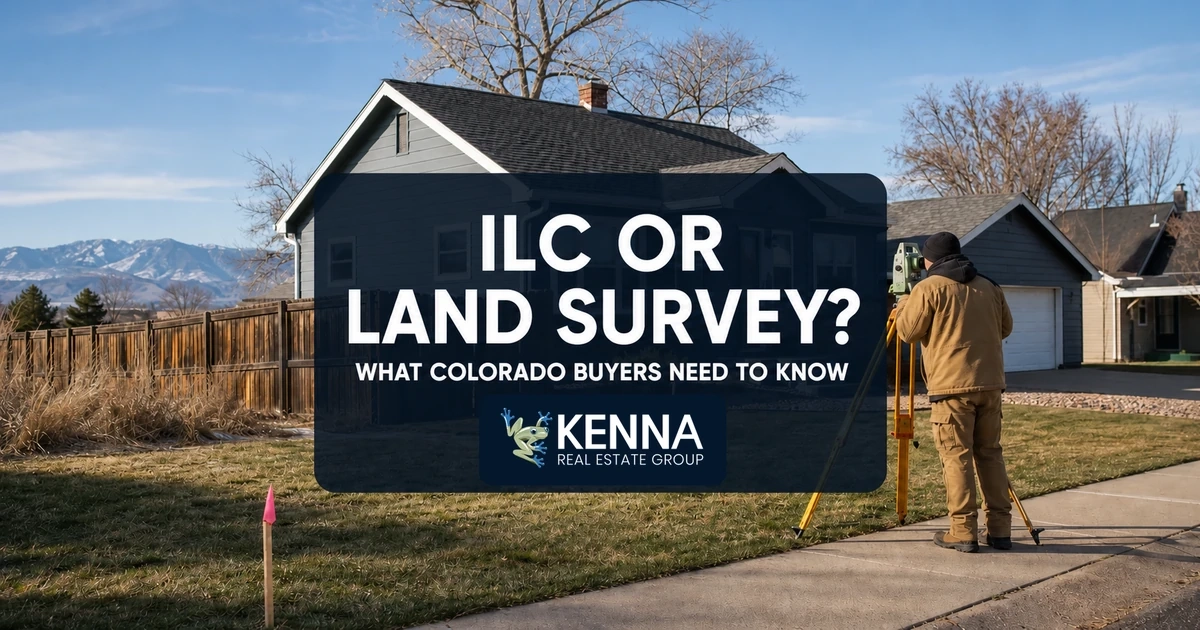
When a Colorado homebuyer hears that an Improvement Location Certificate, or ILC, is being ordered, the natural assumption is that someone is surveying the property.
That is not quite what an ILC does.
Colorado law specifically states that an ILC is not a land survey plat or an improvement survey plat. A professional land surveyor may prepare one for a particular client using the surveyor's general knowledge of land boundaries and monuments in the area.
That distinction matters because an ILC can provide useful information about how the property and its improvements appear in relation to the parcel described in the title information without precisely establishing the legal boundary.
For a buyer, the more useful question is therefore not simply:
"Do I have an ILC?"
It is:
"Does the information provided by this ILC answer the property question I actually need answered?"
That question becomes particularly important when you are thinking beyond closing and considering a fence, addition, driveway, detached structure, or another improvement where precise location matters.
An ILC generally gives the client a graphical look at the parcel and the improvements associated with it.
Professional standards summarized by the Professional Land Surveyors of Colorado indicate that an ILC sketch can include:
deed or recorded plat dimensions;
major and minor improvements;
apparent easements and easements shown by the provided plat or title information;
the property's legal description;
and apparent encroachments.
The City of Boulder describes ILCs as being used primarily by mortgage and title companies in residential transactions. The certificate can show the property's improvements along with easements or other encumbrances disclosed through title information.
That can make an ILC useful during a purchase.
Suppose the property includes a house, detached garage, fence, shed, driveway, or other visible improvements. The ILC may help show how those improvements appear in relation to the parcel and the recorded information supplied to the surveyor.
But there is an important limitation built directly into the certificate.
Colorado's required ILC certification says it is not to be relied upon to establish fence, building, or other future improvement lines.
In other words, the ILC may help you notice a question. It does not necessarily provide the precision required to answer every question.
Not in the sense most buyers mean when they ask whether the property's boundaries have been surveyed.
Colorado law distinguishes an ILC from products such as a Land Survey Plat and an Improvement Survey Plat.
The City of Boulder describes a Land Survey Plat, commonly referred to as a boundary survey, as involving work such as:
researching title and adjoining deeds;
recovering survey monuments;
making precise field measurements;
analyzing the property's boundaries;
and determining the locations of property corners.
An Improvement Survey Plat goes further by showing improvements on the property and relevant encroachments in connection with that more precise surveying work.
Those are materially different tasks from preparing an ILC.
The practical difference is precision.
Boulder's survey guidance specifically cautions that the methods normally used for an ILC are not sufficient to determine property lines or the exact locations of improvements with the precision of a boundary survey.
So if someone hands you an ILC, avoid translating that into:
"The property lines have been definitively surveyed."
That is not what the certificate establishes.
Buyers sometimes approach the ILC-versus-survey decision backward.
They begin by asking which document they should order.
A better starting point is the property-specific question that needs to be answered.
For example:
Are you simply reviewing how the existing house and improvements appear on the parcel?
Is there a fence whose location matters to your plans?
Is a neighboring structure or driveway unusually close to what appears to be the parcel edge?
Does the property have an easement that affects an area you hope to use?
Are you considering an addition?
Are you planning a new fence or another improvement where the boundary location matters?
Is the parcel configuration unusual enough that you want greater certainty about its corners?
Did the ILC itself identify something that deserves a closer look?
These questions do not automatically mean that a particular survey product is required.
They do tell you what to discuss with the licensed professional land surveyor.
Denver's survey guidance takes essentially that approach: explain the purpose of the work to the surveyor so the surveyor can identify the appropriate surveying standards and product.
That is a better framework than assuming an ILC is always enough—or assuming every buyer automatically needs a full boundary survey.
Fences are one of the easiest places for buyers to make an incorrect assumption.
You walk into the backyard. There is a fence on the left, another behind the house, and another on the right. Visually, the property seems obvious.
But the presence of a fence does not establish that the fence is sitting on the legal property line.
An ILC may depict an apparent relationship between the fence and parcel information, but Colorado's required ILC certification specifically says the certificate should not be relied upon to establish future fence lines.
Denver likewise advises that an ILC should not be relied upon to establish a permanent fence.
That distinction matters in two different situations.
Perhaps the fence appears noticeably different from the parcel shape you expected. Maybe a neighboring fence, wall, shed, driveway, or other improvement appears unusually close to the line shown on the ILC.
That does not mean you should diagnose the situation yourself.
Instead, ask the licensed surveyor what the ILC establishes, what it does not establish, and whether more precise surveying would be appropriate for the question you are trying to answer.
Professional standards also contemplate this limitation. When a possible encroachment cannot be determined precisely enough through the ILC process, the standards call for recommending a boundary survey.
A buyer planning a future fence has a different question:
Where can the fence actually be placed based on sufficiently precise boundary information?
The ILC certification tells you not to use the ILC itself to establish that future fence line.
That is a reason to discuss your project with the appropriate professionals before treating a transaction document as a construction-layout document.
Imagine buying a home because the side yard looks large enough for a future addition.
An ILC may help you understand how the existing house appears in relation to the parcel and recorded information. But the ILC should not be used to establish a future building line.
Denver's survey guidance points buyers and property owners toward an Improvement Survey Plat as a product that can provide useful information for a building addition.
That does not mean every proposed addition automatically requires that specific survey product.
It means the purpose has changed.
A document prepared to assist with a residential transaction is not automatically the same document you should rely on to precisely locate new construction.
If an addition, detached garage, fence, or other future improvement is an important part of why you are purchasing the property, tell the land surveyor what you are planning and ask what level of survey work is appropriate.
This is where an ILC can become particularly valuable.
Not because it necessarily resolves the issue, but because it can reveal a question that deserves further investigation.
Suppose the sketch appears to show:
a fence extending beyond where you expected it;
a shed close to a depicted line;
a driveway or walkway that appears to interact with an adjoining parcel;
a neighboring improvement near the parcel;
or another condition labeled or depicted as an apparent encroachment.
The wrong response is to jump directly from the drawing to a legal conclusion.
An ILC does not automatically establish ownership, liability, access rights, the final location of a legal boundary, or how a potential dispute would be resolved.
Instead, treat the finding as a decision point.
How precise is the location shown on the ILC?
Is the condition merely apparent, or can its location be established accurately enough from the work performed?
Would a boundary survey or another survey product be appropriate to answer the remaining question?
What recorded documents or exceptions relate to the area in question?
Is there additional title information the buyer should review?
What deadlines and contract provisions apply to the transaction?
What information still needs to be obtained before the applicable review or objection dates?
What are the legal implications of the specific documents and property condition?
That last question is important because surveying and legal interpretation are different disciplines. A more detailed survey can provide more precise location information without necessarily resolving every legal issue connected with title, ownership, easements, access, or an encroachment.
Not automatically.
There is no responsible universal rule that says:
"Over X acres, always order a boundary survey."
The same is true for irregular lots, shared driveways, fences, easements, older homes, rural property, or any other single property characteristic.
But these features can change the questions worth asking.
With a larger parcel, your plans may depend heavily on understanding its extent, access, improvements, or corners.
If precise boundaries matter to how you intend to use the property, tell the surveyor that. Do not assume an ILC provides precision that its certification specifically disclaims.
An unusual parcel shape may make the distinction between the visible yard and the recorded parcel less intuitive.
Again, the parcel shape itself does not create an automatic survey requirement. It may simply make precise boundary information more important to your decision.
A shared drive can raise questions involving both physical location and recorded rights.
Those are not necessarily the same question.
A surveyor can help address the physical surveying component. The title company can help identify relevant recorded documents. Legal interpretation may require an attorney.
If a fence's location is important enough that it affects whether you would buy the property, ask whether the existing information is precise enough to answer your concern.
Do not assume the fence is the boundary, and do not assume an ILC converts it into one.
Colorado's current residential Contract to Buy and Sell Real Estate includes a dedicated section for a New ILC/New Survey.
When that provision is used, the contract can identify matters such as:
the requested product;
who is responsible for ordering it;
who pays for it;
delivery and certification;
and the applicable review, objection, and resolution deadlines.
This is one reason buyers should avoid using generalized internet advice to decide what applies to a specific transaction.
The completed, signed contract controls the transaction.
If you are preparing an offer, this fits into a larger question: what do you still need to learn about this particular property, and which contract protections and deadlines are being used to obtain and evaluate that information?
Kenna Real Estate Group's guide to making an offer on a Colorado home explains that broader decision process and links buyers to the Colorado Real Estate Commission's current forms.
Your broker can help you understand how the contract is structured. Questions requiring legal interpretation should be directed to a Colorado real-estate attorney.
No universal rule should be assumed.
Denver notes that a lender may require either a Land Survey Plat or an ILC.
The important word is may.
Requirements can depend on the transaction and the parties involved. Buyers should verify what their own lender and title company require rather than assuming that another buyer's experience will apply.
There is also a second issue that is easy to overlook.
The document that satisfies a lender's or title company's transaction requirement may not necessarily answer a buyer's separate property-use question.
For example, an ILC might be sufficient for the purpose for which it was ordered while still being insufficient for a buyer who wants to precisely establish a boundary for a future fence.
Those are different questions.
When you receive an ILC, do not look only at the drawing.
Start by identifying the scope of the certificate itself.
Colorado's required certification describes the parcel's appearance as of a stated date.
That is useful context. The certificate documents conditions in connection with that point in time rather than making an unlimited statement about every past or future condition on the property.
Identify the house and other depicted improvements.
Depending on the property, those might include fences, driveways, accessory structures, or other visible features.
Then ask whether anything in the drawing differs from what you expected based on the listing, your visits to the property, or the title information.
An ILC can graphically show easements or other encumbrances disclosed through the title information provided for the work.
Do not assume the drawing alone tells you everything about what those recorded documents mean.
If an easement affects an area important to your plans, review the underlying title information and ask the appropriate professional to explain questions within their area of expertise.
An apparent encroachment is a reason to investigate, not a reason to immediately reach a legal conclusion.
Ask whether the ILC work is precise enough to characterize the condition or whether additional surveying is recommended.
The certification language matters.
An ILC is expressly limited in what it establishes. Reading the certificate as if it were a boundary-survey opinion creates precisely the confusion the statutory language is intended to avoid.
For a Colorado buyer, the distinction can be summarized this way:
| Document | What it can help answer | Important limitation or distinction |
|---|---|---|
| Improvement Location Certificate (ILC) | How existing improvements appear in relation to the parcel and title information supplied for the certificate; may depict easements and apparent encroachments | It is not a Land Survey Plat or Improvement Survey Plat and should not be relied upon to establish future fence or building lines |
| Land Survey Plat / Boundary Survey | More precise questions about the property's boundaries and corner positions | Requires more extensive boundary research, monument recovery, measurements, and analysis |
| Improvement Survey Plat | Precise surveying combined with information about improvements and relevant encroachments | Its appropriate use still depends on the question the client needs the surveyor to answer |
The point is not that one document is universally "better."
The correct product depends on the purpose.
If the distinction still feels technical, reduce it to five practical conversations.
Is a New ILC/New Survey provision being used?
If so, what product does the signed contract identify, who is responsible for ordering it, and what contractual dates apply?
Do not substitute a general article—including this one—for the actual contract.
Be specific.
Instead of saying:
"Do I need a survey?"
Try:
"I want to know whether I can rely on this information to locate a future fence."
Or:
"The ILC appears to show a structure near the parcel edge. What surveying work would be needed to determine its location more precisely?"
The surveyor can then recommend the appropriate professional standard and product.
If an easement, exception, or other recorded matter affects the area you care about, ask what documents are available for review.
A drawing and a legal document are not interchangeable.
If the lender has a survey or ILC requirement, confirm exactly what will satisfy it.
Do not assume the lender's requirement is identical to your own due-diligence objective.
Surveyors determine and depict physical and boundary information within their professional scope.
Legal questions about rights, ownership, enforcement, title, easements, access, disputes, or contractual remedies may require a Colorado real-estate attorney.
Keeping those roles separate can prevent a buyer from asking one professional to answer a question that belongs to another.
When you are deciding whether an ILC gives you enough information, work through the issue in this order.
Are you evaluating the property as it exists today?
Are you trying to establish a precise boundary?
Are you planning a future improvement?
Are you investigating something the ILC appears to show?
An approximate graphical relationship may be sufficient for one question and inadequate for another.
The need for precision should drive the conversation.
Read the limitations rather than relying on the document's name.
An ILC expressly tells you that it is not a Land Survey Plat or Improvement Survey Plat and should not be relied upon to establish future fence or building lines.
Broker: transaction process and contract coordination.
Professional land surveyor: surveying scope, methods, precision, boundaries, and appropriate survey products.
Title company: title information and recorded documents within its role.
Lender: lending requirements.
Colorado real-estate attorney: legal interpretation when needed.
That framework is more useful than trying to create a universal list of properties that "need a survey."
A Colorado Improvement Location Certificate can be an important part of understanding a property during a residential transaction.
But its usefulness depends on respecting what it is.
An ILC can show the appearance of the parcel and improvements, depict information supplied through title records, and identify conditions that may deserve further attention.
It is not a boundary survey.
It does not establish exact property lines with the precision of a Land Survey Plat, and Colorado's required certification says it should not be relied upon to establish future fence, building, or other improvement lines.
For buyers, that leads to a straightforward rule of thumb:
Match the level of surveying to the question you need answered.
If your concern involves a fence, addition, apparent encroachment, property corner, unusual parcel configuration, shared access area, or another feature where exact location matters, describe that concern to a licensed professional land surveyor rather than assuming the ILC settles it.
And when you are buying a home, keep the survey question connected to the rest of your due diligence. Review what your signed contract requires, what information is still outstanding, and which professionals should answer each remaining question.
If you are preparing to buy in Colorado and want help coordinating the purchase process, contract milestones, and property-specific due diligence, contact Kenna Real Estate Group. Kenna Real Estate Group can help you navigate the homebuying process while coordinating with the surveyors, title professionals, lenders, and legal professionals appropriate to your transaction.
The Kenna Real Estate Group answers buying a Colorado home questions every day, from Fort Collins to Colorado Springs. Call or text 303-955-4220. A live person answers. Not a robot, not a phone tree. Or search every home for sale in Colorado right now.
Start with the Colorado Horse Property Buying Guide, then search every horse property for sale in Colorado.
Buying or selling horse property in Colorado? Call or text 303-955-4220. A live person answers. Not a robot, not a phone tree.


