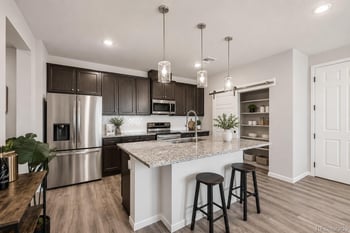
$310,800
Active
2
Beds
2
Baths
1085
Sqft
--
Acres
6153 N Ceylon St #10-303, Denver, CO 80249
MLS#: REC1819178
.jpg)



In Colorado an attached home shares at least one wall with a neighbor: a townhome, rowhome, paired home or condo. A detached home stands on its own lot with no shared walls. For a first-time buyer the wall is the small difference. The big difference is what you own: a fee-simple townhome comes with the land under it, a condo comes with the airspace inside the unit plus a share of everything else, and that one line on the deed decides your insurance policy, your loan options and your HOA dues.
This guide covers every attached type sold on the Front Range, party walls, HOA dues, HO-3 versus HO-6 insurance, warrantable condos, FHA and VA approval, and the Denver metro price gap. Start the search on the Colorado condos and townhomes for sale page.
Colorado MLS listings use five labels, and each one tells you something different about the building:
Ask one question before anything else: does the deed include land? A fee-simple townhome, rowhome or paired home is a single-family lot that happens to touch its neighbor. You own the roof, the walls, the foundation and the ground under them. A condo deed describes a unit number and a percentage interest in the common elements. The association owns the roof, the exterior walls, the hallways and the land.
The listing label does not settle it. Many townhome-style buildings in Denver, Lakewood and Aurora were recorded as condominiums under the Colorado Common Interest Ownership Act (CCIOA). Read the recorded declaration in the title commitment; the word "condominium" there controls everything below.
| Item | Fee-simple townhome, rowhome, paired home | Condo |
|---|---|---|
| What you own | The structure and the lot | The interior airspace plus a share of common elements |
| Roof and exterior | You, or the HOA if the declaration assigns it | The association |
| Insurance | HO-3 (full structure) | HO-6 (walls in) plus the association's master policy |
| Loan approval | Standard, no project review | Project must be warrantable, FHA approved or VA approved |
| HOA dues | Lower, covers shared areas and sometimes exterior | Higher, covers building insurance, roof, exterior, reserves |
A party wall is the shared wall between two fee-simple units. Colorado townhome and paired home declarations include a party wall agreement that says each owner maintains their side, both owners split structural repairs 50/50, and neither owner cuts into the wall without the other's consent. When hail or a fire damages the wall, each owner's HO-3 policy responds for their side. In a condo the association's master policy covers the wall because the association owns it.
Check the roof age on both sides before you close; a townhome roof is one continuous roof and the neighbor's leak becomes yours. The Denver townhome buyer guide lists the questions to put to the seller.
Dues track what the association owns and insures. Round figures on the Front Range in 2026:
Hail is why Colorado condo dues rose so fast after 2020. Denver metro master policies now carry wind and hail deductibles of 1% to 5% of insured value, and the association passes that deductible to owners as a special assessment after a storm. Read the guide to catching an HOA special assessment before closing before you write an offer on any condo.
A detached home, a fee-simple townhome, a rowhome and a paired home all take an HO-3 policy covering the whole structure. On the Front Range an HO-3 runs $2,000 to $5,000 a year because of hail claims, with a separate wind and hail deductible of 1% to 2% of dwelling coverage.
A condo takes an HO-6 policy, which covers the interior finishes, your belongings and liability. The association's master policy covers the building. Three things to line up on an HO-6 in Colorado:
An HO-6 costs $300 to $900 a year in the Denver metro.
A fee-simple townhome, rowhome or paired home finances like a detached house. The lender appraises the unit and closes. No project review.
A condo has to pass a project review before your loan closes:
For a written pre-approval that already accounts for HOA dues and the condo review, talk to Mike Oswald, VP of Mortgage Lending at Rate, NMLS 261003, Equal Housing Lender. You are free to use any lender. The Colorado financing page and the mortgage pre-approval guide explain how dues count against your debt-to-income ratio.
Across the Denver metro, detached homes sell at a median in the $600,000s and attached homes at roughly $400,000 to $420,000. The gap is $200,000 or more in every county, which is why most Colorado first-time buyers start attached. Rounded 2026 ranges:
| Area | Detached (median range) | Attached (median range) |
|---|---|---|
| Denver (city) | $600,000 to $700,000 | $400,000 to $450,000 |
| Aurora | $500,000 to $560,000 | $330,000 to $390,000 |
| Littleton and Centennial | $600,000 to $700,000 | $400,000 to $460,000 |
| Highlands Ranch | $700,000 to $800,000 | $440,000 to $500,000 |
| Parker and Castle Rock | $650,000 to $750,000 | $440,000 to $500,000 |
| Lakewood and Arvada | $580,000 to $680,000 | $380,000 to $440,000 |
| Boulder | $1,200,000 and up | $550,000 to $700,000 |
The current month's medians by city are on the Colorado market reports page.
A detached home carries the whole maintenance bill: a hail-season roof at $12,000 to $20,000, exterior paint every 7 to 10 years at $5,000 to $9,000, sprinkler blow-outs every October and drainage work on bentonite clay soils. An attached home moves the roof, paint and landscaping into the dues; a condo moves all of it. Attached inventory rose in 2025 and 2026 as new projects delivered, which means longer days on market and more negotiating room for a first-time buyer. Three rules for buying an attached home that resells well:
The condo versus townhome equity comparison for Denver runs the numbers over a 7-year hold.
The Colorado Contract to Buy and Sell Real Estate sets an Association Documents Deadline and an Association Documents Termination Deadline. The seller delivers the documents by the first date; you walk away with your earnest money for any reason in them by the second. Read these five:
The Colorado first-time buyer guide lists every contract deadline in order, and the Colorado home styles guide covers ranch, patio, paired and condo layouts.
The Kenna Real Estate Group at Keller Williams DTC helps Denver metro first-time buyers sort fee-simple townhomes from condos, read the association documents inside the deadline and get a condo project through lender review. Call or text 303-955-4220. A live person answers. Not a robot, not a phone tree. Or start now and search every home for sale in Colorado.
Questions about any home in Colorado? Call or text 303-955-4220. A live person answers.
Only if the recorded declaration says condominium. Most Denver rowhomes and suburban townhomes are fee simple, so you own the lot. Some townhome-style buildings in Denver, Lakewood and Aurora were platted as condos, and those follow condo insurance and loan rules.
Two homes that share one wall, each on its own lot with its own deed. Colorado builders use the term instead of duplex or half-duplex. Paired homes finance and insure like detached homes.
Garden-style condos run $250 to $600 a month and high-rise buildings downtown, in Cherry Creek and in the Denver Tech Center run $600 to $1,500. Fee-simple townhomes run $100 to $350.
Yes. The association's master policy covers the building and the HO-6 covers your interior, belongings and liability. Add $25,000 to $50,000 of loss assessment coverage for the association's hail deductible.
Yes when the building is on HUD's approved condo list or qualifies for single-unit approval. A fee-simple townhome needs no project approval at all.
Reserves under 10% of the budget, one owner holding too many units, too much commercial space, more than 15% of owners 60 days delinquent, or active defect litigation. Non-warrantable condos need a portfolio loan with a higher rate and larger down payment.
The median attached home sells for roughly $400,000 to $420,000 and the median detached home in the $600,000s, a gap of $200,000 or more in every metro county.
Cancel the Colorado Contract to Buy and Sell and keep your earnest money for any reason found in the HOA declaration, budget, reserve study, minutes or status letter, as long as you give notice by that date.