New - 13 Hours Ago
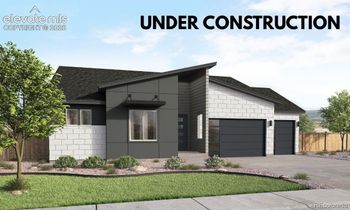


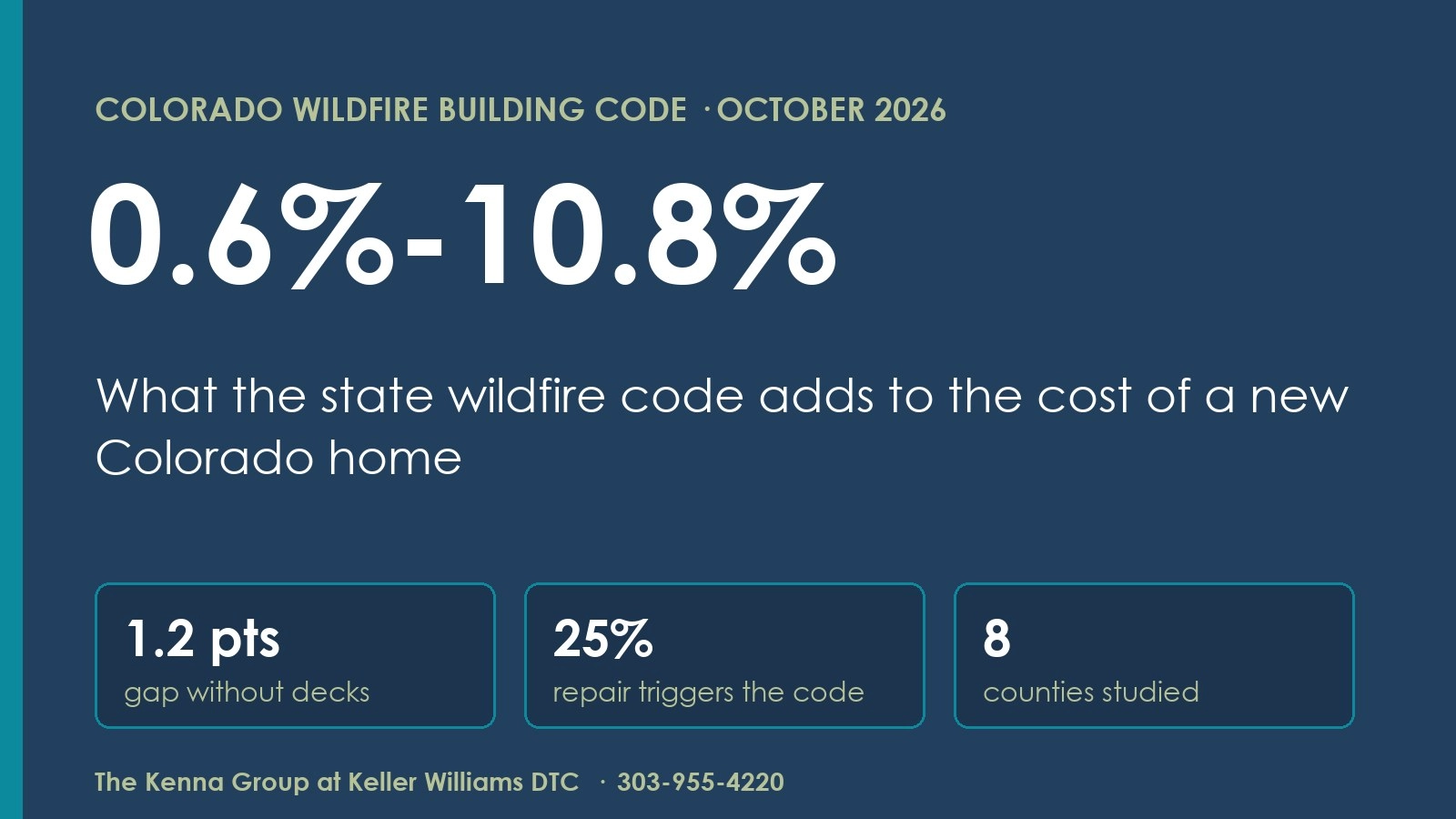
Colorado's wildfire building code adds 0.6% to 10.8% to the cost of building a new home, according to a University of Colorado Boulder report released October 20, 2026. Researchers at CIRES priced wildfire-resilient construction in eight Colorado counties and found most of the extra cost comes from one item: the deck. If you are buying new construction in Monument, Colorado Springs, Golden, Evergreen or Boulder, here is what the Colorado wildfire code means for your price and your payment.
Call or text 303-955-4220. A live person answers. Not a robot, not a phone tree.
0.6%-10.8% Added cost to build a new home Meeting the state wildfire code, per CIRES | 1.2 pts Gap between protection levels without decks Down from 10.2 points with decks |
85%-90% Share of cost in foundation, framing, floors Wildfire items are the smaller slice | 25% Repair share that triggers the code On an existing roof or exterior walls |
The University of Colorado Boulder announced the study on October 20, and Daily Dispatch covered it October 21. A team led by CIRES, the Cooperative Institute for Research in Environmental Sciences, compared five ways to build a new home, from typical pre-code construction to stricter wildfire standards. The counties studied were Boulder, Jefferson, El Paso, Summit, Grand, Delta, La Plata and Las Animas.
The result: a home built to the new code in an at-risk area costs 0.6% to 10.8% more than one built the old way. Per CIRES, foundation, framing, floors and insulation make up 85% to 90% of total construction cost. The wildfire items, roofing, siding, vents, windows, doors, decks and nearby landscaping, are a smaller part of the budget. Decks drove most of the difference between protection levels: take decks out and the gap shrinks from 10.2 percentage points to 1.2. The researchers say the increase held steady across counties with different labor markets.
"Colorado needs more affordable housing, and the homes we build today will shape our communities' wildfire risk for decades," said Virginia Iglesias, CIRES scientist and director of Earth Lab.
Senate Bill 23-166 created a state board to write the Colorado Wildfire Resiliency Code, and the Colorado Municipal League reports the board adopted it on July 1, 2025. It sets minimum standards for new homes in designated wildland-urban interface areas. Per CIRES, the standards come in two groups: protection from wind-blown embers, and added protection from radiant heat and direct flame.
The Gazette, as reprinted by Fire Engineering in May, reported that local governments with wildland-urban interface areas had to adopt the code by April 1, 2026 and be in compliance by July 1, 2026. Existing homes are covered too: when a repair covers more than 25% of a roof or exterior walls, that work has to meet the new standards. Local governments can draw their own maps with three wildfire intensity levels; where none exists, a default state map applies. Some counties change the state version: Garfield County, for one, dropped the state exemption for parcels of 35 acres or more.
| What it touches | What changes for you |
|---|---|
| New homes in wildland-urban interface areas | Built to ember protection, or ember plus flame and heat protection |
| Roofing, siding, vents, windows, doors | Ignition-resistant products, the wildfire share of the build budget |
| Decks | The biggest cost driver between protection levels, per CIRES |
| Existing roofs and exterior walls | A repair over 25% has to meet the code |
| Your location | Local or default state map sets the wildfire intensity level |
Buyers. On a $600,000 build, 0.6% to 10.8% is $3,600 to $64,800. Financed at 7.40% with 10% down, that adds $22 to $404 a month in principal and interest. Ask the builder which protection level the home meets and what the deck is made of, since the deck drives most of the gap. Compare new construction homes in Colorado and run the numbers on the Colorado mortgage calculator.
Sellers. If your foothills home already has ignition-resistant roofing, siding and vents, say so in the listing. A buyer comparing your home to a code-built new home wants to know what upgrades they would have to pay for. Get a free home value report and read whether to repair or replace your roof before selling.
Homeowners. The 25% rule matters after a hailstorm. If more than 25% of a roof in a wildland-urban interface area needs repair and the old materials do not meet the code, the whole roof has to be replaced, per The Gazette's example. Check your policy's code-upgrade coverage now, not after the storm. See Colorado hail-resistant roof grants.
The Colorado market. Foothills and mountain homes already sit longer than the metro: 89 days in Evergreen, 102 in Monument and 136 in Breckenridge on kennarealestate.com today, compared with 86 in Denver. Builders who show the code costs up front give buyers one less reason to wait. More context: Denver now has 68% more sellers than buyers.
What to watch out for
To buy new construction in a Colorado wildfire area, confirm the code level, price the deck and line up insurance before your deadlines. Here is the order we use with our buyers:
Active listings on kennarealestate.com, October 21, 2026
| Area | Homes for sale | Average list price | Average days on market |
|---|---|---|---|
| Colorado Springs | 3,110 | $564,871 | 83 |
| Boulder | 638 | $1,612,364 | 88 |
| Castle Rock | 552 | $1,024,878 | 87 |
| Monument | 256 | $828,068 | 102 |
| Golden | 254 | $1,106,129 | 89 |
| Evergreen | 222 | $1,335,476 | 89 |
| Breckenridge | 111 | $3,090,057 | 136 |
| Conifer | 80 | $1,263,317 | 81 |
| Winter Park | 46 | $1,316,528 | 123 |
Active residential listings on kennarealestate.com on October 21, 2026. In Monument, 151 homes are listed between $500,000 and $900,000. Browse El Paso County, Boulder County, Jefferson County, Summit County and Grand County homes for sale.
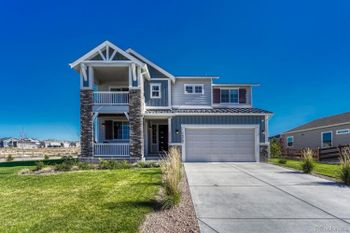
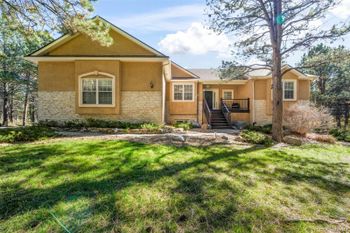

0.6% to 10.8% of construction cost, according to a University of Colorado Boulder CIRES report released October 20, 2026. On a $600,000 build, that is $3,600 to $64,800.
A statewide building code for homes in designated wildland-urban interface areas, created under Senate Bill 23-166 and adopted by the state board in 2025. It sets ember protection standards, plus added flame and heat protection at higher levels.
Yes, when a repair covers more than 25% of a roof or exterior walls. That work has to meet the new standards, per The Gazette's reporting on the code.
Decks drove most of the cost difference between protection levels in the CIRES study. Without decks, the gap between levels fell from 10.2 percentage points to 1.2.
Boulder, Jefferson, El Paso, Summit, Grand, Delta, La Plata and Las Animas, per the University of Colorado Boulder release.
Call or text 303-955-4220. A live person answers. Not a robot, not a phone tree.
Brian Lee Burke, the hardest working man in real estate
The Kenna Group at Keller Williams DTC. Helping You With Your Pad™. Licensed since 2003.
The Kenna Group is a real estate group with Keller Williams Realty DTC, LLC (Keller Williams DTC), serving Denver metro and Colorado home buyers and sellers.