Behind on Your Mortgage in Colorado: What to Do Now
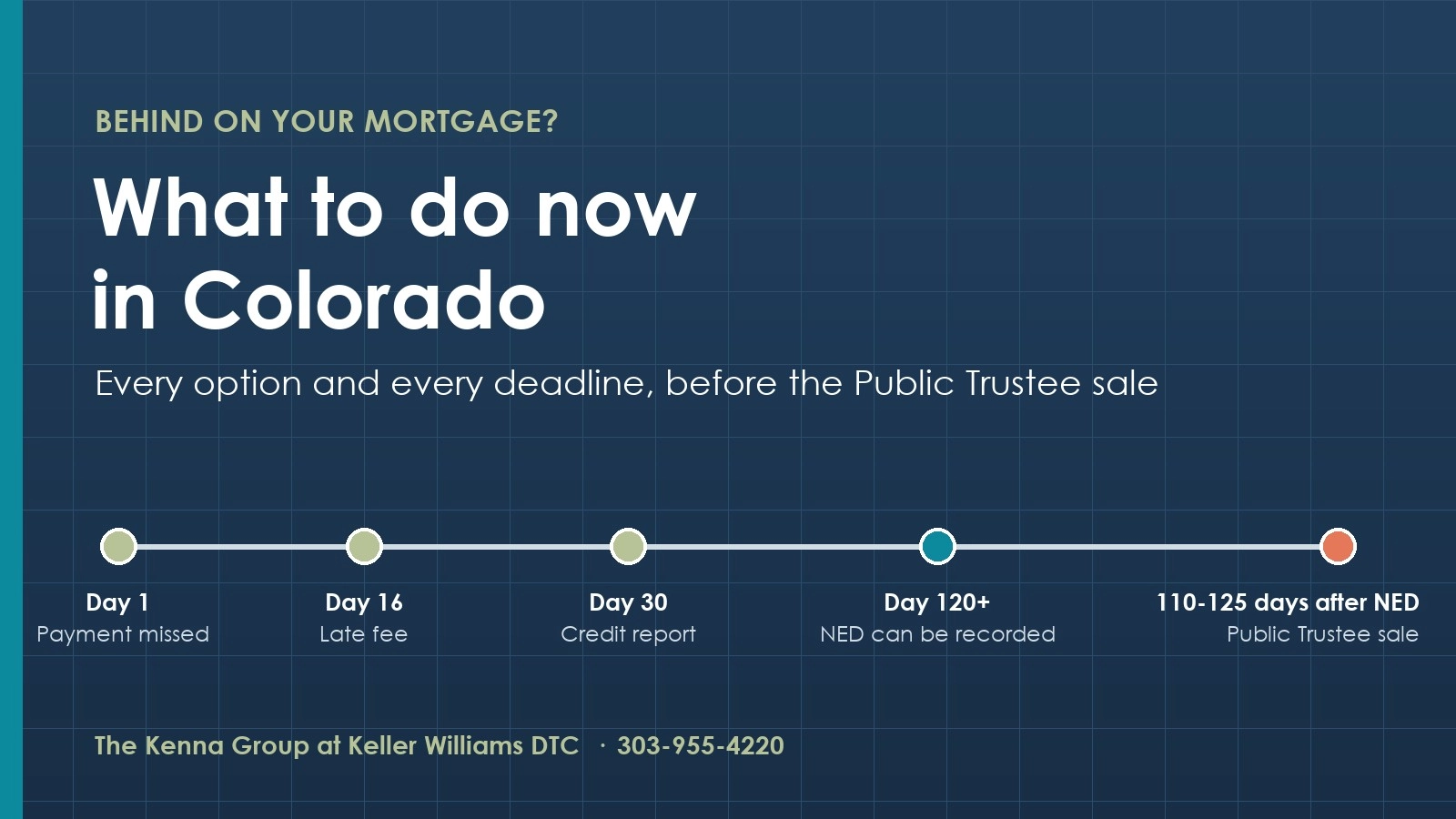
Behind on your mortgage in Colorado? One missed payment is a late fee. Three missed payments put the loan in default. After 120 days the lender can record a Notice of Election and Demand with the county Public Trustee, and the foreclosure sale lands 110 to 125 days later. Until that sale you can still catch up, get a repayment plan or loan modification, or sell the house and keep your equity. Below: what happens at each missed mortgage payment, every option side by side, and what to do this week.
Call or text 303-955-4220. A live person answers. Not a robot, not a phone tree.
Not sure what your home would sell for? Ask for a free Smart Pricing Report or a quick home value check, so you know your equity before you call the lender. Already have a foreclosure notice? Go straight to stop foreclosure in Colorado.
The answer first
120 days Before foreclosure can start Federal rule: no first filing until the loan is over 120 days late | 110 to 125 days NED to Public Trustee sale Colorado sale window for a home that is not farmland |
15 days Notice of Intent to Cure File it at least 15 calendar days before the sale | 0 days Owner redemption after the sale Colorado owners must act before the sale, not after |
The Colorado missed-payment timeline
Most of the damage happens fast, but the foreclosure itself is slow. The months before the Notice of Election and Demand are when you have the most choices and the most time.
Federal rules require your servicer to try to reach you by phone by day 36 and to send a written notice of your options by day 45. If you send a complete loss mitigation application more than 37 days before a sale, the servicer cannot hold the sale until it answers you.
How far behind are you? What to do at each stage
Find your stage. Each one lists what is happening to the loan right now, the moves to make this week, and the options that still fit.
Stage 1 · One payment behind (day 1 to 30)
One missed mortgage payment
What is happening: You are inside the grace period on most loans until day 15, then a late fee hits. Nothing is on your credit report until the payment is 30 days late.
What to do this week:
- Pay before day 30 if you can. That keeps the late mark off your credit report.
- If you cannot, call the servicer before the next due date and ask about forbearance or a repayment plan.
- Write down every call: date, name, what they said.
Options that still fit: catch up, forbearance, repayment plan.
Stage 2 · Two to three payments behind (day 31 to 90)
Two or three missed payments
What is happening: Each month adds a 30-, 60- then 90-day late mark to your credit. The servicer must contact you by day 36 and send your options in writing by day 45. Many servicers send a breach or default letter by day 90.
What to do this week:
- Ask the servicer for a loss mitigation application, fill in every page, and send it with proof of income. Get a confirmation that it is complete.
- Call a free HUD-approved counselor: the Colorado Foreclosure Hotline, 1-877-601-HOPE.
- Find out what the home would sell for. If you owe more than it is worth, read am I underwater on my house?
Options that still fit: repayment plan, loan modification, FHA or VA partial claim, payment deferral, selling with your equity.
Stage 3 · 90 to 120 days behind, no notice yet
Three to four missed payments
What is happening: The loan is in default. Once it is more than 120 days late the lender can send the file to its attorney to record a Notice of Election and Demand.
What to do this week:
- Get your loss mitigation application complete now. A complete application stops the first foreclosure filing while it is being reviewed.
- Compare keeping the home with selling it, side by side, on compare your options when you owe more than the home is worth.
- If you have equity and no realistic way to catch up, list the home now. Every month you wait costs more in fees and lost equity.
Options that still fit: modification, partial claim, reinstatement, sale, short sale.
Stage 4 · Notice of Election and Demand recorded
You received foreclosure papers
What is happening: The lender recorded the Notice of Election and Demand (NED) with the Public Trustee. The sale is set 110 to 125 days later. You will get the Combined Notice by mail with the sale date, and a Rule 120 notice from the district court, where you have the right to respond.
What to do this week:
- Put the sale date on your calendar. Count back 15 calendar days: that is the last day to file a Notice of Intent to Cure.
- Send a complete loss mitigation application more than 37 days before the sale.
- Call a Colorado real estate attorney about the Rule 120 notice, and read pre-foreclosure help in Colorado.
Options that still fit: reinstatement (cure), modification, sale before the auction, short sale, deed in lieu.
Stage 5 · Sale date within 30 days
The Public Trustee sale is close
What is happening: Most doors are closing. A cure still works if you filed the Notice of Intent to Cure on time. A signed contract to sell gives the lender a reason to postpone, but only the lender can postpone the sale.
What to do this week:
- Ask the Public Trustee for the cure statement if you filed to cure; pay by the deadline on it, by noon the day before the sale.
- If you have a buyer, have your agent send the contract and closing date to the lender's foreclosure attorney and ask for a postponement in writing.
- If the sale goes through, any overbid (money above what is owed) goes to junior liens first, then to you: claim it from the Public Trustee.
Options that still fit: cure, sale already under contract, approved short sale.
Every option side by side: keep the home or sell it
Ten ways out, from the gentlest to the last resort. The first six keep the home. The next three sell or hand it back on your terms. Foreclosure is the one that happens if nothing else does.
| Option | Home | What it does | Credit and buying again | How long | Who it fits |
|---|---|---|---|---|---|
| Forbearance | Keep | Pauses or lowers payments for a set time. The skipped amount is still owed after. | Reported per the plan; missed payments before it stay on the report | Days to weeks to approve; plans run months | A short hardship with income coming back |
| Repayment plan | Keep | Normal payment plus part of the past-due amount each month until caught up. | Late marks stay; no new ones if you keep the plan | 3 to 12 months | 1 to 3 payments behind, income back to normal |
| Loan modification | Keep | Changes the rate, term or balance to lower the payment; past-due amount is folded in. | Shows as a modified loan | Application, then a 3-month trial plan | A lasting income drop |
| Partial claim / payment deferral | Keep | Missed payments move to an interest-free second lien (FHA, VA) or to the end of the loan (Fannie Mae, Freddie Mac). | Brings the loan current | After a short trial | FHA, VA and conventional borrowers who can afford the regular payment again |
| Reinstatement | Keep | Pay everything past due plus fees and foreclosure costs in one lump sum. | Loan current; past late marks stay | Until the cure deadline | Owners with a lump sum available |
| Refinance | Keep | A new loan pays off the old one. | None if it closes | 30 to 45 days | Owners still current; hard once 30 days late |
| Sell (regular sale) | Sell | List and sell; past-due amounts are paid at closing and you keep the equity. | No foreclosure; late marks stay | Listing to closing, about 60 to 90 days | Owners with equity |
| Short sale | Sell | The lender agrees to take less than you owe. | Reported as settled for less; Fannie Mae wait 4 years, FHA 3 | Lender approval 60 to 120 days or more | Owners who owe more than the home is worth |
| Deed in lieu | Give back | You sign the home over to the lender instead of foreclosure. | Fannie Mae wait 4 years, FHA 3 | 60 to 90 days; lender must agree | No equity, home did not sell, no second liens |
| Foreclosure | Lose | Public Trustee sale; no owner redemption after it. | 7 years on the report; Fannie Mae wait 7 years, FHA 3, VA 2 | Sale 110 to 125 days after the NED | The outcome every other option avoids |
Want a deeper look at the sell-side choices? Read how a Denver short sale works with our group, the Colorado short sale process, how short sales help Colorado owners avoid foreclosure and what a deficiency judgment means in Colorado. Weighing a fast cash offer? Compare a cash sale with a listed sale in our behind-on-payments cash sale guide.
Years to wait before a new mortgage, by what happened
Standard waiting periods; documented extenuating circumstances can shorten them, and VA's wait after a foreclosure is 2 years. Plan your comeback with buying again after a short sale.
Options by loan type
FHA Partial claim + modification Missed payments go to an interest-free HUD lien. One permanent option every 24 months. | VA New VA Partial Claim Launched June 15, 2026; servicers fully on it by November 28, 2026. Zero-interest second lien. |
Fannie / Freddie Payment deferral + Flex Modification Past-due payments move to the end of the loan, or the loan is modified. | Any loan Sell or short sale Available until the Public Trustee sale, whatever the loan type. |
Not sure who owns your loan? Your monthly statement names the servicer; Fannie Mae and Freddie Mac both run free loan lookup tools. A HUD-approved counselor can find out for you in one call.
What to watch out for, and what not to do
- Never pay anyone up front to save your home. Federal law bans upfront fees for mortgage relief services. HUD-approved housing counselors are free.
- Never sign your deed over to a "rescue" company. Rent-back and "we'll buy your mortgage" deals are how owners lose the house and the equity. The Colorado Attorney General has sued companies for exactly this.
- Do not pay your mortgage to anyone but your servicer. Scammers send letters that look like the lender with a new payment address.
- Do not ignore the mail. The Combined Notice and the Rule 120 notice carry the dates that decide your options.
- Do not miss the 15-day cure deadline. Count 15 calendar days back from the sale date and file the Notice of Intent to Cure before it.
- Do not send a half-finished application. Only a complete loss mitigation application, more than 37 days before the sale, stops the sale while it is reviewed.
- Do not wait for the lender to postpone. A postponement is the lender's choice. Plan as if the sale date is real.
- Do not let equity go to the auction. If the home is worth more than you owe, a sale before the auction puts that money in your pocket.
- Watch the tax bill on forgiven debt. Debt forgiven in 2026 can be taxable; read short sale taxes in 2026 and talk to a tax professional.
- Do not move out early. You keep the right to live in the home until the sale and the legal steps after it. Leaving early can mean a vacant-home penalty from your insurance and a faster sale.
Free help in Colorado
| Who | What they do | How to reach them |
|---|---|---|
| Colorado Foreclosure Hotline | Connects you with a free HUD-approved housing counselor near you | 1-877-601-HOPE (4673) |
| Colorado Housing Connects | Free statewide housing helpline; foreclosure prevention counseling | 1-844-926-6632 |
| HUD-approved housing counselors | Review your budget, talk to your servicer with you, explain every option | Colorado HUD counselors list |
| Your county Public Trustee | Sale date, cure statement, Notice of Intent to Cure form, overbid claims | Your county Public Trustee office |
| A Colorado real estate attorney | Rule 120 response, deficiency, bankruptcy questions | Colorado Bar Association lawyer referral |
| The Kenna Group at Keller Williams DTC | What your home would sell for, sale before the auction, short sale with a professional negotiator | 303-955-4220 |
Behind on your mortgage in a specific city? We have local pages with the Public Trustee details for Denver, Aurora, Littleton, Highlands Ranch, Lone Tree, Parker, Castle Rock, Arvada, Golden, Westminster, Thornton, Broomfield, Fort Collins.
This page explains how the process works in Colorado. It is not legal, tax or credit advice. Talk to a HUD-approved housing counselor, a Colorado real estate attorney or a tax professional about your situation.
Talk to a person who does this every week
Brian Lee Burke, licensed in Colorado since 2003, leads The Kenna Group at Keller Williams DTC, the hardest working group in real estate. We tell you what your home would sell for, what you would walk away with, and how much time the calendar gives you, at no cost and in confidence. If a short sale is the answer, our professional negotiator works the file with your lender.
Call or text 303-955-4220. A live person answers. Not a robot, not a phone tree.
See how we price a home in the Smart Pricing Report sample, estimate your net on the Colorado seller net and closing costs calculator, read the Colorado home sellers guide, or read what our clients say.
The Kenna Group. The real estate business Colorado trusts.
Quick answers
What should I do if I'm behind on my mortgage?
Call your mortgage servicer, ask for loss mitigation options and ask for the application in writing. Then call a free HUD-approved housing counselor (the Colorado Foreclosure Hotline is 1-877-601-HOPE) and find out what your home would sell for today. Do those three things before the loan is 120 days late, while every option is still open.
How many mortgage payments can you miss before foreclosure in Colorado?
Federal servicing rules stop a lender from starting foreclosure until the loan is more than 120 days delinquent, so about four missed payments. In Colorado the first filing is the Notice of Election and Demand with the county Public Trustee, and the sale is set 110 to 125 days after it is recorded. From the first missed payment to a sale is about 8 months at the earliest.
How long does foreclosure take in Colorado?
The Public Trustee sets the sale 110 to 125 calendar days after the Notice of Election and Demand is recorded for a home that is not agricultural property. The lender can postpone the sale, and a complete loss mitigation application filed more than 37 days before the sale stops the sale while it is reviewed.
What happens after 3 missed mortgage payments?
The loan is 90 days delinquent. Three late marks are on your credit report, late fees are adding up, and your servicer has sent letters about loss mitigation and, on many loans, a notice that the loan is in default. Foreclosure can be filed once the loan passes 120 days, so this is the month to apply for a repayment plan, modification or partial claim, or to list the home.
Can I sell my house if I'm behind on mortgage payments?
Yes. You can list and sell at any point until the Public Trustee sale. The past-due payments, late fees and any foreclosure costs are paid out of the sale at closing, and you keep the rest. If you owe more than the home will sell for, the sale needs the lender's approval as a short sale.
Can I refinance if I'm behind on my mortgage?
It is hard. Most refinance programs look for 12 months of on-time mortgage payments, so a refinance stops being realistic once a payment is 30 days late. Ask your servicer about a loan modification instead, which changes the loan you already have.
What is the difference between forbearance and a repayment plan?
Forbearance pauses or lowers your payment for a set number of months; the skipped amount is still owed afterward. A repayment plan is for after you have fallen behind: you pay your normal payment plus part of the past-due amount each month until you are caught up.
What is reinstatement, and how late can I reinstate in Colorado?
Reinstatement means paying everything past due, plus late fees and the lender's foreclosure costs, in one lump sum so the loan is current again. In Colorado you file a Notice of Intent to Cure with the Public Trustee at least 15 calendar days before the sale, then pay the cure amount by the deadline on the cure statement, by noon the day before the sale.
What is an FHA partial claim?
On an FHA loan, HUD can pay your missed payments to the servicer and record the amount as an interest-free second lien. You pay it back when you sell, refinance or pay off the first loan. FHA now limits borrowers to one permanent loss mitigation option every 24 months.
What help is there for VA loans?
VA launched its Partial Claim Program on June 15, 2026 (servicers must be fully on it by November 28, 2026). VA pays the missed amount to your servicer and records it as a zero-interest second lien you repay when the loan is paid off. Repayment plans, forbearance and modifications are still available too.
Is a short sale better than foreclosure in Colorado?
For most owners, yes. In a short sale you pick the buyer and the move date, you can ask the lender to waive the remaining balance in writing, and the Fannie Mae waiting period to buy again is 4 years instead of 7 after a foreclosure.
What is a deed in lieu of foreclosure?
You sign the home over to the lender and the lender cancels the foreclosure. The lender has to agree, it wants proof the home will not sell first, and a second mortgage or other lien makes it hard to get. The Fannie Mae waiting period to buy again is 4 years.
Is there a redemption period after a foreclosure sale in Colorado?
Not for the homeowner. For Colorado foreclosures under the law in effect since 2008, the owner has no right to redeem after the Public Trustee sale; only certain junior lienholders do. Your time to act is before the sale.
How long does a foreclosure stay on my credit report?
Seven years, the same as late payments. A short sale or deed in lieu is also reported, but the waiting period to qualify for a new mortgage is shorter than after a foreclosure.
Will I owe taxes if my lender forgives part of my mortgage?
Possibly. The federal exclusion for forgiven debt on a main home expired at the end of 2025, so debt forgiven in a 2026 short sale, deed in lieu or modification can be taxable income. Ask a tax professional before you sign.
Who can I call for free foreclosure help in Colorado?
The Colorado Foreclosure Hotline at 1-877-601-HOPE (4673) and Colorado Housing Connects at 1-844-926-6632 both connect you with free HUD-approved housing counselors. A counselor can talk to your servicer with you. Never pay anyone up front to save your home.
Where to go next
- Stop foreclosure in Colorado: options and deadlines
- Compare your options when you owe more than the home is worth
- Am I underwater on my house?
- Denver short sale realtor
- Short sale help
- Colorado HUD housing counselors for foreclosure and short sale help
- Get a free Smart Pricing Report
- Colorado foreclosure homes for sale
- Selling a parent's house in Colorado
- Meet The Kenna Group agents
The Kenna Group is a real estate group with Keller Williams Realty DTC, LLC (Keller Williams DTC), formerly known as Kenna Real Estate Group, serving Colorado home buyers and sellers.